
[Exclusive] AI has also dug into the Pangyo development site following Silicon Valley
 Enlarge image
Artificial intelligence (AI) models made in China are spreading quickly among AI developers in South Korea, following a similar trend in Silicon Valley in the United States. Major U.S. technology companies are building services using Chinese AI models. Meanwhile, the share of new AI model outputs released by Korean developers that are based on Chinese models has risen from 1% to 49% in three years. Although security concerns have kept the use of Chinese AI services low among ordinary consumers, Chinese models are becoming more influential among developers because they are affordable and easy to work with.
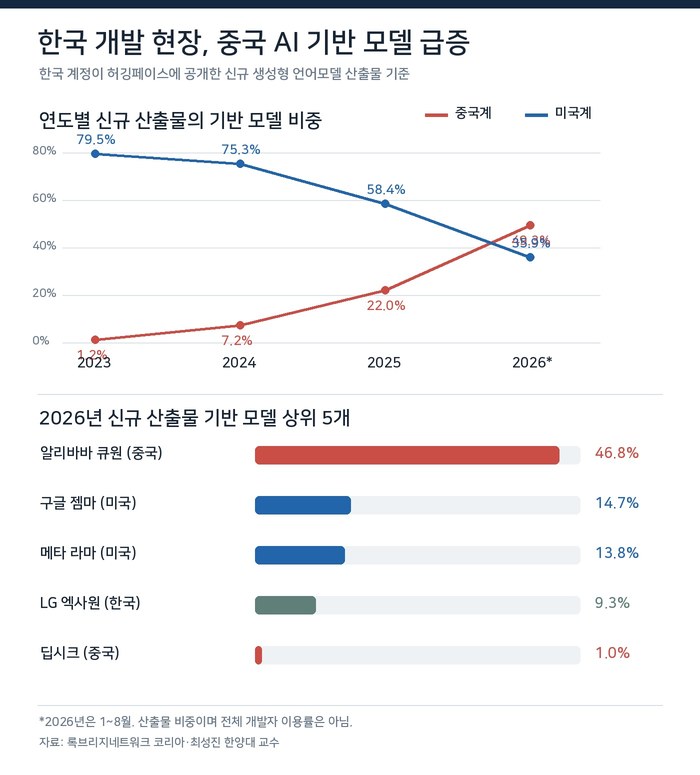
A research team led by Choi Sung-jin, a business professor at Hanyang University, published a report titled "How China's Artificial Intelligence Is Used in Korea." The report found that 49.3% of the new language model outputs released by Korean accounts on the AI model-sharing platform Hugging Face between January and August this year were based on Chinese models. For the first time, this was higher than the 35.9% share of U.S. models. The report is available on Rockbridge Network Korea.
According to the study, the share of Chinese models grew from 1.2% in 2023 to 7.2% in 2024, then to 22.0% last year, before reaching 49.3% this year. Over the same period, the share of American models fell from 79.5% to 35.9%. The researchers analyzed 7,939 AI model outputs released by 1,993 Korean accounts identified through Korean tags and search terms. Professor Choi explained, "On Hugging Face, it is difficult to tell accurately whether a person who releases a model is an individual developer, a startup, or a company." He added, "It is difficult even to identify Korean developers, so our research team used Python to build a separate analysis program. We used clues related to Korea to find relevant accounts and investigate them all."
The Chinese model leading this trend among Korean developers is Alibaba's Q1. Of the 1,845 new outputs released by Korean accounts this year, 864, or 46.8%, were based on Q1. This was well ahead of Google's Gemma, at 14.7%, and Meta's Llama, at 13.8%. A total of 167 Korean accounts released outputs based on Q1. By contrast, only 19 outputs, or 1.0%, were based on DeepSeek, the model that became a symbol of China's AI boom last year. Among Korean models, Exaone from LG AI Research had the largest share, at 9.3%.
Professor Choi pointed to ease of development and "economies of scale" as the main reasons Q1 has spread. Developers tend to choose models that already have many users and plenty of related data, he said. "Q1 offers models in different sizes and makes them easy for developers to use." He added, "Because Chinese companies entered the market later, they have provided models and tools that make development easier." As more people use a model, more related data and examples of how to build with it become available. This can attract even more users, he explained.
Q1 offers models ranging from small to extremely large and can be used for many tasks because it was trained on 119 languages. It is also very competitive in price. When leading models with similar performance are compared, the cost per unit of output from a Chinese model is about one-fourth that of a U.S. model. The overall cost of carrying out the same performance test was also about four times lower.
However, Chinese AI has not gained much ground in South Korea's consumer market. DeepSeek, which ranked first in downloads on Korean app stores in January last year, saw its daily users fall by 60% over two weeks. This happened amid concerns about personal information protection and restrictions on access imposed by governments and companies. As of July this year, no Chinese service ranked among the top 10 AI chatbot apps in South Korea by number of users.
A survey of businesses found a similar pattern. When researchers asked 102 small and medium-sized South Korean companies whether they used Chinese AI services for work, none said they were currently using them. The most common reason for not using Chinese models was fear of data leaks, reported by 80.2% of respondents. Concerns about unclear personal information handling were reported by 67.7%, while only 31.3% raised concerns about performance and quality. In addition, 45.1% said they had never heard of Q1.
However, Professor Choi said these survey results should not be taken to mean that Korean companies do not use Chinese AI at all. "The survey included managers and employees who do not work in development, so they may not know which model their company uses," he said. "We also cannot rule out the possibility that companies did not disclose their use because Chinese AI has a negative image." The spread of Chinese AI models does not automatically mean that the risk of data leaks has increased. The way data is handled differs between developers who download a model and run it on their own servers and users who access online services provided by Chinese companies. Professor Choi said, "There is no need to judge Chinese models unfairly in advance." He added, "What is worrying is that dependence on technology from one particular country is becoming too great." He also said, "Many people in Korea do not even know the name Q1, but it is already widely used in development." He noted that this matches findings that the use of Chinese models is also growing in the United States.
Rather than banning Chinese AI models across the board, the report recommended that companies clearly disclose which base models they use and prepare security guidelines. Depending too heavily on models from one country could disrupt development if license terms change or the company stops releasing later models.
Professor Choi stressed, "For Korean AI models to be chosen by developers, they need more than good performance. They also need licenses that allow commercial use, models in different sizes, and the tools and examples needed for further training." In other words, AI developers need an ecosystem that makes models practical to choose and use, not just models that perform well in tests.
Chinese models are also spreading in Silicon Valley. A report published by Hugging Face this year found that Chinese models accounted for 41% of all model downloads on the platform over the previous year. Among models whose countries of development could be identified, China ranked ahead of the United States in both monthly downloads and total downloads.
Several U.S. companies are already using Chinese AI for important services. In March, Cursor, a U.S. AI coding startup, introduced its own coding model, Composer 2. However, reports indicate that the model was developed using Kimi K2.5, made by China's Moonshot AI, as its base. Cursor later explained in an official technical report that it further trained Kimi and used reinforcement learning to improve performance. Kimi K2.5 was also used as the base model for the later version, Composer 2.5.
Airbnb, the U.S. home-sharing company, also uses Chinese AI. CEO Brian Chesky said, "We use 13 AI models for customer service, and we rely heavily on Alibaba's Q1." However, he explained that Airbnb does not give customer data to Chinese companies.
The growing use of Chinese AI also helps explain why U.S. startups have opposed efforts to restrict it. In July, when the Trump administration considered limits on the use of open AI models made in China, nearly 200 U.S. startups and related companies, including Y Combinator, sent a letter opposing the restrictions. They argued that blocking access to Chinese models could raise development costs for U.S. startups and weaken their ability to compete. Major technology companies, including Microsoft, Meta, and Nvidia, also joined the letter, which warned against imposing broad restrictions on open AI models.
[Silicon Valley correspondent Wonho-seop]