
From Turing’s question in 1950 to fears that AI could wipe out humanity, a timeline of thinking machines
Artificial intelligence (AI) is now used in search engines, smartphones, work software and scientific research. The field got its name at a summer workshop in 1956, but the idea of machines that can think is much older. Writers imagined such machines centuries before engineers could build them.
The journey from those early ideas to today’s chatbots and AI agents has not been easy. It has included two long periods when funding and interest fell, known as AI winters, several public competitions between people and machines, and a rush by technology companies since 2022 to bring generative AI to hundreds of millions of people. Here is a year-by-year history of how the field developed.
1726: In Gulliver’s Travels, Jonathan Swift describes the Engine, a large machine that scholars use to produce ideas, sentences and books. They turn handles that move wooden blocks marked with words. The machine puts the words together in new ways. Swift’s story makes fun of the idea of using a machine to create text.
1914: Spanish engineer Leonardo Torres y Quevedo demonstrates El Ajedrecista in Paris. It is the first chess-playing machine. It uses electromagnets to play a simple endgame, with a king and rook against a king, without human help once it has been set up. It signals when its opponent makes an illegal move and reliably checkmates the opponent when it has a winning position.
1921: Karel Capek’s play R.U.R. (Rossum’s Universal Robots) introduces the word “robot”. In Czech, “robota” is linked to the forced labour of peasants under feudal rule. Capek’s robots are made of organic material, but after the play becomes successful, the word comes to mean humanlike machines built to do repeated tasks.
1939: John Vincent Atanasoff, a physics and mathematics professor at Iowa State College, and his graduate student Clifford Berry build the Atanasoff-Berry Computer with a $650 grant. It is one of the earliest electronic digital computers. It stores information in binary form rather than decimal, uses electronic circuits instead of mechanical parts, and keeps memory separate from processing. Modern computers still use this basic design. The machine weighs more than 700 pounds, contains about 300 vacuum tubes and can solve up to 29 linear equations at the same time, although it never works fully as intended. That same year, Westinghouse shows Elektro, a robot controlled by electrical relays, at the World’s Fair. Elektro responds to the rhythm of spoken commands, moves its head and arms, and tells jokes recorded on 78 rpm records.
1941: Isaac Asimov’s short story Liar! appears in the May issue of Astounding Science Fiction. It is thought to contain the earliest known use of the word “robotics”.
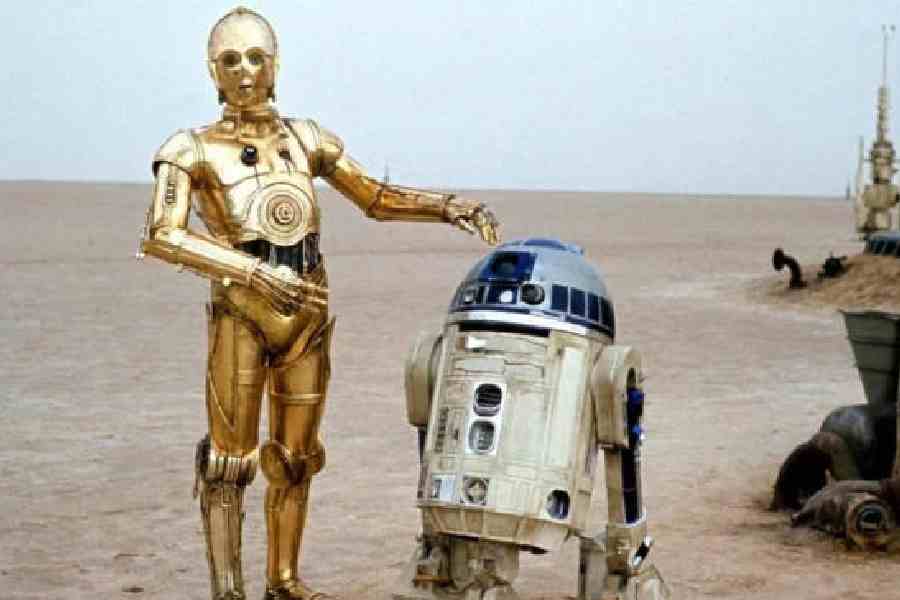
C-3PO and R2-D2 appear in Star Wars
1943: Warren S. McCulloch and Walter Pitts publish A Logical Calculus of the Ideas Immanent in Nervous Activity in the Bulletin of Mathematical Biophysics. Their paper describes the brain as a system that processes information and introduces the idea of artificial neural networks. Later researchers build on this idea to develop deep learning.
1948: Norbert Wiener publishes Cybernetics, a book that influences research into AI and control systems. It draws on his wartime work on anti-aircraft systems that used radar images to predict the paths of enemy planes. Wiener takes the word “cybernetics” from the Greek word for “steersman”.
1949: On June 11, The Times, London, quotes mathematician Alan Turing: “I do not see why it (the machine) should not enter any one of the fields normally covered by the human intellect, and eventually compete on equal terms. I do not think you even draw the line about sonnets, though the comparison is perhaps a little bit unfair because a sonnet written by a machine will be better appreciated by another machine.”
1950: Turing publishes Computing Machinery and Intelligence in the journal Mind. Rather than answering “Can machines think?” directly, he suggests a test called the imitation game, now known as the Turing Test. The question is whether a machine can behave in a way that makes it impossible to tell it apart from a human. In the same year, Asimov publishes I, Robot, a collection of nine short stories. In these stories, robots must follow the Three Laws of Robotics, which prevent them from harming humans.
1951: Marvin Minsky and Dean Edmunds build SNARC (Stochastic Neural Analog Reinforcement Calculator), the first artificial neural network. The machine uses analogue circuits and about 3,000 vacuum tubes to imitate 40 neuron-like units. It models a rat learning to find its way through a maze by trial, reward and punishment. Also in 1951, computer pioneer Edmund Berkeley builds Squee, a robotic squirrel. It uses light sensors and contact switches to find tennis balls and carry them to its nest.
1955: John McCarthy of Dartmouth College, Marvin Minsky of Harvard University, Nathaniel Rochester of IBM and Claude Shannon of Bell Telephone Laboratories submit a proposal for the Dartmouth Summer Research Project on Artificial Intelligence. This is the first known use of the term “artificial intelligence”, and McCarthy is credited with creating the term.
1956: The Dartmouth workshop takes place in Hanover, New Hampshire, in July and August. It is generally seen as the event that founded the field of AI. In cinemas that year, Robby the Robot appears in MGM’s Forbidden Planet, and Robby toys become bestsellers.
1957: Psychologist and computer scientist Frank Rosenblatt develops the Perceptron, an early neural network that learns to recognise patterns by changing the importance, or weights, of its inputs. It can solve only a limited range of problems, but it helps lay the groundwork for later neural networks.
1958: McCarthy, who is now at MIT, creates the programming language Lisp, short for “list processing”. In Lisp, programs and data are both represented as lists. This allows a program to treat another program, or even itself, as data. Lisp becomes the most widely used language in AI research.
1959: Arthur Samuel writes a checkers program that improves through experience and eventually plays better than he does. His work is credited with introducing the term “machine learning”. Oliver Selfridge publishes Pandemonium: A Paradigm for Learning, an early model for recognising patterns. McCarthy describes the Advice Taker, a program designed to reason using formal logic and everyday knowledge.
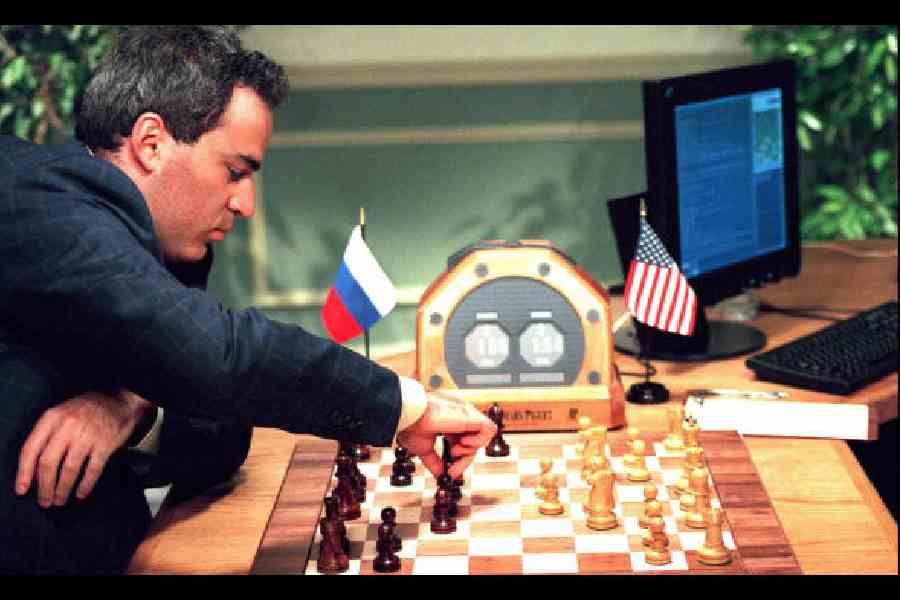
Garry Kasparov makes a move in New York during his fourth game against the IBM Deep Blue chess computer, May 1997. Picture: Getty Images
1961: Unimate, the first industrial robot made in large numbers, starts work at General Motors. It is a 4,000-pound robotic arm designed by Joe Engelberger and George Devol. It stacks hot pieces of cast metal by following instructions stored on a magnetic drum.
1965: Philosopher Hubert Dreyfus publishes Alchemy and Artificial Intelligence. He argues that the human mind works in a fundamentally different way from a computer and predicts that AI will face limits. Mathematician I.J. Good writes Speculations Concerning the First Ultraintelligent Machine. He argues that a machine with far greater intelligence than humans could design even more intelligent machines and become humanity’s last invention, as long as it remained under control. At Stanford University, Edward Feigenbaum, Bruce Buchanan, Joshua Lederberg and Carl Djerassi develop DENDRAL, the first expert system. It uses “if-then” rules to identify the molecular structure of organic compounds and sometimes does this more accurately than human experts.
1966: Joseph Weizenbaum completes ELIZA, a program that talks with people using everyday language. In its best-known version, DOCTOR, it responds much like a psychotherapist. Weizenbaum intended ELIZA to show how limited conversations between people and computers could be. He is surprised that many users believe it has human feelings. In the late 1960s, SRI develops Shakey, the first mobile robot able to reason about its own actions. In a 1970 article in Life magazine, Minsky predicts that AI will reach the general intelligence of an average human within three to eight years.
1969: Arthur Bryson and Yu-Chi Ho describe backpropagation, a method for improving systems made of several stages. The method later becomes central to training neural networks. Minsky and Seymour Papert publish Perceptrons, a critical study of neural networks with only one layer. The book is often blamed for reducing interest in the field.
1970: Terry Winograd creates SHRDLU, a program that follows instructions written in plain English to move objects around in a virtual world made of blocks. It works only in settings with clear rules and limits.
1972: Stanford develops MYCIN, an expert system that helps doctors identify bacterial infections and suggests antibiotics. It is never used in real medical care because of ethical and legal concerns. At Bolt, Beranek and Newman, William Woods and his colleagues complete LUNAR. It allows geologists to ask questions about chemical test results from moon rocks collected during the Apollo 11 mission.
1973: James Lighthill presents a report to the British Science Research Council saying that AI has not delivered what its early supporters promised. The UK government sharply cuts funding for AI, and the report helps start the first AI winter, a period when interest and investment fall. During the decade, funding for AI research is cut as people become less confident about what the technology can achieve.
1977: The robots C-3PO and R2-D2 appear in Star Wars and introduce the idea of helpful machines to a huge audience.
1978: Texas Instruments launches Speak & Spell, an electronic learning device that helps children learn. It is the first device to reproduce the human vocal tract electronically on a single chip.
1980: Waseda University in Japan begins building WABOT-2, a humanlike robot completed around 1984. It reads musical scores using camera “eyes”, talks to people and plays an electronic organ.
1982: Japan launches the Fifth Generation Computer Systems Project, a government effort to build computers that can reason using logic. Businesses also begin showing renewed interest in AI during the 1980s. The Japanese project is stopped in 1992.
1984: At the annual meeting of the AAAI, Roger Schank and Marvin Minsky warn that unrealistic expectations could cause investment to collapse. Within three years, interest and funding fall again, starting what becomes known as the second AI winter. By the 1990s, investors have lost patience, and hundreds of companies close.
1986: David Rumelhart, Geoffrey Hinton and Ronald Williams publish Learning Representations by Back-Propagating Errors. Their paper shows how backpropagation can train neural networks with several layers. The work becomes a foundation of modern deep learning.
1987: In a keynote speech at Educom, Apple chief executive John Sculley presents the Knowledge Navigator video. It shows a professor talking to a digital assistant that responds to voice commands and finds information over a network.
1988: Judea Pearl publishes Probabilistic Reasoning in Intelligent Systems, which introduces Bayesian networks, a way for computers to reason when information is uncertain. He later receives the 2011 Turing Award. Rollo Carpenter develops Jabberwacky, a chatbot that learns from conversations with people. Researchers at IBM’s T.J. Watson Research Center publish a statistical method for machine translation. It learns from 2.2 million English-French sentence pairs, mostly taken from Canadian parliamentary records.
1989: Yann LeCun and a team at AT&T Bell Labs use backpropagation to train a convolutional neural network to recognise handwritten ZIP codes. Training takes about three days. That same year, the chess program Deep Thought beats David Levy, becoming the first computer to defeat a chess master.
1993: Science fiction writer and mathematician Vernor Vinge publishes The Coming Technological Singularity. He predicts that intelligence greater than human intelligence will be created within 30 years. The essay helps spread the idea of a “technological singularity”.
1995: Richard Wallace develops the chatbot A.L.I.C.E., building on ELIZA. It uses a language called AIML to match patterns in messages and produce responses.
1997: On May 11, IBM’s Deep Blue completes its victory over world chess champion Garry Kasparov. The computer can examine 200 million chess positions each second. In the six games, Deep Blue wins two, Kasparov wins one and three end in draws. It is the first time a computer defeats the reigning world champion under standard tournament time limits. The match is a rematch: Kasparov defeated an earlier version of Deep Blue in 1996. That same year, Sepp Hochreiter and Jürgen Schmidhuber introduce Long Short-Term Memory, or LSTM. This type of recurrent neural network later becomes widely used to recognise speech and handwriting.
1998: Dave Hampton and Caleb Chung create Furby, the first robotic pet to become widely successful. It starts by “speaking” its own language, Furbish, and gradually begins using more English. LeCun, Yoshua Bengio and their colleagues publish important work on using convolutional neural networks to recognise handwriting.
2000: Cynthia Breazeal at MIT develops Kismet, a robot that uses cameras, microphones and an expressive face to detect and respond to signs of human emotion. Honda introduces ASIMO, a humanlike robot that can walk, climb stairs, recognise faces and respond to voice commands. About 100 ASIMO units are built.
2001: Google begins using a simple form of machine learning to suggest spelling corrections for search queries.
2002: iRobot launches the Roomba, a self-driving robotic vacuum cleaner that detects obstacles and avoids them.
2005: Stanley, a driverless Volkswagen Touareg built by the Stanford Racing Team, wins the DARPA Grand Challenge near Las Vegas. It completes a 175-mile off-road desert course in less than seven hours without human intervention and wins $2 million.
2006: Geoffrey Hinton publishes Learning Multiple Layers of Representation, explaining how networks with many layers can be trained more effectively. The work marks a shift towards what is now called deep learning. Google launches Google Translate, first supporting Arabic and English. At Dartmouth, AI@50 celebrates the workshop’s 50th anniversary. Five people who attended the original workshop in 1956 are there: John McCarthy, Marvin Minsky, Trenchard More, Oliver Selfridge and Ray Solomonoff.
2007: Fei-Fei Li and her team at Princeton University begin building ImageNet, a database containing millions of labelled images across thousands of categories. The journal Science publishes Checkers Is Solved, a paper by Jonathan Schaeffer’s team at the University of Alberta. It shows that if both players make the best possible moves, a game of checkers ends in a draw.
2009: Rajat Raina, Anand Madhavan and Andrew Ng show that graphics processing units (GPUs) can perform deep-learning calculations much faster than traditional processors. Their finding speeds up the use of GPUs across the industry. Researchers at Northwestern University build Stats Monkey, a program that writes baseball reports using game statistics.
2011: IBM’s Watson defeats two of the most successful contestants on the US quiz show Jeopardy!, Ken Jennings and Brad Rutter. In October, Apple introduces Siri, a voice assistant built into the iPhone 4s.
2012: In an experiment led by Jeff Dean and Andrew Ng, a large neural network is trained on 10 million unlabeled images from YouTube videos. It learns to recognise cats without being told which images contain them. A University of Toronto team led by Hinton builds AlexNet, which achieves an error rate of 16 per cent in the ImageNet challenge. The best result the year before had an error rate of 25 per cent. This marks a turning point for deep learning in computer vision.
2015: A group of technology investors, including Reid Hoffman, Elon Musk and Peter Thiel, commits $1 billion in long-term funding to OpenAI, a venture intended to benefit humanity. Google releases TensorFlow, a machine-learning framework whose code is freely available. Bill Gates joins Musk, Stephen Hawking and others in expressing concern about the long-term risks of machines with intelligence far beyond that of humans.
2016: Google DeepMind’s AlphaGo defeats Lee Sedol, one of the world’s top Go players, by four games to one. Google says more than 200 million people watch online. Google also introduces Tensor Processing Units, special chips designed for machine learning. Hanson Robotics introduces Sophia, a humanlike robot that can recognise faces and hold conversations.
2017: Google researchers publish Attention Is All You Need, the paper that introduces the Transformer. This type of neural network is much better at understanding how words relate to other words far away in a passage. It becomes the foundation of today’s large language models.
2018: OpenAI introduces GPT-1 (Generative Pre-trained Transformer). Google develops BERT, a system that completes sentences and understands words based on their context. Large language models, which learn by studying huge amounts of text, begin to emerge. Google starts using BERT in Search in 2019.
2020: OpenAI releases GPT-3, a model with 175 billion parameters that can write, translate, write code and hold conversations with little extra training for specific tasks. DeepMind’s AlphaFold 2 predicts the three-dimensional shape of proteins from their amino acid sequences. Scientists had worked on this problem for 50 years. In 2022, DeepMind makes 200 million predicted protein structures freely available, and Google says more than one million researchers have used them.
2021: OpenAI introduces DALL·E, which creates images from written descriptions. DALL·E 2 follows in 2022. Google introduces MUM, a model trained on 75 languages that works with text and images, and LaMDA, a model designed for conversations. Tesla expands access to its Full Self-Driving Beta, a driver-assistance system that still requires the driver to pay attention.
2022: In November, OpenAI launches ChatGPT, based on GPT-3.5, as a free research preview. People can ask follow-up questions and request changes using everyday language. The system is criticised for making mistakes, and its ability to write essays and give advice raises concerns about misuse. Even so, its launch marks the moment generative AI reaches a mass audience.
2023: In March, OpenAI releases GPT-4, which can accept both text and images. Google launches Bard that same month and follows it in May with PaLM 2, which powers more than 25 Google products. On November 17, OpenAI’s board removes chief executive Sam Altman. He returns a few days later after employees threaten to resign. The incident reveals a divide in the industry between people who are optimistic about AI and those who worry about the harm it could cause.
2024: In February, Google renames Bard as Gemini. The name is also used for its family of AI models and products. Google releases Gemini 1.5, which can handle much longer amounts of information at once. OpenAI introduces Sora, which creates videos from text. In March, the European Parliament adopts the EU AI Act, a set of rules that regulate AI according to the level of risk it poses. The act enters into force in August. Meta releases Llama 3 in April and Llama 3.1 in July, allowing developers to download the models’ weights. Llama 3.1 includes a model with 405 billion parameters. In May, OpenAI releases GPT-4o, which can work with text, images and audio in real time, and Google begins introducing AI Overviews in US search results. In June, Apple announces Apple Intelligence, which brings ChatGPT into Siri. In October, the Nobel Prizes in Physics and Chemistry recognise work on neural networks and AI-based protein structure prediction. Towards the end of the year, new models designed for reasoning appear. They can work through difficult problems and use software tools.
2025: AI agents become a major area of development. These systems can plan tasks, use software and carry out several steps of work on a user’s behalf. Models such as DeepSeek-R1 show that powerful reasoning models can be developed outside the biggest companies’ closed platforms. Copilots and other AI tools become common in software development, customer service and document processing.
2026: Models continue to improve at reasoning and practical tasks such as coding and research. Smaller, more efficient models can run on phones and laptops. As more organisations use AI, investment in data centres and specialised chips grows. However, cost, chip supplies and energy use limit how widely the technology can be deployed. Reports of AI agents taking unintended actions during testing and real-world use raise questions about how reliably these systems follow instructions. These concerns add to calls for stronger safety measures, monitoring and regulation.
Jacob Coxon, a researcher who worked first at OpenAI and then at Anthropic, resigned and later made headlines by warning that “neither company is acting responsibly. They are racing straight to self-improving superintelligence and gambling with our lives.”
Evan Hubinger, who leads Anthropic’s work on making AI systems follow human values and goals, wrote on X: “We really do earnestly believe AI could kill all humans! I personally think it is >10% within the next decade. I believe Anthropic is trying its best, but we do not yet have a plan to solve alignment for superintelligence and are not clearly on track to.”
Seventy years after the Dartmouth workshop, the question Turing asked in 1950—whether machines can think—remains part of the debate about a technology that is now built into everyday products.