
Draft bill tied to Anthropic would let courts halt AI models for 45 days
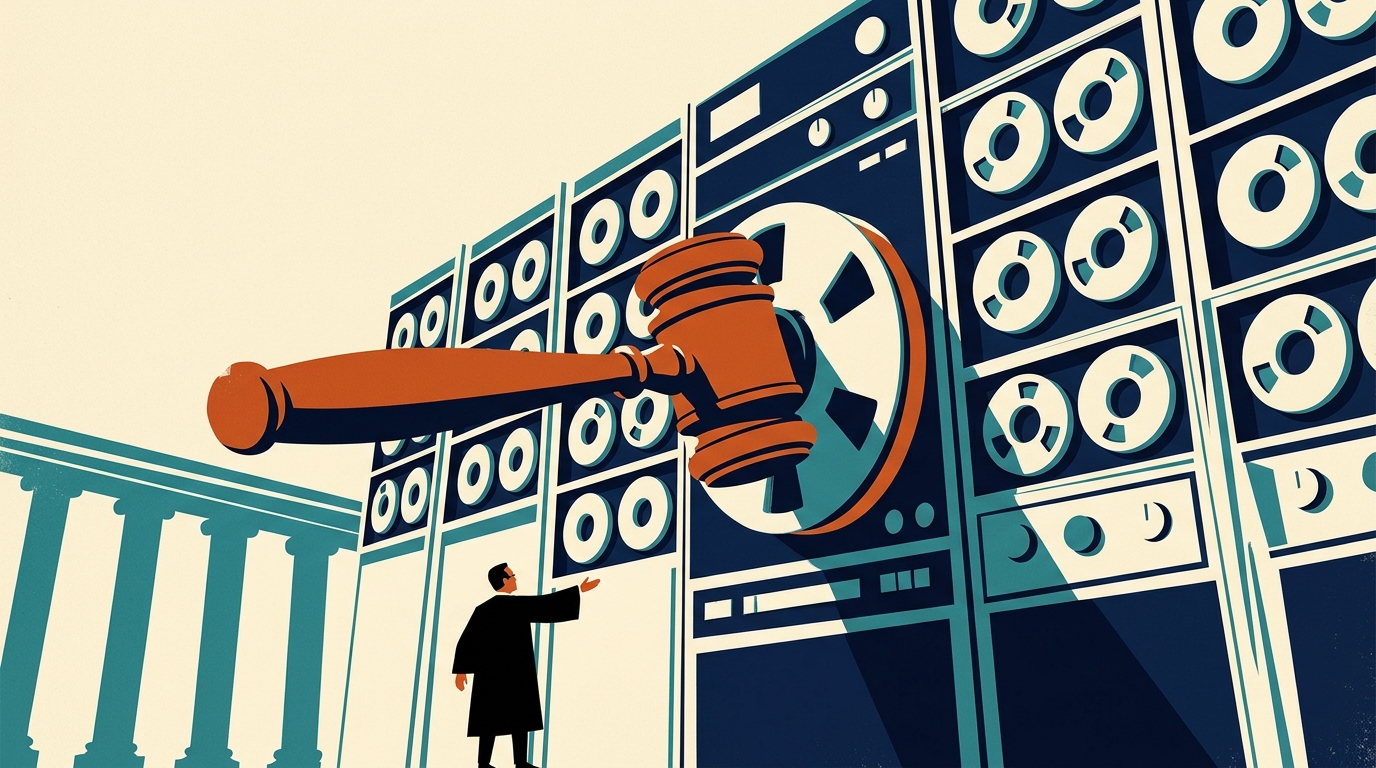
A 37-page draft of a federal bill, marked privileged and confidential and last edited on September 29, 2026, reached a wider audience on October 19 through a LinkedIn post linking it to Anthropic. The draft would make the US Department of Commerce the regulator of the country's most powerful AI models. It would require independent experts to assess these models every 180 days and give one federal court in Washington, DC, the power to suspend a model for an initial 45 days. It would also prevent states from creating their own rules for AI developers on safety disclosures, incident reports and model evaluations.
In Short
A draft US law covering the most powerful AI systems is circulating online. A LinkedIn post, citing Politico Pro, says Anthropic is behind it, but the document itself never mentions Anthropic. The draft would require the largest AI companies to publish safety plans, report dangerous incidents within days and pay independent experts to assess their models. It would also allow a court to pause a model if it appeared close to causing widespread harm. If passed, the law would stop states from creating their own rules on these specific safety issues, while allowing them to keep laws covering children, privacy, consumer protection and how companies use AI.
Where the document came from
The document spread through a LinkedIn post by Luis Alberto Montezuma, whose profile headline reads "Data and Privacy Policy | Personal Opinion." The copy of the post provided to PPC Land shows that it was published "7h" earlier and had been edited. The PDF capture was created at 06:23 UTC on October 20, 2026. The post's LinkedIn identifier points to 23:05 UTC on October 19, 2026, which matches the seven-hour difference. PPC Land therefore dates the post to October 19, 2026.
"The draft Anthropic bill, first reported by Owen Dahlkamp at Politico Pro, is now floating around online," Montezuma wrote. He added a shortened link (lnkd.in/eNQjB-bU) and the sentence "A lot of discussion about Anthropic's proposal for an AI framework." The link information in the captured post shows that it tags Dahlkamp's LinkedIn profile and sends the shortened URL through LinkedIn's external-link system. The post includes the full document as a 37-page carousel.
This chain of claims is important. The word Anthropic does not appear anywhere in the 37 pages. Every page has the heading "Discussion Draft / Privileged & Confidential / Attorney Work Product" and the note "Last edited 9/29/26." The document names no sponsor, bill number or committee and includes no cover letter. Its connection to Anthropic comes from the Politico Pro report as described by Montezuma. PPC Land has not seen that report and could not confirm who wrote or shared the draft, or whether it reflects anything a member of Congress plans to introduce. This article therefore treats it as an unverified discussion draft, not as a published proposal from Anthropic.
The draft is also clearly unfinished. Section 2, called "Findings," is empty. The proposed short title appears in brackets in three forms: "[TBD]," the "Artificial Intelligence Evaluation, Governance, and Incident Safety (AEGIS) Act," or the "Advanced Artificial Intelligence Accountability Act of 2026." Throughout the document, the agency responsible for enforcement is called "[Enforcement Authority]," even though the definitions section identifies the Department of Commerce for that role. Penalty amounts, deadlines and a funding figure are also left in brackets or blank.
Who would be covered
The bill creates two levels of coverage. A frontier model is defined as a foundation model trained using more than 10^25 integer or floating-point operations. The total includes the original training and "any subsequent fine-tuning, reinforcement learning, or other material modification." A frontier developer is a person or company operating in interstate or international commerce that has trained, or started training, such a model.
This computing threshold is ten times lower than the 10^26 operations threshold in California's SB 53, the Transparency in Frontier Artificial Intelligence Act. Governor Newsom signed that law on September 29, 2025, and it took effect on January 1, 2026, according to PPC Land's coverage of California's executive order on frontier AI. Connecticut's SB 5 also used a threshold of 10^26, as PPC Land reported in April. This comparison comes from PPC Land; the draft itself does not mention either state.
The stricter requirements would apply to a large frontier developer. This means a developer whose company and related businesses earned more than $500,000,000 in revenue "attributable to artificial intelligence products and services" during the previous calendar year, or spent more than $1,000,000,000 on development. Development costs are defined broadly. They include training, fine-tuning, security, research and evaluation of AI models, "without regard to their treatment for financial reporting or tax purposes."
The revenue requirement is higher and more limited than the one in Anthropic's own proposal from July 2025. When Anthropic published a framework for transparency in frontier AI in July 2025, it suggested covering companies with annual revenue of about $100 million or research and development or capital spending of about $1 billion. The new draft keeps the $1 billion spending requirement but raises the revenue threshold fivefold and counts only revenue linked to AI. This could matter for companies with many different businesses whose AI revenue makes up only a small part of their total income.
The Commerce Department could change the computing and revenue thresholds through regulations. It could normally do so only once every 24 months, unless the change would bring more companies under the law. It would need to allow at least 90 days for public comments. Any change that reduces the number of companies covered would have to wait 180 days after being sent to Congress before taking effect.
Two definitions of risk
The draft separates risk into two categories. Catastrophic risk means a foreseeable and serious risk that a frontier model will play a significant part in causing the death of, or serious injury to, more than 50 people, or more than $1,000,000,000 in property damage or loss in one incident. The incident must involve a model doing at least one of the following: providing expert-level help with a chemical, biological, radiological, cyber or nuclear weapon; acting without meaningful human oversight in a cyberattack or in conduct that would count as murder, assault, extortion or theft if a person did it; or escaping the control of its developer or user.
Enumerated risk uses the same thresholds for deaths, injuries and property damage, but lists different activities. These include providing expert help specifically with a biological weapon, escaping the control of the developer or user, carrying out offensive cyber operations, and "automated research and development of artificial intelligence" that would greatly speed up any of the other three activities. Most of the bill's practical requirements, including safety plans and independent evaluations, apply to enumerated risk. Catastrophic risk mainly appears in the rules for whistleblowers and false statements.
Both definitions exclude information that is publicly available in a similar form from a source other than a foundation model, lawful activity by the federal government, and harm caused by combining the model with other software when the model did not make a significant contribution to that harm. The 50-death threshold matches the definition of catastrophic risk in Connecticut's bill. It is half the 100-person threshold in Illinois SB 3444, a bill that would limit liability and that OpenAI supported and Anthropic opposed. The Illinois bill also used a computing threshold of 10^26 operations.
The draft also states that property damage "does not include the loss of value of equity." In other words, a fall in stock market value caused by an AI incident would not count toward the $1 billion threshold.
Safety frameworks, transparency and risk reports
Within 90 days of the law taking effect, or of a company crossing the coverage threshold, a large frontier developer would have to "write, implement, comply with, and publish a safety framework." The framework must cover 11 areas. These include the tests used to measure model capabilities, the thresholds that trigger safety measures, how unreleased model weights are protected against outside attacks and threats from insiders, and how the company manages risks from internal use. This includes "risk arising from a frontier model circumventing an oversight mechanism." The framework must also name the company officer responsible for safety. That officer would sign an annual statement confirming compliance and send it to the Commerce Department. Any major changes to the framework would need to be published within 30 days, along with an explanation.
The same companies would have to maintain a security program covering model weights, "algorithmic secrets," the systems used to train and run models, and access by outside parties. Testing, including "red-team exercises, penetration testing, and monitoring for distillation attacks," would have to happen at least once a year. The results would be sent to the agency within a deadline of 90 days, which remains in brackets in the draft. After Commerce names a security standard, an accredited independent auditor would check whether the company meets it. These checks would begin within a proposed 18 months, also shown in brackets.
Every frontier developer, whether large or small, would have to publish a transparency report before or when releasing a new model for general access. The report would include the release date, contact information, supported languages and types of output, intended uses and restrictions on use. Large developers releasing a model that is significantly more capable at any enumerated risk would also have to provide summaries of risk assessments, testing methods and results, observed behavior and the involvement of outside parties. A system card or model card could meet this requirement.
A separate risk report would be due within 180 days of the law taking effect and at least every 180 days after that. It would cover models used outside the company and any internally used model that is "substantially riskier than any frontier model it deploys externally." The report would need to state the remaining level of each enumerated risk after safety measures are applied. It must include enough evidence and reasoning to "allow a reasonable person to reach a conclusion similar to that which the large frontier developer reached." The company board would receive the full, unedited report.
Incident reporting on a 15-day clock
The Commerce Department would have 120 days to set up a confidential way for people to report a critical safety incident. The draft lists five types of incidents: someone taking model weights without permission or changing them maliciously; harm caused by a catastrophic risk becoming real; loss of control that causes death or physical injury; a model using "deceptive techniques against its frontier developer to subvert the controls or monitoring of that developer"; and a containment failure, in which a model escapes its developer's controls and gains unauthorized access to a computer or information system outside that developer's control.
Developers would have to report an incident within 15 days of deciding that it had occurred. If an incident creates an immediate risk of death or serious injury, the company would have to report it to Commerce and the relevant law enforcement agencies within 24 hours. Containment failures would fall under the 15-day rule only if they were expected to cause more than $250,000 in damage to someone other than the developer, or cause death or serious injury. Other containment failures would be included in an annual report to Commerce and the Attorney General. Records would have to be kept for five years. Members of the public could also submit reports.
Deadlines for incident reports have already caused disagreements elsewhere. At a New York City Council hearing on October 5, 2026, a Google representative said the council's proposed 24-hour reporting rule conflicted with a 72-hour state requirement, according to PPC Land's report on the 10 proposed New York City AI bills. The federal draft proposes a third approach: 24 hours for immediate danger and 15 days for other reportable incidents.
Commerce would publish a yearly summary of the reports without identifying the people involved. The first summary would be due March 31 of the second calendar year after the law takes effect. The department could share individual reports with other federal agencies only when those agencies need the information.
Independent evaluators as the centre of the scheme
Section 8 covers eight pages and is the most detailed part of the draft. Within 270 days of the law taking effect, every large frontier developer would have to hire at least one qualified independent evaluator to assess its models for every enumerated risk. The first report would be due within a year, followed by new reports every 180 days. Developers could pay the evaluators, but payment could not be "conditioned on the results of the evaluation." Evaluators would have to confirm that they were independent and disclose funding received from other large frontier developers.
Evaluators would receive broad access. They could use "the large frontier developer's most capable frontier models," read unedited versions of every document filed under the Act, and obtain information "reasonably comparable to the access of the large frontier developer's internal risk assessment teams." Customer content, personal information and data that the developer has promised not to access would be excluded. Developers could require reviews to take place at their own facilities, limit note-taking and conduct background checks. They could also remove a specific person for a documented security or conduct reason. However, they "may not require the removal of an individual on the basis of the individual's views, conclusions, or findings."
The reports would include the evaluator's own risk assessment and comments on the developer's latest risk report, including whether any removed information was important and whether the reasons for removing it were justified. They would also assess whether conditions that could cause widespread harm are "present or impending." Evaluators would publish a version with protected information removed within 30 days. The developer would receive 15 days' notice to suggest information that should be removed. The published report would have to state whether any removed information affected the evaluator's conclusions. Contract terms that limit what an evaluator can say in a report would be "void and unenforceable."
If an evaluator decides that an earlier finding is no longer valid, the evaluator must send an additional report to the developer and Commerce within 14 days. If conditions that could cause widespread harm are present or about to occur, the deadline would be 72 hours. Developers would have at least 48 hours to respond before the conclusion was sent.
The draft also limits the legal power of these assessments. They are "not conclusive of any fact or legal conclusion," are "not entitled to deference," and give the evaluator "no authority" to demand information or restrict a model. Evaluators would also receive protection from liability for harm caused by a model they assessed. The exception would be death or serious injury caused by intentional wrongdoing, proven by clear and convincing evidence. Statements made in good faith would also be protected against defamation claims.
Commerce would create a registry and rating system for evaluators within 180 days. It could provide funding to help keep them financially independent from AI companies. The draft leaves the funding amount blank as "[$______]." The Comptroller General would report each year on whether there were enough evaluators and whether they were independent enough.
How a model could be suspended
Section 12 creates the blocking order. If the Commerce Department applies for one, the US District Court for the District of Columbia could suspend "the development, deployment, or internal use of a frontier model on the ground that the model presents an imminent enumerated risk." That court would have exclusive authority over these cases. No other federal body could suspend a model under this law.
The draft sets a high standard for such an order. The head of Commerce would have to personally sign a written decision explaining the specific way the model could cause widespread harm, when that harm was expected, why a less restrictive measure would not work, and how much weight was given to an independent assessment. That assessment would also have to be filed with the court. Commerce would carry the burden of proof at every stage. The court would decide every issue "de novo, without deference," meaning it would reach its own decision rather than simply accepting the agency's view. It would also have to consider possible harm to users, safety research and cybersecurity.
An order would expire after a proposed 45 days unless the court renewed it for another 45 days. Both periods remain in brackets in the draft. An emergency order issued before the developer has a chance to respond could last no more than seven days. It could be used only once for each model and risk. Appeals would go to the US Court of Appeals for the DC Circuit, which would have a proposed 30 days to decide. An order could not require the deletion or alteration of model weights, training data or code. It could not force the developer to give model weights to the government or stop safety research. The court could not rely on classified information that the developer's security-cleared lawyer had not been allowed to see.
Enforcement and whistleblowers
Only the Enforcement Authority, which the draft defines as the Commerce Department, could bring a lawsuit under the Act. For a first violation, penalties would be capped at whichever is greater: a proposed $1,000,000 or a percentage of global annual revenue that has not been filled in. After a final court judgment, the cap would rise to a proposed $3,000,000 or another unspecified percentage. Only a federal district court could impose these penalties. Violations would include failing to file required documents, submitting documents with serious omissions, failing to follow a safety framework, failing to report an incident, and knowingly or recklessly making materially false statements about risk. Statements that were made in good faith and were reasonable at the time would be excluded.
The proposed $1 million penalty matches the maximum fine for each violation under California's SB 53. If the draft's revenue-based percentage is filled in, penalties could increase with the size of companies such as Google, Meta, Microsoft and Amazon, whose AI revenue is part of much larger businesses. Global annual revenue is defined to include all affiliated companies.
Section 10 would protect current and former employees and contractors of AI developers and evaluators who report violations or "a specific and substantial danger to public health or safety." Agreements could not remove these rights, including agreements containing arbitration clauses. Large developers would have to operate an anonymous internal reporting channel, send updates to reporters every month and provide summaries to their boards every three months. This design is similar to the one in Connecticut's SB 5. Complaints would first go to the Secretary of Labor. After 180 days, the person could take the case to federal court and request a jury trial. Possible remedies would include getting the person's job back and receiving "two times the amount of back pay owed with interest."
Information submitted to the government would not be subject to public release under the Freedom of Information Act, except for information that the Act itself requires to be published.
What states would lose and keep
Section 14 is likely to attract attention in Washington and state capitals. It defines four covered functions: public disclosures required by the safety framework, transparency and risk-reporting sections; outside evaluation and checking of enumerated risks; incident reporting; and state orders suspending AI models because of an immediate enumerated risk. States would be barred from adopting, keeping or enforcing requirements for AI developers in the first three areas, "notwithstanding the date of its enactment or adoption." This wording would cover existing laws as well as future ones.
The fourth function, state suspension of models, "shall have no effect unless section 12 is enacted." The drafters have linked state powers to stop a model to the existence of a federal process for doing the same thing. This suggests that the blocking-order provision could be used as a bargaining point in negotiations.
In one respect, the proposed restriction on state laws is broad. For Section 14, an "artificial intelligence developer" is "not limited to a frontier developer," and catastrophic and enumerated risks "are not limited by the thresholds stated in section 3." A state therefore could not require a small AI developer to publish risk information that federal law would not require that developer to provide.
In other respects, the restriction is narrow. States would keep laws covering how people other than the developer use AI. These include consumer protection, child safety, civil rights, contracts, employment, criminal law, personal injury claims and privacy. States would also keep rules protecting minors, specifically including sexually explicit content, self-harm content, age verification and parental controls. State whistleblower laws and state rules developed through court decisions on personal injury, contracts and property would remain in force. The draft rejects a rule that would wipe out all state laws in the field. Instead, it says Section 14 "be construed narrowly" and that any unclear wording "shall be resolved in favor of preserving the authority of the States." Following the federal law would not protect a company from liability under state law.
A clause also ties the provisions together. If the main federal duties in Sections 4 through 11 were struck down or became unenforceable to a substantial extent, the restrictions on state laws would fall with them. The draft states: "It is the intent of Congress that State authority be displaced under section 14 only so long as the Federal requirements of this Act remain in force."
How it fits the federal fight over state AI laws
The draft enters a long-running debate over who should regulate AI. In March 2026, the White House published a national AI policy framework asking Congress to override state AI rules. It included a request to stop states from regulating AI development while allowing exceptions for child protection. In July 2026, the Federal Trade Commission proposed a policy statement naming Colorado's amended AI law as a possible case where federal law would take priority. On June 2, 2026, President Trump signed an order setting up a voluntary federal review before frontier models are released. That review could last up to 30 days and did not require a license.
The draft goes further than these earlier measures because it would impose binding federal duties. But it would remove fewer state laws than the White House framework proposed. Its restrictions cover developer disclosures, independent evaluations and incident reporting, the same areas addressed by California's SB 53. At the same time, it would preserve state rules on consumer protection and child safety, which have been major concerns for state lawmakers. On September 18, Governor Newsom signed an executive order asking California agencies to report by November 16 on onsite verifiers, independent checks of safety frameworks and a model "kill switch." All three topics would fall under the draft's covered functions.
Anthropic's public position has faced criticism before. In July 2026, the company responded to claims that it supported a ban on Chinese open-weights models. It said it had never called for such a ban and supported mandatory safety testing before the release of capable models, as PPC Land reported when 77 companies signed an open letter. The draft would apply equally to open and closed models above 10^25 operations. It contains no rules on exports or open model weights. It does, however, list "monitoring for distillation attacks" as a security test.
At the New York hearing in October, all four companies represented, including Anthropic, said they preferred a federal standard. An Anthropic representative said the company had supported SB 53 before it became law.
Why this matters for marketing and advertising
The companies most likely to be affected by the draft are also among those that run the largest advertising platforms and supply AI models used in ad buying, creative work and measurement. Based on their publicly reported AI spending, Google, Meta, Microsoft and Amazon appear likely to meet the $1 billion development spending test, although the draft does not name any companies. A transparency report for each major model release, a risk report every six months and independent evaluator reports published within 30 days would create a regular stream of public information about AI systems that advertisers increasingly use to manage advertising budgets and create content.
The definition of a frontier model counts fine-tuning and reinforcement learning added to an existing model toward the 10^25 operations threshold. Companies adapting a large existing model for advertising products could therefore cross the threshold through additional training rather than the original training process. The draft leaves this issue for Commerce to address, but the department could only change the thresholds under the conditions set out in the bill.
The proposed limits on state laws also matter to publishers and marketers who follow AI regulation. Most state AI laws affecting marketing cover how AI is used, including chatbot disclosures, automated decisions about hiring or credit, protections for minors and misleading consumer practices. The draft would leave those laws in place. What it would remove is the state-level system for requiring AI developers to report safety information, which California and New York have started to build.
None of these proposals is law. The document has no named sponsor, its findings section is empty and its penalty amounts remain placeholders. Nothing in the two documents supplied to PPC Land establishes whether a version of the draft will be introduced in Congress or who might introduce it.
Timeline
- July 7, 2025 - Anthropic proposes a transparency framework for frontier AI developers, covering companies with around $100 million in revenue or $1 billion in spending.
- September 29, 2025 - California signs SB 53, setting a threshold of 10^26 operations and penalties of up to $1 million per violation.
- January 1, 2026 - SB 53 takes effect.
- March 2026 - The White House framework asks Congress to override state rules on AI development.
- April 17, 2026 - PPC Land reports on Illinois SB 3444, a bill limiting AI company liability that uses a 100-death threshold and is supported by OpenAI but opposed by Anthropic.
- April 21, 2026 - Connecticut's Senate passes SB 5, which includes rules for frontier models and whistleblower protections.
- June 2, 2026 - President Trump signs an order creating a voluntary 30-day review before frontier models are released.
- July 2026 - The FTC proposes a policy statement identifying Colorado's AI law as potentially overridden by federal law.
- July 27, 2026 - Anthropic says it has never supported a ban on open-weights models.
- September 18, 2026 - Newsom signs Executive Order N-9-26, setting a November 16 deadline for recommendations on a frontier AI kill switch.
- September 29, 2026 - The last edit date shown on the federal discussion draft.
- October 5, 2026 - OpenAI, Anthropic, Google and Meta appear before the New York City Council and say they prefer a federal standard.
- October 19, 2026 - Luis Alberto Montezuma posts the 37-page draft on LinkedIn, citing a Politico Pro report that describes it as an Anthropic bill.
- November 16, 2026 - Deadline for California's recommendations under the Newsom order.
Summary
Who: An unnamed author prepared a draft of a federal bill. According to a LinkedIn post by Luis Alberto Montezuma, Politico Pro reported that the draft was an Anthropic bill. The proposal would put the Commerce Department in charge of regulation and give the federal district court in Washington, DC, authority to suspend models. Frontier AI developers, independent evaluators, whistleblowers and state governments would be affected.
What: A 37-page draft bill with the possible names AEGIS Act or Advanced Artificial Intelligence Accountability Act of 2026. It would require safety plans, transparency and risk reports, incident reporting within 15 days, independent evaluations every 180 days and whistleblower protections. It would allow courts to block models that pose an immediate risk of widespread harm and prevent states from setting their own rules on developer disclosures, evaluations and incident reports. Important details, including penalties and the proposed 45-day suspension period, remain in brackets.
When: The draft was last edited on September 29, 2026, and was shared publicly through a LinkedIn post on October 19, 2026. It has not been introduced in Congress.
Where: The United States, at the federal level, with possible effects on state laws such as California's SB 53.
Why: The draft would replace different state rules on frontier AI developers' safety duties with one federal system, while allowing states to keep laws on AI use, children and consumer protection. However, the document's origins remain unconfirmed. It does not mention Anthropic, and the claim linking it to the company comes from a secondhand account of a Politico Pro report.