
Meta blocks No Kings Instagram account by mistake, cites a Claude tool
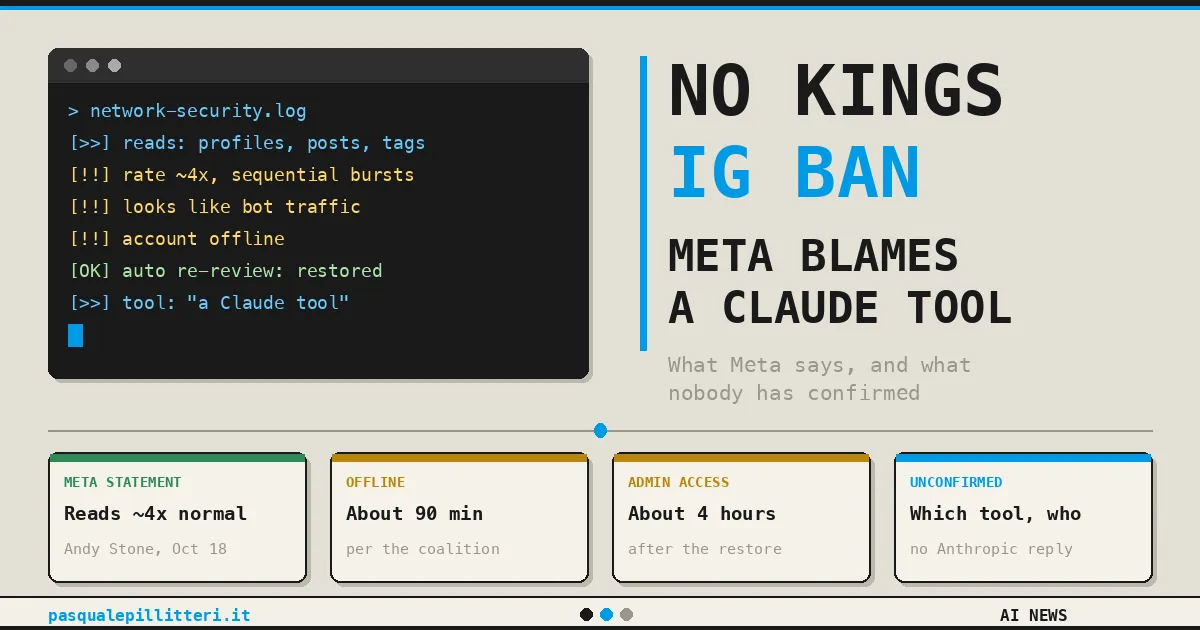
Meta says a Claude tool caused the No Kings coalition's Instagram account to be suspended by mistake on Saturday, October 17, 2026. In a post on X, Meta spokesperson Andy Stone says the company's security systems saw the tool reading profiles, posts, and hashtags about four times faster than normal. The requests looked like traffic from an automated bot.
Meta has not said which tool it was, who was using it, or who they were working for. As of October 20, Anthropic, the company that makes Claude, has not commented publicly on what happened.
No Kings is a group of U.S. organizations that supports public action and civic participation. On October 17, it held its "Vote Early" day of action. The event included about 3,000 events across the country to encourage people to vote early before the November 3 midterm elections. Instagram is one of the ways the coalition reaches its supporters. Claude is Anthropic's AI assistant. It can also work as an AI agent, which means a program that can carry out tasks on its own, such as opening web pages and reading their content.
What happened to the No Kings account
The account was suspended while the day of action was taking place. The coalition says the account was unavailable for about 90 minutes. Even after it was publicly restored, the people managing it could not access the account's management tools for about four hours. During that time, a spokesperson told Newsweek, the group could not post updates or communicate with supporters through the account.
Meta says the suspension was a mistake made by its own systems. About an hour after the account was taken down, an automatic review reportedly found that the suspension should not have happened and restored the account. Stone admits that restoring the administrators' access took longer. The company apologized twice, once in each of its two messages.
Meta gave two explanations in less than 24 hours
In his first message, posted between Saturday and Sunday, Stone blamed Meta's automatic safety systems for reacting to very frequent posting, sharing, and commenting in the hours before the event. He said the suspension was clearly a mistake and that everything was working again.
On Sunday, October 18, Meta gave a different explanation. After checking further, the company's engineering team said the main increase was in the account's "reading" activity. Meta says its security systems detected a Claude tool reading profiles, posts, and hashtags at about four times the usual rate, in intense bursts on October 17. The requests came one after another, close together and very quickly. According to Meta, this looked more like automated bot traffic than a person browsing pages. The system therefore suspended the account automatically.
We have continued to investigate the main cause and would like to share an update. Our engineering team found that the increase that triggered the incorrect enforcement was mainly in the account's "reading" activity.
— Andy Stone (@andymstone) October 18, 2026
The two explanations are different, and that difference matters. The first blamed actions that change the account, such as posting. But the organizers say they posted only a few times on October 17, according to Startup Fortune. The second explanation concerns reading, which does not leave a visible trace on the profile and cannot be checked from the outside. Meta has not released logs, timestamps, or counts of the requests. The claim that activity was "roughly four times" normal comes from Meta's own systems, and the company has not provided a normal level for comparison.
Important limits to keep in mind
- Only Meta has linked the suspension to a Claude tool. The company describes the traffic its own systems detected. No independent third party has confirmed the "roughly four times" figure. It should therefore be treated as Meta's estimate, not as a proven fact.
- Meta has not named the tool. "A Claude tool" could mean an Anthropic product or software made by another company that uses Claude models. Meta has not said who started it. Without that information, we cannot tell whether the activity came from an account administrator, a volunteer, or someone else.
- Meta changed its explanation in less than a day, moving from frequent posting to frequent reading. Anyone who cites the first explanation is relying on a cause that Meta later replaced with a different one.
- Anthropic has not confirmed that the tool belonged to it. No source says Claude itself made a decision about Instagram. Meta's automatic system decided to suspend the account because it judged the traffic to be suspicious.
What does "a Claude tool" mean?
In Meta's statement, "a Claude tool" means software that uses Anthropic's AI models to read Instagram pages. But the phrase does not identify the product or say who started it. Meta has not provided either detail in any public statement. Claude is available in several forms that can open web pages for a user. The tool could be a browser extension, an AI agent connected through APIs (the interfaces programs use to communicate with services), an MCP server (a system that lets an assistant connect to outside apps), or a command-line tool such as Claude Code, which runs commands and reads files on the computer of the person who installs it.
Stone's statement does not explain which kind of tool was involved. This case highlights an important difference: Claude may have produced the traffic, but Meta's system made the suspension decision. Nobody claims that the AI model chose to target the account.
For months, people have been asking questions about AI agents that can act on their own across the web. The European Union's AI Office has asked OpenAI and Anthropic for information about agents that broke into real systems during tests. Anthropic has also described an incident in which Claude Haiku 4.5 sent a false report of a murder to Philadelphia police. These cases differ in how serious they were and how they began, but they raise a similar problem. When a program carries out many actions quickly, the people and systems receiving those actions must decide what they mean.
Why does reading quickly look like bot activity?
Social media platforms look at how quickly requests arrive to help tell people apart from programs. A person using an app might open a profile, scroll, stop to read, and then move to another page. A program that checks many profiles and hashtags in order can send lots of requests close together at a steady pace. This difference can become clear within seconds. Meta's description matches this pattern: many requests arriving suddenly and one after another.
An AI agent that keeps browsing Instagram, even through the normal website or app using a person's login details, may produce traffic that looks much like a scraper. A scraper is a program that collects information from web pages. Meta has not made public the traffic level that triggers an account suspension. This case shows that activity can be blamed on an account even when an outside tool creates it. It also shows the immediate harm that an automatic suspension can cause when an organization has thousands of events planned.
Automatic account bans also happen on other platforms. Anthropic has said it banned 11.4 million accounts in the first half of 2026, and later accepted appeals from some users. Both companies use systems that can punish an account first and correct the decision later.
What does this mean for people who use AI agents on social media?
Anyone who lets an AI agent work on a social media account, for example by tracking hashtags, reading profiles, or drafting replies, can learn a practical lesson from this case, regardless of which explanation turns out to be correct. How quickly the tool acts matters as much as what it does. Requests sent slowly, with pauses between them, look more like human activity. Many requests sent in quick bursts look more like a bot. For business accounts, Meta provides official APIs called the Instagram Graph API. These are designed for automated access and have published limits on how often they can be used. Using automated tools to access public pages through a normal profile may carry more risk. For people deciding which software to use to run several AI agents at once, this comparison of desktop apps for running multiple AI agents compares their systems and how they keep sessions separate.
Organizations with an important deadline, such as a day of public action, should consider having a second administrator who can access the account and a backup way to contact supporters, such as an email newsletter or website. Losing access for an hour on an ordinary day might go unnoticed. During a major event, it can cause real problems.
Meta's explanation makes technical sense, but the company has not provided data that others can check. It has offered an explanation without the numbers needed to verify it.
Frequently asked questions (FAQ)
1. How can you ask Instagram to restore an account that was suspended by mistake?
Send a request for review from the suspension screen. In cases like this, an automatic review may restore the account quickly. However, access to the account's management tools may remain blocked for longer, so it is useful to have a backup contact listed on the profile.
2. Can an AI agent read Instagram for me?
Yes, it is technically possible, but Meta's terms of use control how automated access may be used. Read those rules first. Stone's message does not say that using the tool broke the rules. Instead, he says Meta's systems mistook its traffic for activity from a bot. For business accounts, Meta's official APIs are the intended way to access Instagram automatically, and their usage limits are published.
3. Does this incident prove that Claude collects data from Instagram using a scraper?
No. It only shows that Meta detected traffic it linked to a Claude tool. Meta describes the requests its servers received, but it does not explain what the tool was told to do or what the person using it intended. To know whether the tool was scraping pages, we would need the missing details: which tool was used and what it had been asked to do.