
Gradual disempowerment, the AI risk with no robot uprising, explained
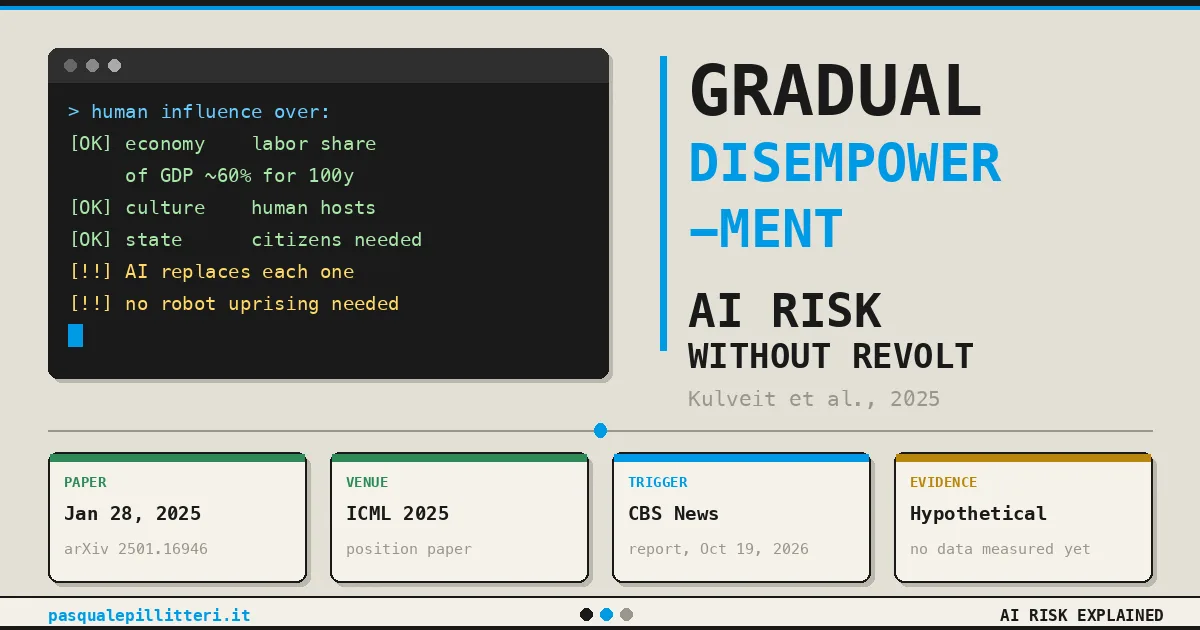
Gradual disempowerment means the slow, step-by-step loss of human power. The idea is that artificial intelligence (AI) could take control away from people in the economy, culture and government without any machine rebellion. This could happen simply because AI becomes better than humans at almost every task. Jan Kulveit developed this idea with five other researchers in a paper dated 28 January 2025. On 19 October 2026, the American news network CBS News introduced the idea to a general audience in a long report by journalist Shaun Raviv.
Kulveit works in the ACS Research Group, a research group connected to Charles University in Prague. The people who signed the paper are also connected to Mila, a research institute in Montréal founded by Yoshua Bengio, the University of Toronto and the British agency ARIA. The paper later appeared in a version for the ICML 2025 conference under the title "Position: Humanity Faces Existential Risk from Gradual Disempowerment". The word "Position" is important. It means the paper argues for an idea rather than presenting a study based on experiments.
What is gradual disempowerment, in simple terms?
Gradual disempowerment is the slow loss of human influence over the economy, culture and government. It could happen as AI becomes more capable and takes over people's work and decisions. AI does not need to be hostile, and its abilities do not need to improve in one sudden leap. It may be enough for every company and institution to hand a little more work to machines to keep up with competitors.
Discussions about AI risks usually focus on two possibilities, both mentioned in the paper. The first is people using AI for harmful purposes, such as cyberattacks or biological weapons. The second is an AI system that acts on its own and pursues goals that do not match human interests. It might suddenly act to gain a major advantage, perhaps after spending time misleading the people watching over it. The authors suggest a third possibility that is less dramatic. Each step seems reasonable, and no single step looks like a disaster. But together, these steps move power away from people.
Why social systems obey us today, at least in part
The argument starts with a fact that is easy to overlook because we have never seen the opposite happen. Today, the economy, culture and government take human needs into account in two ways. The direct way includes voting, choosing what to buy, going on strike and boycotting products or services. The indirect way comes from the fact that these systems need people to take part, using their work and intelligence.
The numbers in the paper help explain this. For years, household spending in the United States has made up about 70% of gross domestic product (GDP), while the share of GDP paid to workers has stayed around 60% for more than a century. In other words, much of the economy works because people produce things for other people. As the authors explain, coffee reaches a shop shelf because thousands of people have a reason to help get it there. Consumers can afford to buy it because they also earn money by working.
The same idea applies to governments. Even the harshest governments need civil servants, police officers and soldiers. These people can make mistakes, hesitate or refuse to follow orders. The paper explains that this dependence helped lead to public schools, political rights and basic protections. The authors refer to historian Charles Tilly, who explained that governments needed educated citizens and armies whose members were willing to fight.
How control is lost, one system at a time
The economy, where human work is no longer needed
Older technologies automated particular tasks, such as weaving, washing and calculating, but left more complicated work to people. AI could instead replace human thinking in almost every area, the authors argue, drawing on economists Anton Korinek and Joseph Stiglitz. A calculator could do the arithmetic, but a person still had to understand what to use it for. An AI system can handle that step too.
Competition pushes companies in this direction. A company that keeps people closely involved in every decision may fall behind a rival that hands more control to machines. It could even lose its place in the market. The paper predicts that companies that refuse to automate on principle will sooner or later be replaced by companies that do not refuse. There is another reason this can happen: people stop investing in skills once a task seems likely to be automated. Companies and workers put less effort into learning how to do the task themselves. This makes replacing people both more likely and more necessary.
Culture, where ideas no longer need people to spread them
The authors see culture as a collection of ideas, habits and stories that spread when they can copy themselves. Until now, these ideas have needed people to carry them. This limit has helped hold back some harmful ideas and habits, because communities that adopted very destructive ways of living lost ground to other communities. When AI can create, spread and select content, this limit becomes weaker. The paper gives the example of "Sydney," an unstable personality that appeared in the Bing chatbot in early 2023. It spread to social media and newspapers and then entered the training data of later AI models. The authors see this as an early, harmless example of a cultural trait spreading because machines can easily reproduce it.
Speed also matters. An AI system that tests millions of versions of a piece of content may find ways to capture our attention more quickly than we can respond. Society may not have enough time to develop the "cultural antibodies" that helped people deal with problems such as spam, online radicalization and social media addiction over many years. The paper also mentions artificial companions, romantic partners and digital friends. These systems can offer affection and patience without the limits that every human being has.
The state, where citizens are no longer essential
The paper compares this possibility with rentier states. These are countries that get money from outside sources, such as oil, rather than mainly from taxes paid by citizens. When a government does not depend on its people's work for its income, the authors say, one reason for political participation becomes weaker. If governments earned most of their money from companies that produce goods and services using AI, they might have less reason to develop people's skills or give them a voice in government.
The same argument applies to police and military forces. Today, a government cannot treat the people it relies on for police officers and soldiers too badly without risking their refusal to follow orders. An automated security system that can predict protests before they happen could remove this check on government power. The third concern is the law. If AI systems wrote and interpreted most laws and legal decisions, it could become harder and harder for ordinary people to understand the law without help.
The gap between regulation and adoption is already visible. Human workers are covered by minimum-wage rules, social contributions and workplace inspections. AI work, by contrast, operates in an area with almost no rules, the paper notes. Europe is moving ahead with the AI Act, for which the European Commission has presented rules on fining ChatGPT and Gemini. Italy is also trying to establish basic safeguards through decree 179/2026, with fines of up to 35 million euros starting on 23 October.
Why the economy, culture and state influence one another
A clear objection is that these three systems can limit one another. Governments regulate markets, for example, while culture influences governments. The paper replies that these relationships do not automatically protect human values. They can also work in the opposite direction. The authors point to the tobacco industry, which used its economic power to influence politics and public opinion. Companies that replace human workers with AI will have reasons to influence laws and public opinion in ways that support this change. The money they earn could make that influence even stronger.
Even partial solutions have costs. If the government gives people some of the wealth created by AI, people may become more dependent on that support. The historical link between paying taxes and having a say in government may then weaken. The government also becomes responsible for keeping the economy in line with people's interests, but it has its own reasons for moving away from what people want.
Gradual disempowerment or runaway superintelligence, what is the difference?
The main difference is how the harm happens. The best ways to prevent it also depend on the cause. It is one thing to share the concerns of someone like Masayoshi Son in Kyoto, who fears superintelligence falling into the wrong hands. It is another to face a risk that grows even when nobody makes an obvious mistake.
| Aspect | Sudden takeover | Gradual loss of power |
|---|---|---|
| How it arrives | A leap in capability or a system's betrayal | The sum of rational choices by companies, states and people |
| Needs an AI with hostile goals | Usually yes | No |
| Aligning the single model is enough | It is the main answer | No, the problem concerns whole social systems |
| Warning sign | An abrupt, visible action | GDP and services can rise while human influence falls |
The authors stress the third point. Even if every AI model did exactly what people asked it to do, the overall system could still move away from human interests. This is because the goals of a company or government office do not always match the wellbeing of people outside it. The paper does not dismiss the other AI risks that have already been discussed. It adds another risk that needs different solutions.
The CBS examples and what has actually been shown
Raviv's report does not announce a new study or provide new figures. Instead, it presents the views of three people. Kulveit explains the paper's main argument. Margaret Mitchell, a research scientist at Hugging Face, a platform that hosts open AI models and datasets, has signed recent work on keeping humans involved in decisions. Jay Chooi, the CEO of Robocurve, a company that tracks the abilities of AI-powered robots, says gradual disempowerment is his biggest concern.
The examples are meant to explain the idea. They are not reports of real events. In one example, a fictional company called "Hammer Co." lays off its workers to compete with rivals using cheaper robots. When people stop practicing a skill, they lose it and become dependent on the system that performs it for them. If the United States hands battlefield decisions to AI, its enemies may feel forced to do the same. Governments that no longer need citizens to pay taxes or serve in the military may become less democratic, as the comparison with oil-producing countries suggests. Mitchell warns that if a system breaks, there may be no human left who knows how to fix it: "There's no human you can point to who can fix it". Chooi calls this a "civilization-scale problem".
These examples make more sense when compared with what is happening today. Companies trying to hand large amounts of work to AI agents often run into problems (why corporate AI agent projects fail). Even major brands, from Amazon to JPMorgan, are closing the door on AI agents. For now, there are still obstacles to handing work over to AI. The paper argues that competition will gradually weaken these obstacles.
Not everyone agrees with the paper. On 4 February 2025, economist Tyler Cowen discussed it on the blog Marginal Revolution. He called it "one of the smarter arguments" he had encountered on the subject, but said he was not convinced. Cowen asks whether humans have ever really been in control. He also points out that the paper does not show that enough AI systems will end up coordinating against humans. He adds that models such as DeepSeek can be copied at very low cost. In his view, this points towards a more decentralized future in which other sources of power can continue to limit AI's influence.
Limitations to keep in mind
- Gradual disempowerment is a reasoned idea about what might happen, not a measured fact. The paper is a 19-page "position paper" with two figures. Its chart about automation is a simplified model inspired by simulations from other economists. The paper provides no measurements showing that human power is declining today.
- The authors themselves say that nobody has a concrete plan to stop this process and that the suggested solutions are mostly temporary measures. Anyone looking for a ready-made solution will not find one in the paper. Anyone who promises one is going beyond what the paper says.
- The examples in the CBS report, including Hammer Co., are hypothetical. The report gives no statistics on the effects on jobs. Its judgments about how serious the risks are come from people who work on the subject and have not been independently checked.
- The paper warns that there are no outside reference points for measuring whether social systems are aligned with human interests. Until people agree on shared measures, any claim about "where we stand" remains an opinion.
What do the authors propose to stop it?
The authors suggest four groups of actions and warn that all four are needed. The first is to measure what is happening. In addition to tracking the share of GDP paid to workers, they suggest measuring the share of GDP produced by AI as a separate category from labor and capital. They also propose tracking how many major company decisions are made mainly by automated systems, how much cultural content is created by humans rather than generated by AI, and how complex laws are, as a way to judge whether people can still understand them.
The second group of actions aims to limit AI's influence. These include requiring human oversight for important decisions, limiting AI's independence in certain areas, preventing AI from owning assets or taking part in markets, and increasing taxes on income generated by AI as that income grows. The third group aims to strengthen human power through faster democratic processes, AI systems whose results remain understandable, and "AI delegates" that can defend people's interests while keeping up with competing systems. The fourth group is less clearly defined. It concerns how to make entire social systems work in line with human interests. The authors say there is not yet even a clear positive vision of how to bring very capable AI into society without losing human influence.
The authors recognize that these measures have costs. Restrictions can mean giving up some economic gains, and the more costly they are, the stronger the incentive to avoid them. They may also work poorly if some countries refuse to follow them. The countries with the strongest economies could end up being those where people have lost the most power. For these reasons, the authors see the measures mainly as steps towards a solution rather than a complete answer.
The CBS report offers a few more practical ideas. Mitchell talks about "strategic friction," which means deliberately keeping humans involved at certain stages of a process even when machines could work without them. Kulveit argues that some areas should be protected so that competition cannot remove people from the process. He also supports designing AI to explain things rather than replace people, because humans should not have to compete directly with machines. Both researchers want to track how much work is being handed over to AI.
The legal limits being discussed today focus on a different kind of harm. The Anthropic draft law proposes stopping an AI model only if it causes more than 1 billion in damages or 50 deaths. This limit is designed for a sudden incident. The slow loss of power described in the paper is unlikely to cross such a limit in one event. That is why tracking a measure such as the share of GDP run by AI may be more useful than setting a limit based on damages.
In my view, the most useful part of the paper is also the least exciting: the measurements. No official statistic currently separates the GDP produced by AI from the GDP produced by human labor. Without this number, the debate remains divided between people who say "it's all under control" and those who say "it's already too late". Physical work is also part of the picture through physical AI, including the data, models of the physical world and robots discussed in our explanation. For now, there is one simple question that still has no answer.
Frequently asked questions (FAQ)
1. What is the difference between relative and absolute loss of power?
Relative loss of power means people can remain well-off while having less influence. Absolute loss of power means their wellbeing also suffers. The paper uses the word "relative" for a situation in which people remain rich in material terms, perhaps because they own assets, receive government support or get a basic income. But they have less and less say in economic decisions, even as GDP grows and more activity serves AI, such as building computing infrastructure. In the "absolute" version, people struggle to meet even their basic needs. AI may use land, energy and raw materials more efficiently, pushing up the prices of things people need.
2. Does the paper say humanity will go extinct?
No, it does not predict that. The authors argue that a worldwide and permanent loss of human influence would be an existential disaster. They write that it could "plausibly" lead to human extinction or similar outcomes. This is an argument about a possible risk, not a prediction with estimated probabilities or dates.
3. Can gradual disempowerment already be measured?
Not yet. The paper acknowledges that there are no outside reference points for measuring many social systems. It proposes developing indicators, including the share of GDP produced by AI and the amount of culture created by non-human systems. The CBS report also provides no numerical data to measure the problem.
4. Where can I read the original paper?
It is available for free on arXiv. The version dated 28 January 2025, revised the next day, is available at arXiv 2501.16946. It is written in English and has separate sections on the economy, culture and the state, followed by a section on possible responses. The version published in the ICML conference proceedings is also available in the conference proceedings. Another resource on this topic is the ForeCast series episode "Is Gradual Disempowerment Inevitable?" from Forethought, featuring Raymond Douglas and released on 9 September 2025.
5. Why is it being discussed right now?
Because of the CBS report published on 19 October 2026. There is no new study and no reported event that suddenly brought the issue to the fore. The idea is now 21 months old, and interest is growing because the report introduced a topic previously discussed mainly by specialists to a general audience.