
Semis Slide Despite OpenAI 30B, Micron Strike
Before the market opens, futures show that investors are avoiding risk.
Futures tied to the NASDAQ 100 are down 0.78%, S&P 500 futures are down 0.37%, Russell 2000 futures are down 0.27%, and Dow futures are down 0.16%. Meanwhile, the CBOE Volatility S&P 500 Index (VIX) has jumped 3.63% to 19.11, and crude oil futures are up 1.58%, adding more pressure to the market.
Chip and storage stocks are giving back gains from last week. Micron Technology is down 2.73%, Intel is down 2.16%, and NVIDIA is down 0.96%. SpaceX is down 1.23% ahead of its earnings report, while Apple is down 1.63%, weighing on large technology stocks. Microsoft is up 0.04%, making it the only stock in this group to rise.
Fears about credit risks have not gone away. Reports say trading in Wall Street credit default swaps (CDS), which investors use to protect themselves against the risk of debt defaults, has risen fourfold as concerns about AI-related debt grow. Technology stocks are also facing record net selling before the market opens.
Why it matters: The market is reacting first to the risk that AI-related debt could cause problems. Even a single positive headline has not been enough to reduce demand for these financial protections.
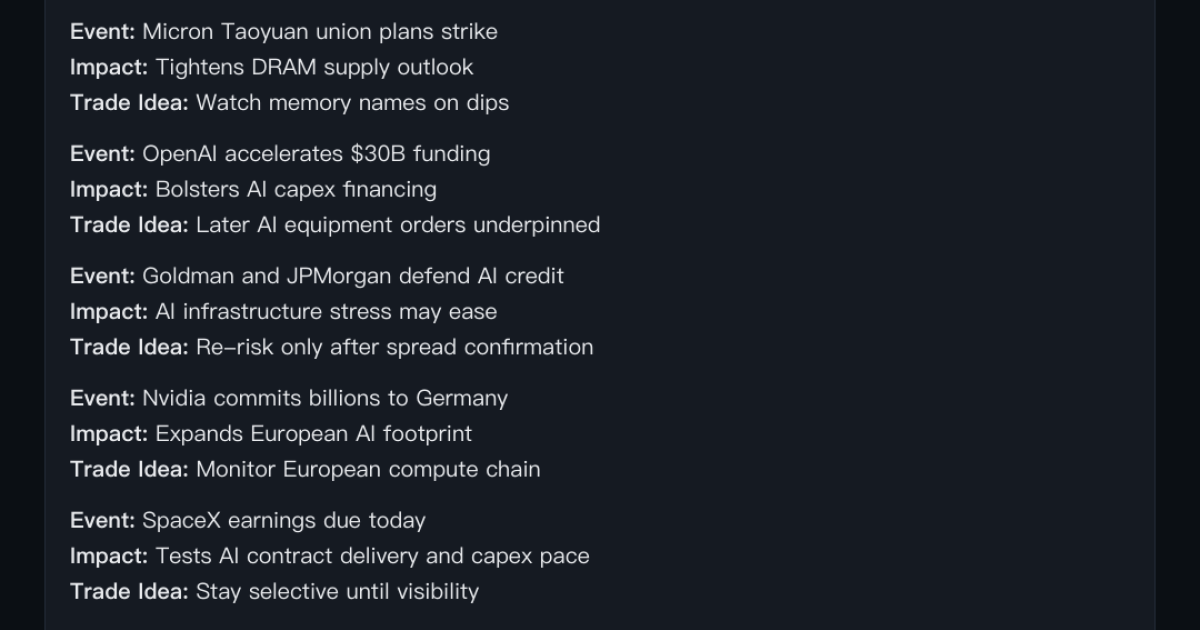
The union at Micron Technology's Taoyuan site is planning a strike. This creates a new risk for DRAM production and could reduce memory supplies after months of debate over prices.
$Micron Technology (MU.US)$is also working with Indium on processing critical minerals in New York. This partnership gives Micron greater control over the raw materials needed to make advanced memory.
$NVIDIA (NVDA.US)$is committing billions of dollars to Germany. This expands its AI and computing presence in Europe and could attract more investment in chip manufacturing and computer systems across the region.
Demand for DDR5 memory is picking up. A leading Chinese maker of interface chips expects its net profit for the third quarter to rise by 153.6% to 174.7% compared with the same period last year as production grows.
High-bandwidth memory (HBM) and other advanced memory products were already among the strongest areas of the supply chain. The risk of a strike now adds a possible short-term reason for prices to rise.
Why it matters: Labor problems and limits on raw materials could tighten supply even before new demand figures arrive. This could help support memory and interface-chip stocks when their prices fall.
OpenAI is speeding up a $30 billion funding round. This shows that the biggest AI model developers still need huge amounts of money to pay for computing power.
JPMorgan believes its exposure to
can be managed, while Goldman Sachs is defending the expected returns from AI computing. Both are pushing back against last week's fears about debt defaults.
Morgan Stanley has pointed to three risks that could slow the $1.6 trillion investment in AI infrastructure. This means debate over total spending on AI facilities and equipment is still ongoing.
$SpaceX (SPCX.US)$reports earnings today. Investors will focus on whether it delivers on its AI contracts and how quickly it is spending money on capital projects.
$Tesla (TSLA.US)$reports later and will face similar questions about AI and cash flow.
$Amazon (AMZN.US)$plans to invest more than EUR 16 billion in Germany through 2027. The investment will cover AI, satellites, and logistics, adding another major technology company's spending plan to the picture.
Why it matters: Funding for AI demand remains strong enough to support selected investments. But before investors are willing to value these companies more highly despite their debt, they need earnings reports to show that the spending is producing real cash flow.
The market is expected to open lower. Buying the whole market through broad index investments looks like a poor choice in these conditions, especially while the
$CBOE Volatility S&P 500 Index (.VIX.US)$ is rising and demand for credit protection remains high.
A more focused approach is to look at memory and HBM stocks linked to the
strike risk and growing DDR5 demand, rather than buying semiconductor stocks across the board.
Investors should consider taking on more risk in AI infrastructure only if
credit spreads become more stable after Goldman Sachs and JPMorgan's reassuring comments, and
$SpaceX (SPCX.US)$shows that it is delivering on contracts and managing capital spending as expected.
OpenAI's $30 billion funding round and the positive case for
$CoreWeave (CRWV.US)$can provide reasons to consider investing later. For now, wait until market prices stop falling below important technical levels before taking on more risk.
Why it matters: The market is favoring companies that can show they have the power to maintain prices and provide a clear picture of future cash flow. AI-related debt with high borrowing risk is still being treated with caution.