
Machine learning spots hidden risk of functional decline after heart failure
edited by Swati Mestri, reviewed by Andrew Zinin
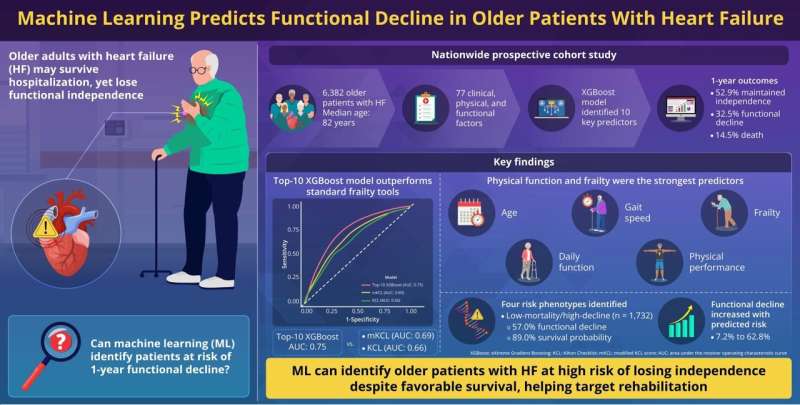
For older people with heart failure (HF), surviving a hospital stay does not always mean they can return to living independently. Losing the ability to do everyday activities can lower quality of life, increase the work caregivers must do and create a need for more care. However, most methods for predicting what will happen to patients focus on death or returning to the hospital. This makes it difficult to identify people who may survive but lose their independence.
To address this problem, a research team led by assistant professor Kanji Yamada from the Department of Physical Therapy, Faculty of Health Science, Juntendo University, Japan, studied 6,382 patients aged 65 or older. All had been hospitalized for heart failure, received physical therapy and been able to carry out daily activities independently before entering the hospital. The team also included associate professor Nobuyuki Kagiyama and specially appointed professor Tetsuya Takahashi, both from Juntendo University.
Using data from the J-Proof HF Registry, which follows patients over time, the researchers built a machine learning model called eXtreme Gradient Boosting (XGBoost). It was designed to predict whether patients would remain independent, lose some of their abilities or die within one year of leaving the hospital. The study was published online in the Journal of Cardiac Failure on Aug. 20, 2026.
The team considered 77 possible factors that might help predict what would happen to patients. The model included tests carried out by physical therapists when patients left the hospital. These included maximum walking speed, the Short Physical Performance Battery (SPPB), handgrip strength and the Barthel Index (BI), which measures how well people manage daily activities. The researchers also used the Kihon Checklist (KCL), which measures how frail a person was before entering the hospital. They tested a simpler model using the 10 most important factors, called the Top-10 model. They checked how well it worked by repeatedly leaving out one study site for testing, then compared its results with scores based on the KCL.
One year after leaving the hospital, 2,076 patients had lost some of their ability to carry out daily activities, 928 had died and 3,378 had remained independent. The Top-10 XGBoost model performed significantly better than both the modified KCL score and the total KCL score. Walking speed, the KCL score before hospital admission, the BI score at discharge and the SPPB score were among the most important factors. These factors were more useful for predicting outcomes than heart measurements such as ejection fraction, which shows how much blood the heart pumps out with each beat.
"Being able to live independently is just as important to many patients as how long they live," says Yamada. "Our findings show that physical function at discharge can reveal a risk that models focused on death may miss. They can identify patients who are likely to survive but lose their independence."
The model identified four groups of patients by combining their predicted risks of losing physical ability and dying. One important group included 1,732 patients who had a low predicted risk of death but a high risk of losing physical ability. In this group, 57% lost some of their abilities, even though the predicted chance of surviving for one year was 89%. Identifying these patients could help health care professionals decide who needs more support after leaving the hospital, such as more intensive rehabilitation at a clinic or at home.
"Instead of asking only whether a patient will survive, we need to ask whether they will be able to maintain the life they value after discharge," Yamada says. "A practical risk estimate could help clinicians and patients discuss rehabilitation needs earlier and make better use of limited resources."
To help health care professionals use the model, the researchers built an early version of a web application. It estimates each patient's risk when they leave the hospital and shows how changes in physical ability, such as walking faster, might affect the predicted risk. The application is still a prototype. More studies are needed to find out whether using the model to guide decisions improves patient outcomes.
Overall, the study shows that machine learning may help health care professionals identify the risk of losing physical abilities in older people with heart failure, alongside the risk of death. By combining medical information with direct tests of physical ability, this approach could help care teams focus rehabilitation on patients who need it most and make discharge plans that reflect each patient's needs. The goal is to help patients stay independent and maintain their quality of life.
Publication details
KANJI YAMADA et al., Machine Learning Predicts Functional Decline and Risk Phenotypes in Older Patients With Heart Failure, Journal of Cardiac Failure (2026). DOI: 10.1016/j.cardfail.2026.08.005
Journal information: Journal of Cardiac Failure