
‘One Step Forward, Two Steps Back’. OpenAI, DeepSeek & Idealab. ARD #188
…OpenAI works on COBOL, the US bans DeepSeek, AI faces a shortage of power, and Bill Gross shares his millions of ideas.
It is Tuesday, and today's theme is ‘One Step Forward, Two Steps Back’ in the world of AI. AI progress never follows a straight line. There are always steps forward and steps backward. In this AI Tech Wave, some setbacks are caused by outside forces, while others are mistakes we make ourselves.
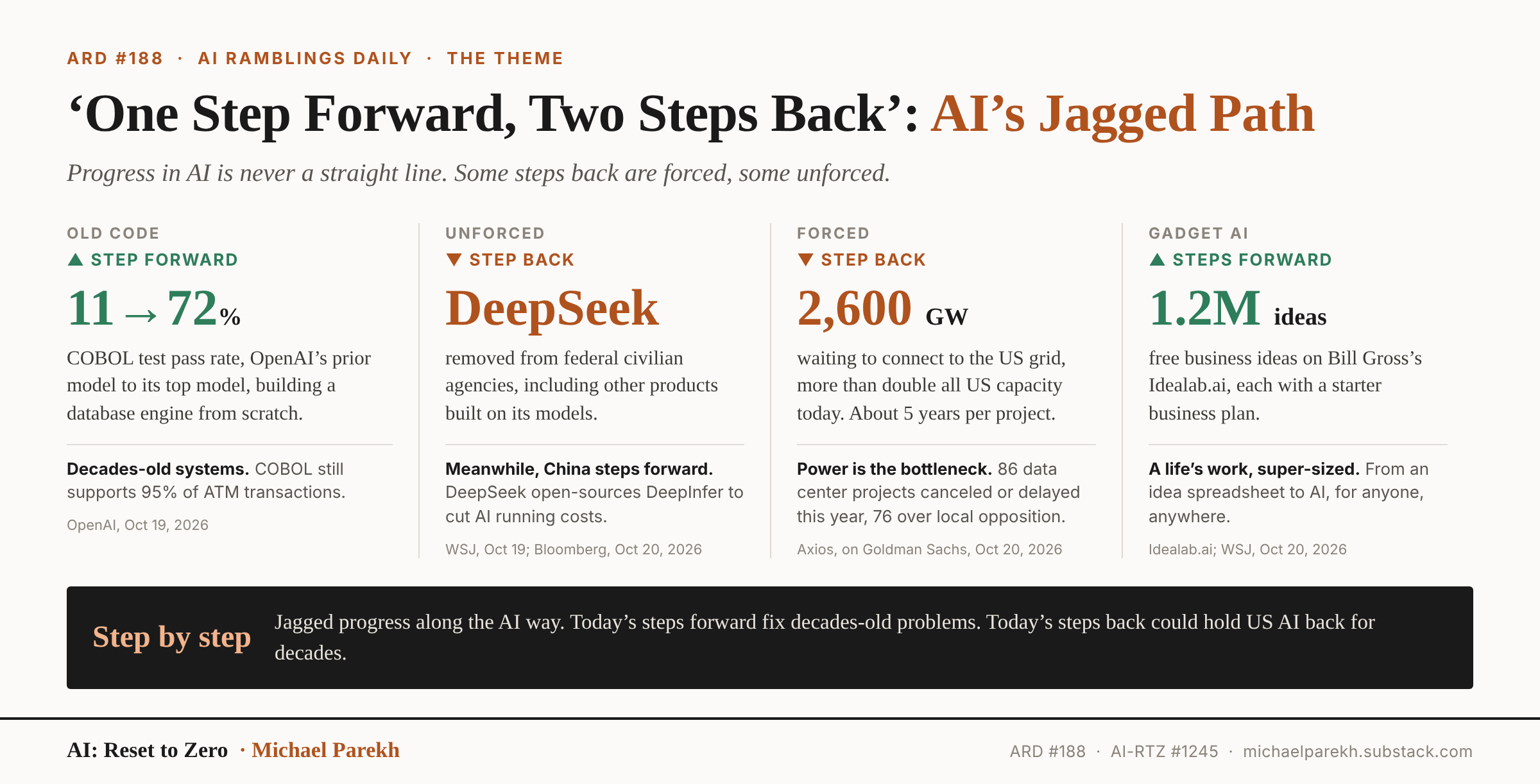
There are three main stories today: OpenAI makes a big advance in working with old computer code that still runs our banks; Washington takes a step backward by restricting China's DeepSeek, even as DeepSeek makes progress; and AI development runs into power shortages once again. Then, in Gadget AI, a good friend uses AI to expand the reach of his life's work.
(1) OpenAI makes a big advance in working with old code.
OpenAI says its newest models are much better at writing code in programming languages that have limited resources available for AI to learn from. It explained this in a post called ‘Advancing coding in low-resource programming languages’. These are often older languages with much less code and documentation available online. Examples include COBOL and Fortran, which date back to the early days of mainframe computing in the 1950s and continued to be used through the 1970s and beyond.
COBOL still supports more than 40 percent of online banking, 80 percent of in-person card payments, and 95 percent of ATM transactions. Fortran is used for weather forecasts and safety analysis at nuclear reactors.
OpenAI created a test in which an AI model had to build a working database engine compatible with SQLite from scratch, using 20 different programming languages. Its top model, GPT-6 Astra, passed about 87 percent of the tests on average. The previous model passed about 27 percent. For COBOL, the score rose from 11 percent to 72 percent, although COBOL remained the hardest of the 20 languages. For Fortran, the score increased from 21 percent to 84 percent. In a second test, the models had to move old COBOL programs into modern programming languages without changing how the programs worked. The newest model got 87 percent right, compared with 5 percent for the previous model, and cost less to run. With more effort, it reached 98 percent accuracy. The details matter. COBOL handles money in a special way, including how it rounds decimal numbers. If this is done incorrectly, the program may run without errors, but the bank's numbers will be wrong. OpenAI says experts must still check code before it is used in real systems. It is also publishing the test on GitHub so others can examine it.
MP Take: I go through these detailed measurements because this work is difficult but important. It shows how AI can help move old code into new systems.
Unlike many other types of computer code, these older languages have less information available online because they were created decades ago, when mainframes were at the center of traditional computing. Remember Y2K? Much of that problem involved these old languages. Retired programmers had to return to work because younger programmers had never learned the old code. They helped fix the problem. OpenAI's approach brings AI models into the huge amount of existing software built with COBOL and Fortran.
OpenAI's progress on this specific problem deserves praise. It is a major step forward for programmers, developers, and the software systems that businesses depend on. It may not be one of the exciting, headline-grabbing things AI can do in the future, but it shows how AI can help us update old code faster. These kinds of business benefits are also an important part of the story behind a possible OpenAI IPO, which I discussed in March in RTZ #1021. This is a worthwhile step forward.
Sources: OpenAI, ‘Advancing coding in low-resource programming languages’.
For longtime readers: RTZ #1021, ‘AI: OpenAI IPO prospects assessed 6 months early’.
(2) Washington takes a step back on DeepSeek, while DeepSeek moves forward.
The Department of Homeland Security has ordered US federal civilian agencies to remove DeepSeek's AI, according to the Wall Street Journal article ‘DHS Orders Federal Civilian Agencies to Remove China's DeepSeek AI’. The order also bans future purchases. It covers more than the DeepSeek app itself: it also applies to DeepSeek's related companies and products made by other companies using its models. The order relies on a 2018 law about supply-chain security, but it does not identify a specific security threat or set a deadline.
Meanwhile, just one day later, DeepSeek made another advance, according to Bloomberg's article ‘DeepSeek Unveils DeepInfer Software to Boost AI Efficiency’. It released DeepInfer as open-source software. This is the software DeepSeek uses to run its AI models in real-world services. The goal is to reduce the computing power and energy needed to run AI. Anyone can use and change the software. Independent tests have not yet been published, but the tool looks promising. This follows DeepSeek's V4 models, released earlier this year, which I discussed in RTZ #1062. For now, these models are open, inexpensive, and a few months behind the most advanced US models.
MP Take: I discussed this just a few days ago. Many companies in the US and other Western countries are eager to use open-source AI and AI models whose internal settings, or weights, are available to others. But one risk is that the government may step in and block or even ban these models. Now the US government is doing this to its own federal agencies. I think this is the wrong direction. Technology from anywhere in the world can be valuable, even when there are political concerns. Open-source AI and AI with open weights let people build on existing models, often with greater control. Developers can create their own applications without being tied to political boundaries. They do not have to send anything back to China. DeepSeek's models are open, so developers around the world, including in the US, can build on them and run them on their own servers, with their own privacy and security arrangements. Open models do not automatically send your data anywhere. A ban that also covers products built using DeepSeek reaches far beyond a single Chinese app.
In my view, the government's actions are a step backward and an avoidable mistake. The US is making global AI progress, the ability of different systems to work together, and the ability to build on any model more difficult. Last summer, I described US-China AI trade problems as ‘two steps back, one step forward’ in RTZ #783. One thing that may ease the pressure is that US companies, from Nvidia onward, are also embracing open-source AI and models with open weights. So progress continues unevenly, with both setbacks and advances. We will see what happens next.
Sources: WSJ, ‘DHS Orders Federal Civilian Agencies to Remove China's DeepSeek AI’ · Bloomberg, ‘DeepSeek Unveils DeepInfer Software to Boost AI Efficiency’.
For longtime readers: RTZ #1062, ‘AI: DeepSeek not faded out in China’ · RTZ #783, ‘AI: Nvidia in China, two steps back, one step forward’ · RTZ #622, ‘AI: A Tale of three ‘Deep AI Reasonings’’.
(3) AI development hits the power wall again.
We have been discussing this problem for months. Now a new Goldman Sachs report examines how much electricity AI will need. Axios covered it in ‘The U.S. power grid is becoming AI's biggest bottleneck’. Goldman expects global data center electricity demand to rise by 170 percent between 2025 and 2030, with more than 60 percent of that increase coming from the US. One Goldman banker calls power the ‘forever bottleneck’. About 2,600 gigawatts of proposed new power capacity are waiting to connect to the grid. That is more than twice the total capacity the US has today. A typical project takes about five years from its initial application to becoming operational.
Since January, 86 data center projects have been canceled or delayed, and 76 of them faced local opposition. Goldman expects data center spending to reach nearly $8 trillion from this year through 2031. Utility companies are expected to spend more than $1 trillion on their own systems through 2030. Debt issued by the largest cloud computing companies could reach $420 billion next year, a 60 percent increase.
MP Take: This is another setback because it is unclear how quickly we can build the power systems we need. Remember, one gigawatt of AI computing capacity, using chips and infrastructure mostly from Nvidia, costs more than $50 billion today and takes two or three years to build. That is the speed at which this industry is changing. China is adding electricity capacity faster, using renewable energy and batteries. In contrast, the US has taken several steps away from solar, wind, and batteries for many political reasons. This makes our path longer and more expensive. I wrote about this in March, after attending a major energy conference in Houston, in RTZ #1042.
The new issue is growing opposition to data centers across the country. This opposition is often based on mistaken beliefs about AI itself, at a time when people in the US have a more negative view of AI than the generally more positive mainstream views in places such as China, other parts of Asia, and India. The issue now crosses party lines, especially with the midterm elections only a couple of weeks away. So progress will likely continue to involve steps forward and backward, with power remaining a major obstacle.
Sources: Axios, ‘The U.S. power grid is becoming AI's biggest bottleneck’.
For longtime readers: RTZ #1042, ‘AI: Update on ‘monster’ US AI Energy & Power needs’ · AI-RTZ #1244, ‘The $10 Trillion AI Build Meets Its Bankers’.
My overall view
MP Take: Progress never follows a straight line. OpenAI's work on older software is a positive development because AI can now help improve and update code that has been difficult to change for decades. China is moving forward, while the US is taking a step backward with restrictions. At the same time, a lack of electricity remains a major obstacle despite the huge expected demand.
Some setbacks are unavoidable, such as limits in power supplies, the electricity grid, and the permits needed to build new projects. Others are choices we make ourselves, such as government policies. Progress can range from small improvements to major leaps. That is how the AI Tech Wave is moving forward: unevenly, one step at a time.
Gadget AI: A good friend uses AI to greatly expand his life's work in technology.
The friend I mean is Bill Gross, who founded Idealab in 1996. He has spent many years building and running companies. Idealab has launched more than 175 companies, including several that became global unicorns, meaning privately held companies valued at more than $1 billion. Now he has turned the methods he has developed over his career into a free AI platform called Idealab.ai. It uses news, research papers, patents, and company filings to generate business ideas. It offers more than 1.2 million ideas, each with an initial business plan. Users follow three steps: tell the platform about themselves, find an idea, and make it their own. Its partners include Imperial College London, Caltech, Arizona State, Cloudflare, and Endeavor. Bill is demonstrating the platform this week, according to the Wall Street Journal article ‘Bill Gross's AI Tool Could Supercharge the Number of Startups’.
MP Take: Business ideas have always been at the heart of Bill's work. I have known him for decades, and whenever I visited him, he had spreadsheets containing dozens, sometimes hundreds, of ideas. He ranked them by how excited he was about pursuing them. I will never forget when he showed me an interesting idea: letting people bid for search keywords. I wrote about it in RTZ #566. He created a company called GoTo.com, which became Overture and was later bought by Yahoo. The idea developed further into the search advertising systems used by Google, one of the internet's most important business models. When I first saw the idea, it was on a spreadsheet on Bill Gross's office computer.
It is exciting to see my good friend use AI to expand this work so greatly. He has turned his collection of ideas into a website where anyone can explore many different possibilities. As Bill himself would say, coming up with ideas is relatively easy; what matters is carrying them out and building something from them. Now he is making this resource available to the world, almost like an open-source project. This could help countless people take steps forward. I applaud Bill Gross for doing this, and encourage interested readers to take a look.
Sources: Idealab.ai · WSJ, ‘Bill Gross's AI Tool Could Supercharge the Number of Startups’.
For longtime readers: RTZ #566, ‘AI: Where “we're going we don't need Browsers”’.
Q&A
What is the one advance in AI that excites me most right now?
I am most excited about the growing use of AI agents by everyday consumers. I have talked about this a lot, including Meta's Muse efforts, Dots from OpenAI, and Google's plans for Gemini. I am excited about the many experiments from Apple, Google, and new startups. I use these tools every day. There are many advances and setbacks, and many more versions to come. None of these tools has the perfect user interface yet. Their creators are still working out how to make them easier to use. But it is exciting to be here in the early days.
What is the biggest mistake most AI agents are making?
I have long opposed making AI seem more human than it really is, and I have written about this many times over the past few years. One problem is the use of cute mascots that make AI agents look and act like little characters people can relate to and form emotional bonds with. I understand why companies do this: it can make AI easier for ordinary users to connect with. But AI is machine intelligence, not human intelligence. I would prefer to see future versions that do not try so hard to look human. They should be more like the computer in Star Trek, rather than a cute character jumping up and down in front of me. This also applies to Clippy, the help assistant Microsoft introduced decades ago.
Clips from today
Washington's step back on DeepSeek
The Department of Homeland Security has ordered federal civilian agencies to remove DeepSeek's AI. The order also covers products built using its models, not just the app itself.
MP Take: One risk of using open AI models from China was always that the government might step in. This is a step in that direction.
AI hits the power wall again
Goldman Sachs expects global data center electricity demand to rise by 170 percent by 2030. More than twice the total power capacity of the US is waiting in line to connect to the grid.
MP Take: Building one gigawatt of AI computing capacity costs more than $50 billion and takes two or three years.
Bill Gross uses AI to expand his collection of ideas
Idealab founder Bill Gross has turned the methods he developed over his career into Idealab.ai, a free AI platform offering more than one million business ideas.
MP Take: GoTo.com began with an idea on one of Bill's spreadsheets. Now he is making his collection of ideas available to everyone.
The AI advance that excites me
The AI advance that excites me most is the growing use of AI agents by everyday consumers.
MP Take: None of these tools has the perfect interface yet, but it is exciting to be here in the early days.
Today's AI-RTZ #1245, ‘AI Loops 101 (Part 2). From GPT-1 to a GPT-6 Octillion’ explores the huge amount of mathematics behind GPT models, from GPT-1 to GPT-6 and what may come next. I have worked hard to make the numbers easier to understand. Please take a look; there are a couple more parts to come.
AI Ramblings Daily on AI-RTZ is a place to think through AI and take a fresh look at it together.
Tomorrow, we will publish ARD 189 and AI-RTZ #1246.
Thanks for joining us, AI Curious Folk. Stay tuned.
Full source reading
Old code, new AI
The US, China, and DeepSeek
WSJ, ‘DHS Orders Federal Civilian Agencies to Remove China's DeepSeek AI’, Oct 19, 2026
Bloomberg, ‘DeepSeek Unveils DeepInfer Software to Boost AI Efficiency’, Oct 20, 2026
The power wall
Gadget AI
Earlier articles
AI-RTZ #1245, ‘AI Loops 101 (Part 2). From GPT-1 to a GPT-6 Octillion’
RTZ #1042, ‘AI: Update on ‘monster’ US AI Energy & Power needs’
RTZ #1021, ‘AI: OpenAI IPO prospects assessed 6 months early’
RTZ #783, ‘AI: Nvidia in China, two steps back, one step forward’
ARD #187, ‘The Art of the AI Deal’. Anthropic, OpenAI & Microsoft

(NOTE: These discussions are for information only and are not investment advice. Thank you for joining us.)