
Machine learning reveals potential warning signal for polar vortex disruptions
October 20, 2026
by Nathaniel Scharping, Eos
The polar vortex is a large swirl of cold air that circles the North Pole. Sometimes, it is disrupted by events called sudden stratospheric warming (SSW). During these events, very cold air can move farther south than usual. Temperatures across North America and Europe can drop sharply. But these events are still difficult to predict, so it is hard to warn people when an SSW event is about to happen.
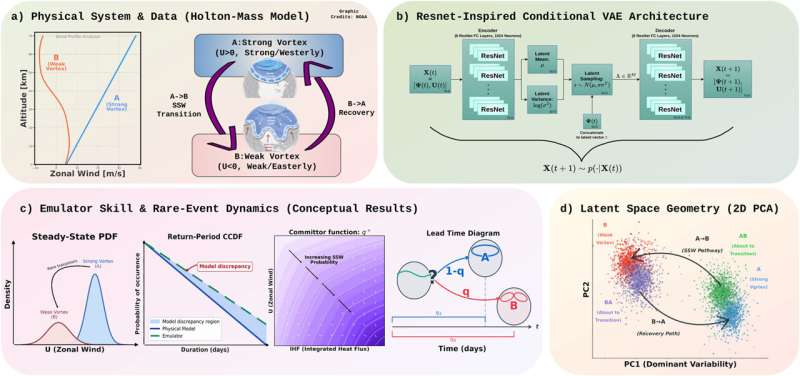
Boscu and his team used a machine learning (ML) method to learn how SSW events behave. They trained the system using a computer simulation based on the laws of physics. The simulation recreates important movements in the atmosphere and makes it possible to run polar vortex simulations faster. The researchers also studied the ML model itself to understand how it represents different features of the polar vortex. Their findings were published in the Journal of Geophysical Research: Machine Learning and Computation.
The researchers trained their model using the Holton-Mass model, which simulates changes in the stratosphere, a layer of Earth's atmosphere. This model produces two states in which the polar vortex can remain stable for a time: a strong state and a weak state. When the vortex changes from the strong state to the weak state, an SSW event occurs.
First, the researchers checked that their model, which uses a method called a conditional variational autoencoder, could reproduce both the strong and weak states. They then used a method called principal component analysis to better understand how the model represented these states. They found four groups of patterns that scientists could explain using physical processes. These groups represented the strong and weak states, as well as the paths the system follows when changing between them.
The researchers say these groups contain a clear signal that can predict whether a polar vortex disruption is about to happen. This finding suggests that scientists may be able to adapt the ML model to better predict when future SSW events will occur in the real world. The study also shows, they add, that artificial intelligence can help scientists model and understand complex features of the atmosphere.
More information
C. Daniel Boscu et al., AI Emulation of Stochastic Sudden Stratospheric Warming With Interpretable Latent Structure, Journal of Geophysical Research: Machine Learning and Computation (2026). DOI: 10.1029/2026jh001387
Provided by Eos