
OpenAI buys Orchestra Bio to add workflow agents to its drug-development stack
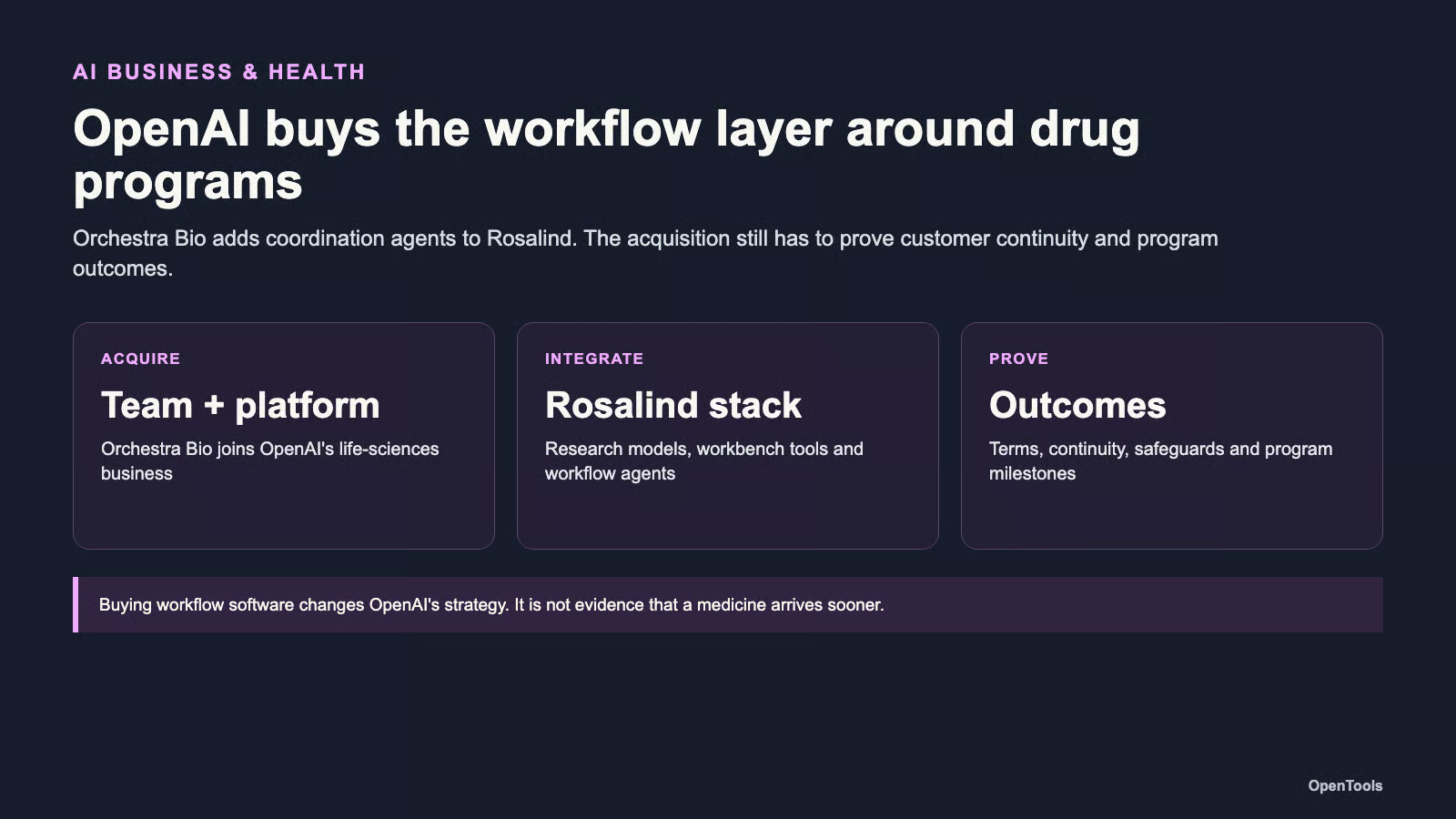
OpenAI has bought Orchestra Bio and plans to add its software for organizing drug-development work to Rosalind, GPT-Rosalind and Rosalind Workbench. The deal expands OpenAI's work from research models into the systems that help manage the process of developing medicines. However, the purchase price, plans for existing products and any effect on how long it takes to develop treatments have not been shared or proven.
The purchase adds tools for coordinating drug programs to Rosalind
OpenAI announced on October 20 that it had bought Orchestra Bio, a platform designed to organize and coordinate drug-development work. OpenAI says Orchestra's team and technology will become part of Rosalind, its family of products for life sciences. The companies did not share the financial terms. TechCrunch also reported the acquisition independently.
Rosalind already includes GPT-Rosalind, which helps reason about biology and chemistry, and Rosalind Workbench, which connects AI models to scientific tools and data. Orchestra adds another layer: it tracks the studies, work plans, dependencies and decisions needed to move a possible medicine through a long development program.
This means the deal covers more than updating an AI model. OpenAI is buying software for managing work and a team with specialist knowledge. It is not relying only on partnerships or general-purpose AI assistants to enter the business of running drug-development programs.
Orchestra's AI agents track work while people make decisions
OpenAI describes Orchestra as a workspace where people can ask AI agents to monitor and track work. For example, if a manufacturing batch fails, an agent could identify which studies and schedules might be affected, gather useful information and compare possible responses. Scientists and program leaders would still decide what to do next.
This distinction matters when developing medicines. Finding out which tasks are affected is mainly a matter of gathering and organizing information. Deciding whether to change a study, supplier or clinical plan can have scientific, regulatory, financial and patient-related consequences. OpenAI's announcement does not say that Orchestra's agents have independent authority to make these decisions.
A useful system would keep links to the original information, show which versions of documents are current, identify the people responsible for each task and record how each recommendation led to a human decision. It should also be tested to see whether it misses important connections between tasks or sends false alerts. Testing should measure more than just the time saved.
The deal leaves important business questions unanswered
Neither OpenAI's announcement nor the independent report reviewed for this article states the purchase price. OpenAI also has not said how many customers Orchestra currently has, whether existing contracts and product access will stay the same, or when the combined features will become available to Rosalind users.
These details will help show whether the deal is mainly about hiring a team, adding a product to Rosalind or expanding OpenAI's business more broadly. Before customers move records from regulated drug-development programs into the combined platform, they need clear information about how data will be handled, which outside companies may process it, how user identities and access will be controlled, how long data will be kept and how customers can export their data.
The deal also means that more parts of the life-sciences work process may be handled by one company's products. This could reduce the effort needed to connect different systems, but it also makes it more important for customers to be able to move their data, choose different AI models and leave the platform if needed.
Better coordination does not prove that medicines will be developed faster
OpenAI says that developing a medicine takes about 10 to 15 years on average, from finding a biological target to getting approval from US regulators. The company presents AI agents for managing workflows as a way to reduce the problems caused by disconnected systems and delays. This time range comes from OpenAI as background information; it is not a result of the acquisition.
To show that the system helps, researchers would need to make clear comparisons. These could measure whether fewer connections between tasks are missed, review periods become shorter, more milestones are completed on time or less work has to be repeated in similar drug-development programs. Understanding effects on patients would take longer to study, because faster coordination inside a company does not prove that a medicine is safe, works well or will receive regulatory approval.
The acquisition shows where OpenAI wants to compete: in research and scientific reasoning, scientific tools and the day-to-day management of drug-development programs. The real value of the deal will depend on how the products are introduced, whether existing customers can continue using them, what safeguards are in place and what measured results the programs achieve. Those results have not yet been made public.
Figure by OpenTools Team; no expressive material from third parties was used. The figure separates the acquired workflow tools from their integration and evidence of outcomes.
Sources
- 1.TechCrunch independently reported the acquisition (techcrunch.com)
- 2.OpenAI's announcement (openai.com)