
Claude Designs 310,000 Novel Proteins in Just 64 Hours: 17 Successfully Verified by Experiments
AI is now being used in pharmaceutical research not just to study molecules on computers, but also to help test them in real laboratories.
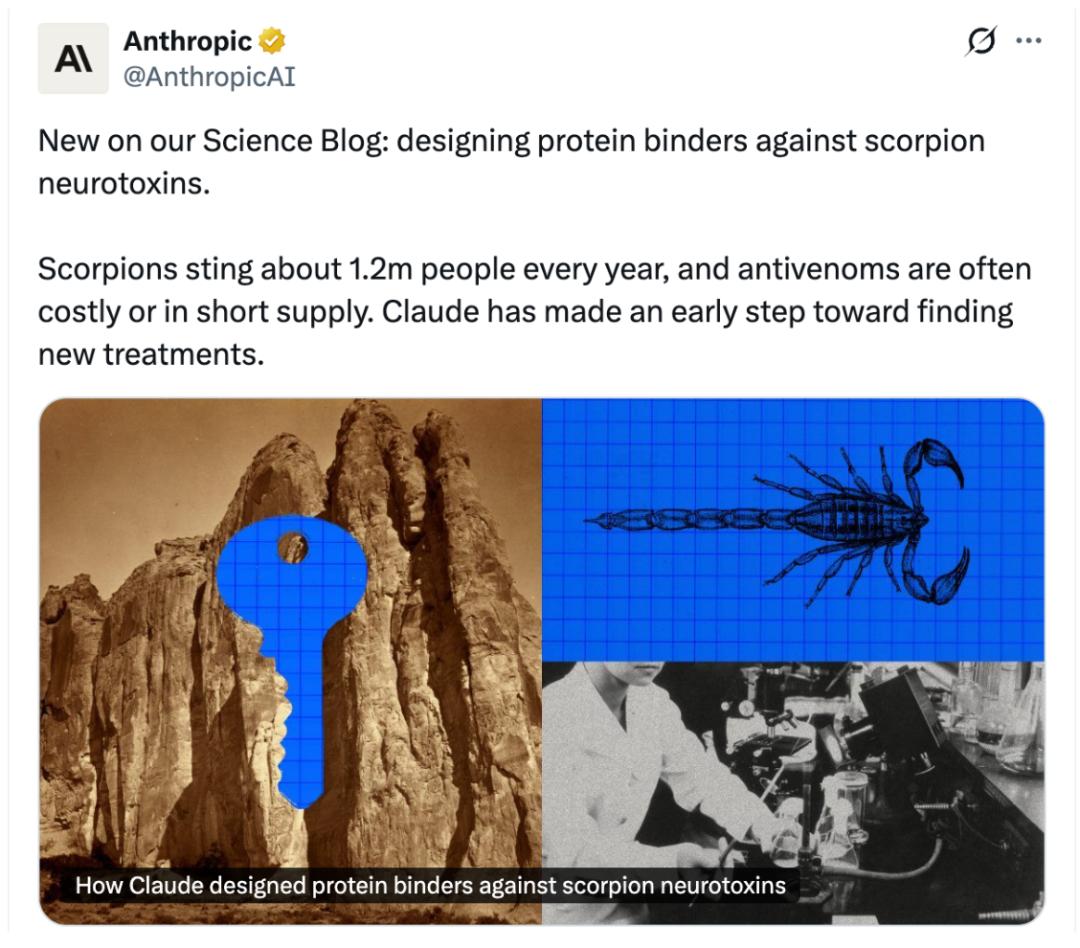
Anthropic recently shared a biological research result: Claude designed 318,484 proteins in 64 hours to find possible molecules that can bind to neurotoxins in scorpion venom.
Anthropic said that about 1.2 million people around the world are stung by scorpions each year. Antivenom treatments can also be expensive or hard to find. Using Claude to design proteins that bind to scorpion venom neurotoxins could be an early step toward exploring new treatments.
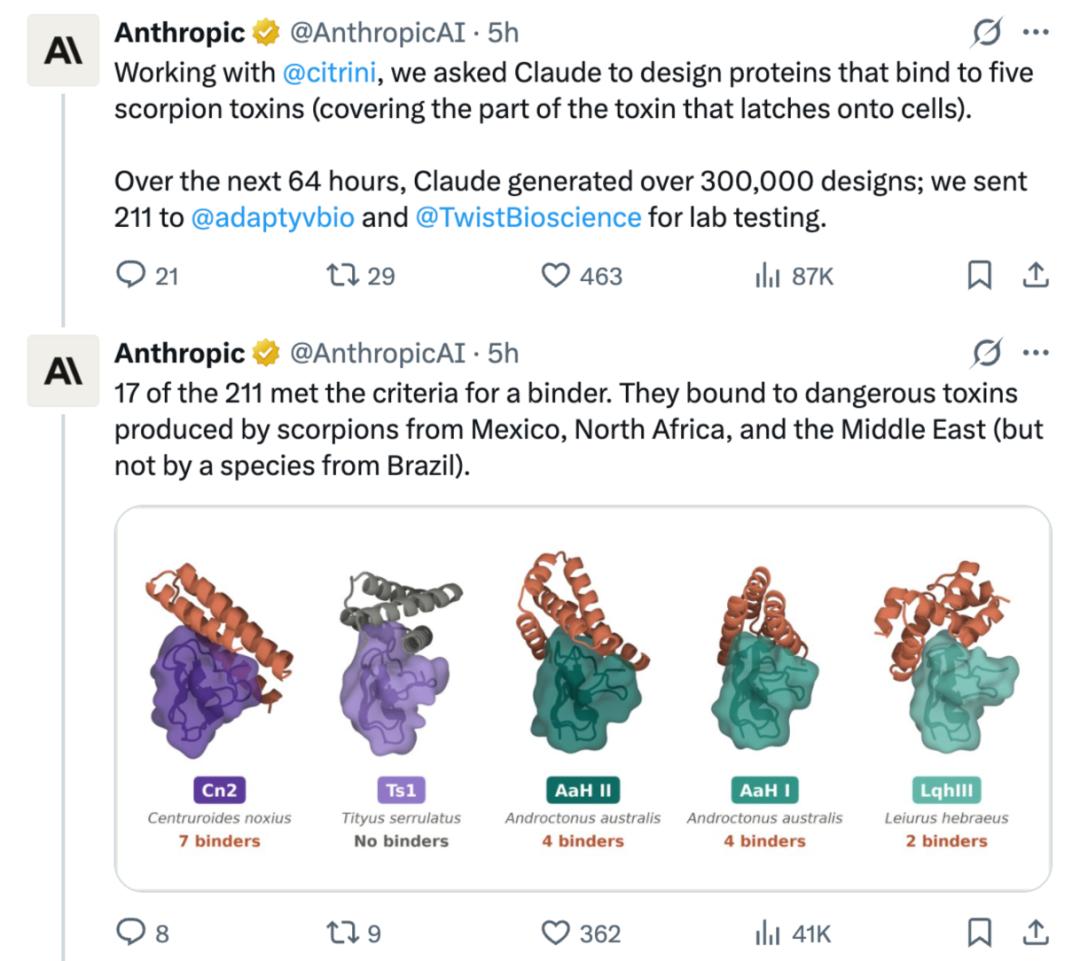
The research team selected 211 possible proteins from the 318,484 designs and sent them to laboratories for testing. Seventeen passed the team's preset tests for binding to their target toxins. These molecules may help researchers develop new treatments for scorpion venom poisoning.
The experiments only showed that these proteins could bind to the target toxins. They did not prove that the proteins could neutralize the toxins or protect living organisms from them. What makes this research especially notable is that Claude helped not only design proteins, but also select and screen possible candidates. AI took part in a larger part of the research process, from creating molecules to checking them in the laboratory.
Here are the details.
318,000 Protein Designs, 17 Pass Laboratory Tests
Why did the researchers choose scorpion venom?
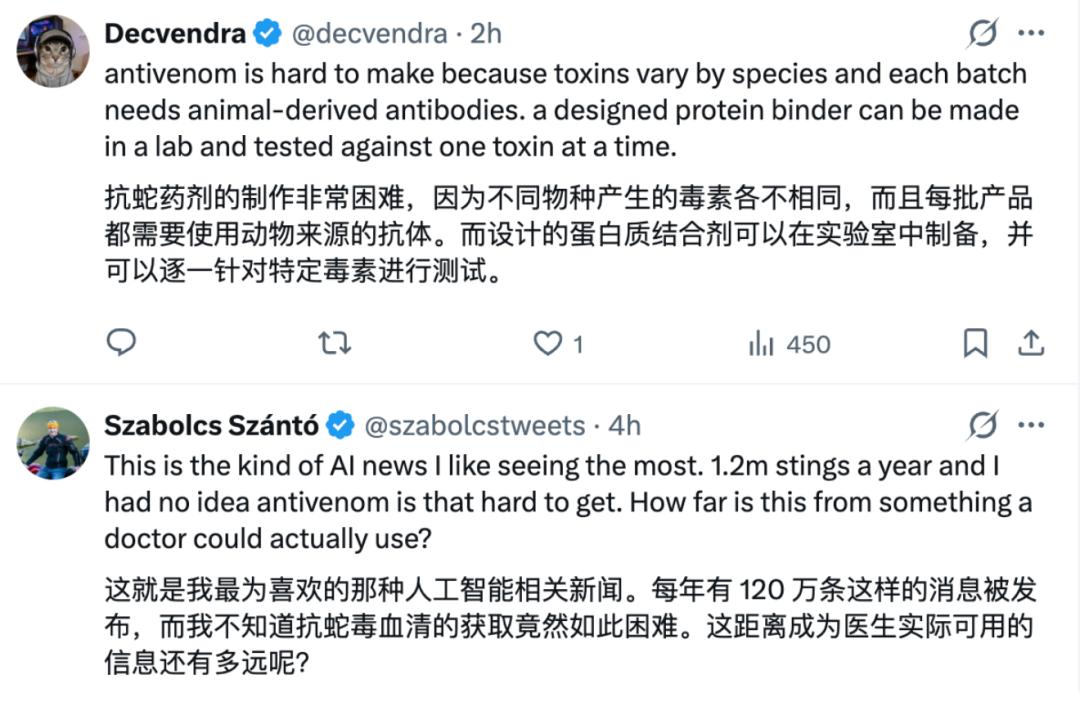
More than 1.2 million scorpion stings occur around the world each year, causing more than 3,250 deaths. Traditional antivenom is made by immunizing animals. It can be expensive, and each treatment may work against only a limited range of toxins. As a result, scorpion venom poisoning has long been a public health problem that has not received enough research and development investment.
Anthropic worked with the investment research firm Citrini Research to see whether AI could design small proteins from scratch that bind to scorpion venom neurotoxins. These proteins are called minibinders.
In simple terms, some neurotoxins in scorpion venom attach to sodium channels on the surface of nerve cells. These channels help nerve cells send signals. When the toxins interfere with them, the body may not work properly. In severe cases, this can lead to heart failure and fluid buildup in the lungs, known as pulmonary edema.
The researchers thought that if they could design proteins that accurately attach to the part of a toxin that interacts with sodium channels, the proteins might stop the toxin from working.
The experiment focused on five neurotoxins found in scorpion venom from Mexico, Brazil, North Africa and the Middle East. They were Cn2, Ts1, AaH I, AaH II and LqhIII.
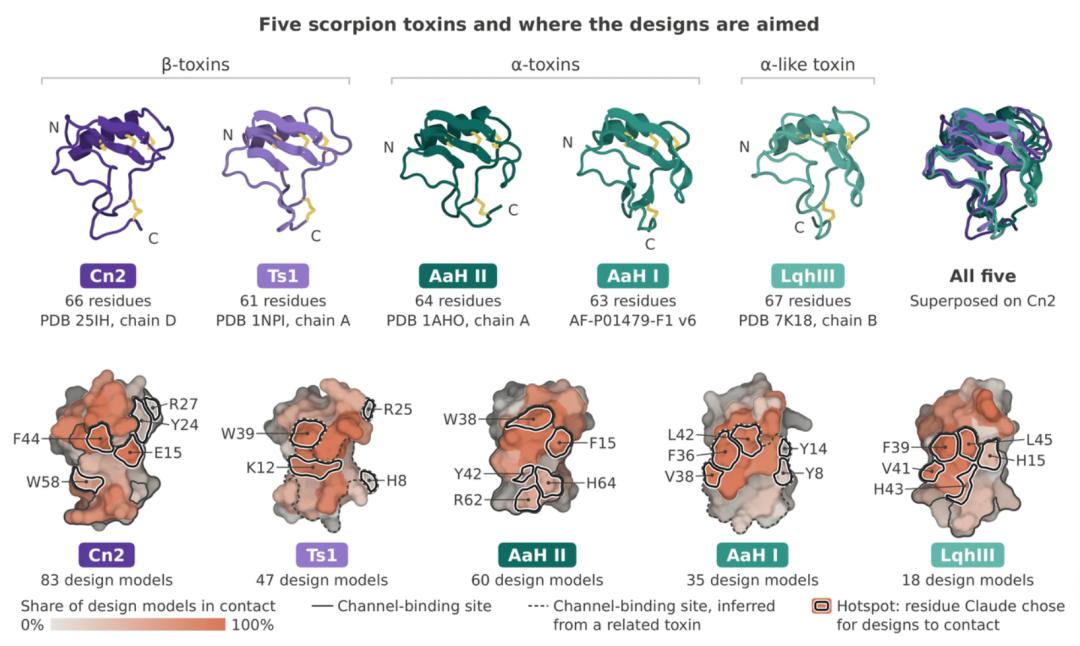
Claude studied the structures of these five neurotoxins and identified important places where other molecules might bind to them. It then designed possible binding proteins. The image above shows the three-dimensional structures of the toxins, while the marked areas below show the regions Claude chose as possible binding sites.
Claude created 318,484 possible protein designs and selected 180 of them. With Claude's help, the research team added another 31 candidates, bringing the total to 211. These proteins were sent to two laboratories, Adaptyv Bio and Twist Bioscience, for testing.
In the end, 17 designs met the research team's requirements for binding to the target proteins.
Of these, seven could bind to Cn2, four to AaH I, four to AaH II, and two to LqhIII. None of the designs targeting Ts1 passed the tests.
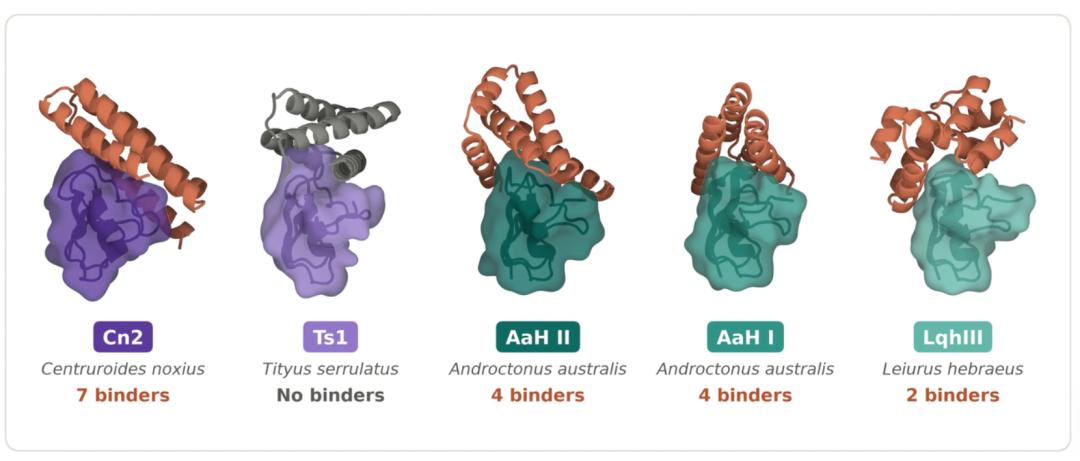
This image shows the proteins Claude designed for the five scorpion venom neurotoxins and the laboratory test results. Seven proteins passed the binding tests for Cn2, four each for AaH I and AaH II, and two for LqhIII. No protein designed for Ts1 passed the tests.
Two of the most notable candidates in the study were designed to target the Cn2 toxin. They are called Cn2-B1 and Cn2-B2.
Both bound strongly to the toxin in experiments. Their dissociation constant, called KD, was in the single-digit nanomolar range. A lower KD usually means that a molecule binds more tightly to its target.
The researchers also carried out competitive binding tests.
They found that Cn2-B1 and Cn2-B2 might bind to the same location as, or a nearby location to, a known antibody called LR that can neutralize toxins. Earlier studies had shown that LR could neutralize the Cn2 toxin in mice.
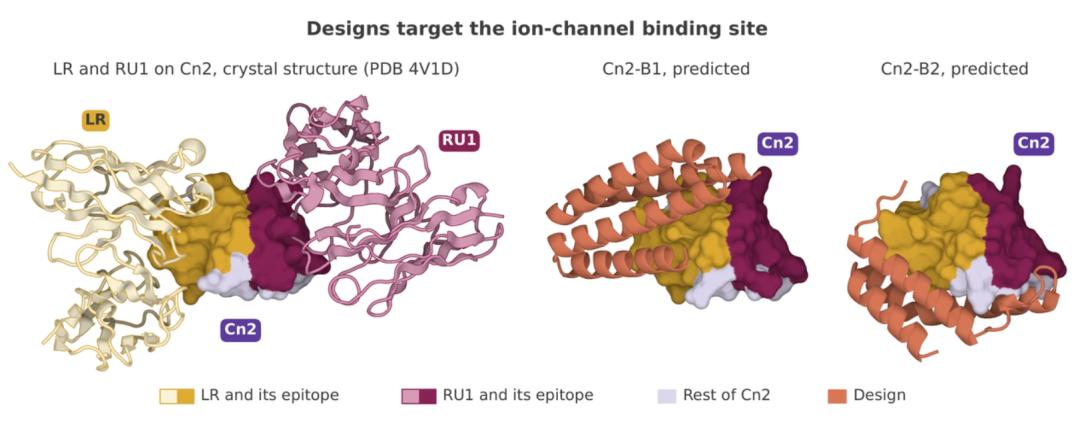
This image shows predicted binding structures for Claude's Cn2-B1 and Cn2-B2 proteins and the Cn2 scorpion venom neurotoxin. Both proteins are predicted to target an important region where the toxin binds to ion channels. The image also compares their binding sites with those of the known antibodies LR and RU1.
This suggests that the two proteins designed by Claude may be useful candidates for further research.
However, it is important to remember that these experiments only confirmed that the proteins could bind to the toxins. They did not prove that the proteins could neutralize scorpion venom.
The researchers have not yet tested whether the proteins can stop the toxins from working in cells. They have also not tested whether the proteins can protect living animals.
Another interesting finding was that Claude had difficulty designing proteins that could target several toxins at once.
The research team had hoped to find general-purpose proteins that could bind to several types of scorpion venom. If successful, this could reduce the number of different molecules needed in a future antivenom treatment.
However, each of the 17 proteins that passed the tests was shown to bind to just one toxin. None met the requirements for binding to multiple toxins at the same time.
Looking only at the proteins specially designed to target a single toxin, 11 out of 60 candidates passed the tests. This was a success rate of about 18%.
Anthropic said this result was broadly in line with the performance of typical protein design research.
The results are still a long way from producing a general-purpose antivenom drug. Even so, the study shows that Claude can quickly suggest many possible protein designs and identify some that can actually bind to their targets in laboratory tests.
What Did Claude Actually Do in 64 Hours?
Traditional protein design requires researchers to use several tools for tasks such as studying protein structures, creating candidate molecules, predicting how well they bind, and screening the results. In this study, Anthropic tried letting Claude organize these tasks on its own.
The research team first told Claude which toxins to target, which tools it could use, and which rules to follow when screening candidates. Claude then found protein structures, chose design tools, set screening criteria, and repeatedly adjusted its designs.
During the process, Claude used 12 protein design tools, created 318,484 candidate designs, and predicted the structures of more than 550,000 possible protein-toxin pairs.
After receiving the initial instructions, Claude worked continuously and independently for 24 hours. The researchers then gave it four more prompts to help improve the designs. The full computer-based design process lasted 64 hours, and Claude ultimately selected 180 candidate proteins.
Claude also handled the task of sending the protein sequences to the laboratories, following the researchers' instructions.
This shows that Claude can take on many research tasks that involve planning, analysis, and coordinating tools. It can also adjust its approach as it receives results during the process.
However, people still played an important role. The researchers set the goals, provided additional prompts, and helped add more designs. Professional laboratories carried out the later work of making and testing the proteins. The 64 hours covered only the computer-based design stage, which used about 10,000 GPU hours of computing time.
This was not Claude's first attempt at protein design. In August of the same year, Anthropic announced another research result: Claude worked on 15 protein targets, and 14 of them produced proteins that were confirmed to bind to their targets in experiments.
Research blog: https://www.anthropic.com/research/Claude-accelerates-protein-design
Compared with earlier studies, this experiment provides more evidence that Claude can coordinate complicated scientific research tasks for specific biomedical problems.
Still, much more work is needed before these results can lead to a real antivenom drug. Anthropic has made all 211 candidate designs and the related experimental data publicly available so that other researchers can continue testing them.
From Protein Design to Drug Development,
AI May Be Taking on More of the Biomedical Research Process
Anthropic's work showed how AI can help design biological molecules. Another biotechnology AI company, Radical Numerics, has taken a further step toward using AI-designed treatments in people.
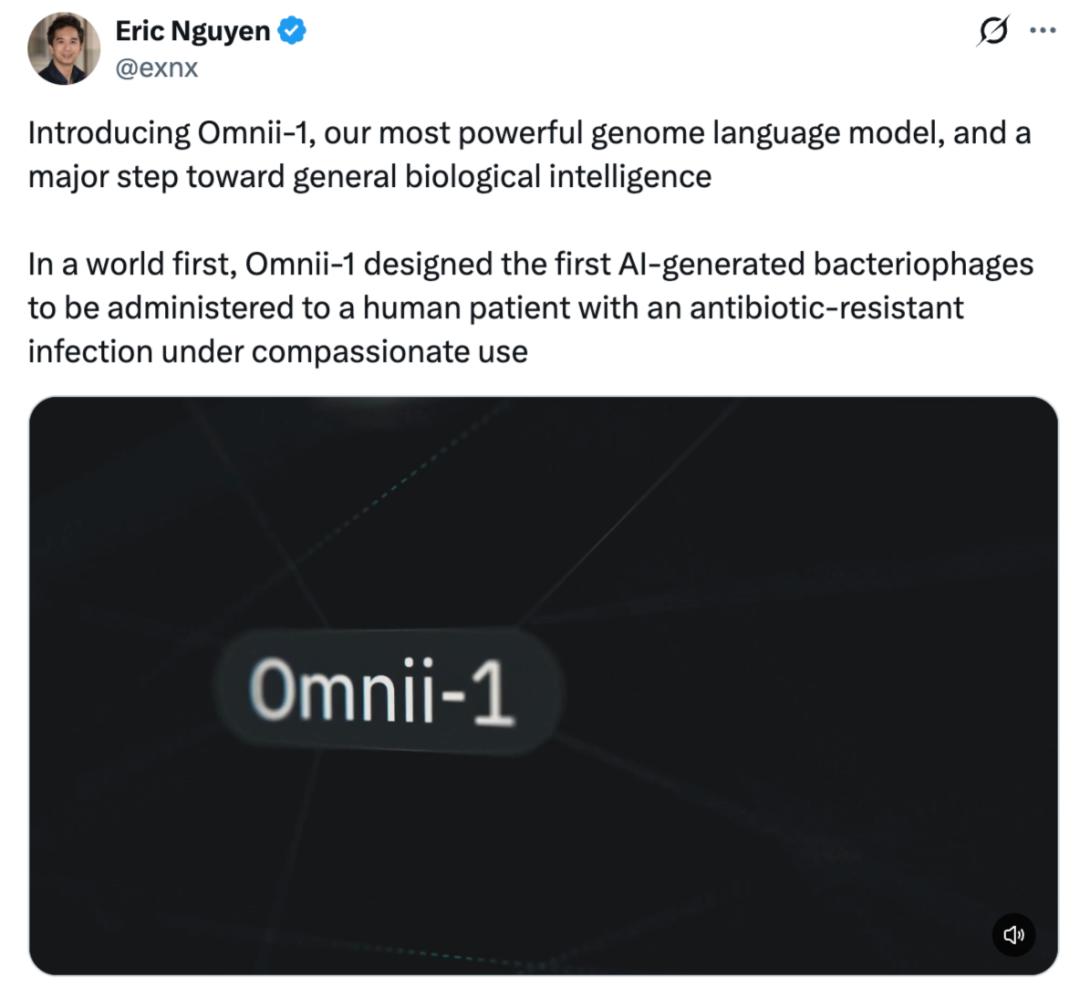
Radical Numerics recently released Omnii-1, a large model for working with genomes. The company also announced that a phage designed by its AI had been approved for compassionate use in a patient with a drug-resistant bacterial infection. The company said the phage had passed laboratory tests showing that it could kill bacteria and had received authorization for treatment of the patient.
Phages are viruses that infect bacteria. Under certain conditions, they can be studied and used as treatments for bacterial infections. They may be especially relevant when usual treatments are limited, such as in infections caused by bacteria that resist drugs.
Unlike designing proteins that bind to toxins, this phage case raises the further question of how biological treatments designed by AI can enter real medical care.
At the same time, OpenAI announced that it would acquire the biomedical AI company Orchestra Bio and bring its team and technology into its life sciences platform, Rosalind.

Anthropic's work focused on showing what AI can do in protein design. OpenAI's acquisition focuses on another complicated part of drug development: organizing and managing research projects.
In April of the same year, OpenAI had already launched GPT-Rosalind, a model designed for life sciences research. It helps researchers work through difficult problems in biology, drug development, and translational medicine, which aims to turn scientific findings into medical treatments. Rosalind Workbench also connects scientific tools and data so researchers can study results and plan experiments.
Orchestra Bio mainly helps biomedical teams coordinate research and development work across different departments, track experiments, and understand how one task depends on another.
For example, a failed batch during drug production could delay the start of later clinical trials. Orchestra's AI agent can help track which tasks are affected, gather related information, and compare possible responses so researchers and project leaders can make decisions.
For OpenAI, this is another step toward using AI not just to analyze scientific questions, but also to help manage the wider drug development process.
Anthropic is designing possible proteins to counter scorpion venom. Radical Numerics is exploring the use of AI-designed biological treatments in patients. OpenAI is working to help coordinate drug research and development. Together, these companies are exploring different parts of biomedical research.
The next challenge is to guide these designs and discoveries through the long process of testing and verification, so they can eventually become safe and effective treatments that help patients.
After all, finding a molecule that might work on a computer is only the beginning of developing a new drug.
References:
https://x.com/AnthropicAI/status/2112579251555721573
https://www.anthropic.com/research/claude-scorpion-toxin-binder-design
https://x.com/ChrisGPT/status/2112616867303178701
https://x.com/exnx/status/2112580926651904379