
Claude Cautious, GPT Daring: AI Risk Tendencies Vary by Task
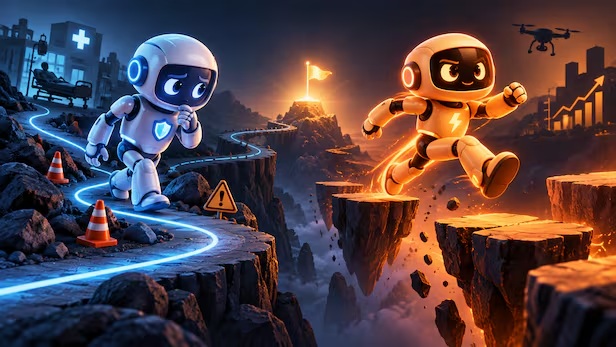
In a city center with strong winds and many obstacles, researchers asked artificial intelligence (AI) to control a drone. Anthropic's Claude Sonnet 4.5 tried to avoid risks as much as possible and put safety first. Grook 4, made by Elon Musk's xAI, took the biggest risks. But the results were different when the AI models had to make stock investments. Grook suddenly became the most careful investor, while OpenAI's GPT-5.2 was the most willing to take risks and invest aggressively.
The research shows that, like people, AI models differ in how they avoid or accept risks. Some models even changed how they handled risk depending on the task, such as healthcare, investing, or controlling drones. Experts say people should consider how willing an AI model is to take risks, along with how smart it is and how well it performs, before giving it a task.
A research team led by Professor Eric Jing Du at the University of Florida compared how willing six major AI models were to take risks. The team published its findings on arXiv, an online website where researchers share scientific papers before formal publication. The study looked at GPT-5.2, Claude Sonnet 4.5, and Grook 4, as well as Google's Gemini 3 Pro, Alibaba's Qwen3-Max, and DeepSeek's V3.2.
The researchers gave the AI models three made-up situations to consider: choosing a flight path for a drone in strong winds with many obstacles, deciding which emergency patients should receive treatment first, and dividing investments between stocks and bonds. They studied how each model judged and handled risks in these situations.
Claude was the most careful when controlling drones and the second most careful in healthcare and investing. GPT showed the opposite pattern: it was the most willing to take risks in healthcare and investing and the second most willing to take risks when controlling drones. DeepSeek, Gemini, and Qwen kept similar positions compared with one another in all three situations. Grook was different from the others. It took the biggest risks when controlling drones but was the most careful in healthcare and investing. This showed that its approach to risk depended on the situation.
The researchers found that the AI models usually made similar judgments when they faced the same situations more than once. They cleared the models' previous conversations to prevent them from remembering earlier answers, then repeated the tests under the same conditions. Claude gave consistent results an average of 99.7% of the time, the highest rate. Grook had the lowest rate, at 80.3%. These results suggest that each AI model has its own pattern for judging risks and deciding what to do.
The team also gave similar tasks to 100 people. The people showed a wide range of attitudes toward risk, from avoiding it almost completely to accepting it readily. By comparison, the AI models' risk-taking tendencies fell into a narrower range of categories. The researchers suggested that this might be related to training data shaped by human judgments, but they said the reason was not certain.
The researchers also found that people had trouble correctly judging how willing AI models were to take risks. Experts reviewed records of the models' decisions without being told the models' names. Their estimates of the risk levels differed greatly from the levels measured in the experiments.
The researchers stressed that people should test how willing an AI model is to take risks before using it for real-world tasks, and should consider this along with its performance. They noted that people might assume AI made by well-known companies is always careful, but some models may be quick to accept risks. They said it is important to understand an AI model's tendencies in advance, especially in areas where mistakes could threaten safety, such as healthcare and air traffic control.