
Artificial intelligence for symptom assessment and patient-reported
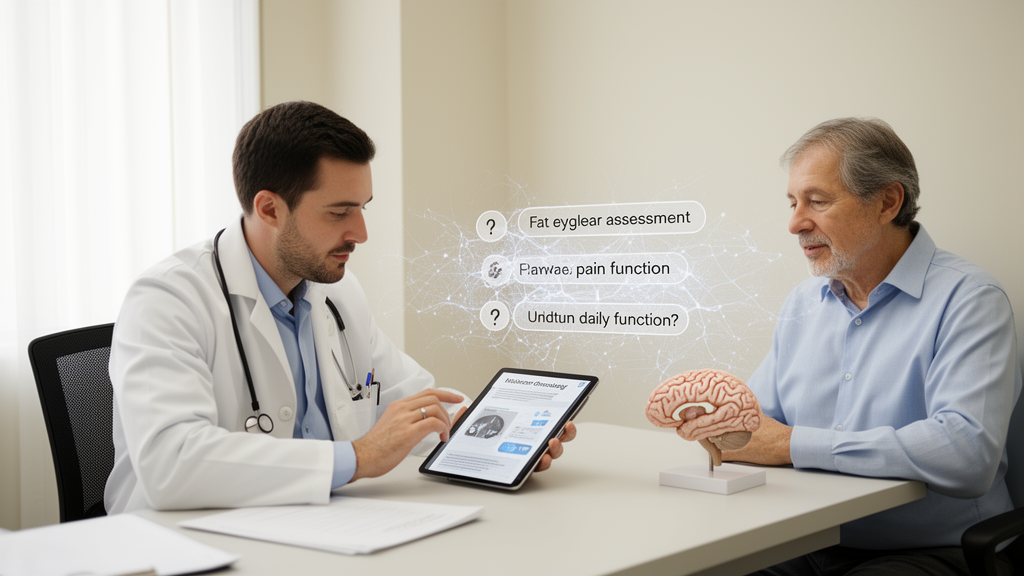
A review of research on artificial intelligence (AI) and patient-reported outcomes in brain cancer care found that machine learning and large language models could help identify symptoms, track how they change over time, and support medical decisions for people with brain tumors. However, there is still limited evidence that these tools improve patient outcomes. The review included 53 articles selected from searches of PubMed/MEDLINE, Embase, and Google Scholar. The researchers looked for English-language studies published between January 2015 and April 2026 and also checked the reference lists of relevant articles. The review focused on symptom assessment and patient-reported outcomes throughout care. It did not cover AI applications for medical imaging, tissue analysis, or genomics.
Most studies in neuro-oncology, the field that treats cancers of the brain and nervous system, examined technical performance, whether a tool could be used, past patient data, or planned research. They did not show that these tools improved patients' health. Patient-reported outcomes, or PROs, are reports that patients give directly about their symptoms, ability to function, and quality of life, without a clinician interpreting the information for them. The review identifies pain, difficulty communicating, how patients judge their own thinking abilities, seizures, side effects that cause symptoms, physical functioning, and the ability to carry out everyday roles as important things to measure in clinical care and trials for high-grade gliomas, which are aggressive brain tumors.
Doctors still rely on measures such as the Karnofsky Performance Status, Neurologic Function Score, and Common Terminology Criteria for Adverse Events. The Mini-Mental State Examination and Montreal Cognitive Assessment are also used to screen thinking and memory through tests of performance. These tools complement patient reports rather than replace them. Studies discussed in the review found that doctors may underestimate how often symptoms occur and how severe they are. At the same time, problems with thinking, language difficulties known as aphasia, and limited awareness of one's own condition can make it harder for some patients to report their symptoms accurately.
Caregivers can report symptoms on behalf of patients, but interpreting these reports adds another layer of complexity. The quality of patient-reported data limits what AI systems can learn. Missing answers, biased selection of who provides data, differences in when assessments take place, and disagreements between patients and clinicians can all distort patterns of symptoms over time, estimates of treatment effects, and predictions made by AI models.
Patients often become less likely to complete questionnaires when they take too much time or effort, when their health gets worse, or when practical barriers make them difficult to complete. In a phase III clinical trial of preventive radiation to the brain in patients with extensive-stage small cell lung cancer, fewer than half of the expected quality-of-life questionnaires were returned at 12 months. This loss of responses is especially important because patients whose health is getting worse are more likely to stop answering. As a result, studies may have less statistical power and produce biased findings.
The review explains that data quality may improve through regular assessment schedules, electronic questionnaires, reminders, staff training, checks on completion rates, and suitable methods for handling missing answers. However, these approaches must account for differences in patients' neurological conditions, communication abilities, and access to technology and care. The strongest evidence that frequent symptom monitoring can improve outcomes comes from research outside neuro-oncology. In a randomized trial at one medical center, 766 patients receiving chemotherapy for metastatic cancer were monitored using electronic patient reports and automatic alerts to nurses. This approach reduced emergency department visits, helped patients remain on chemotherapy longer, and improved survival at one year.
The PRO-TECT cluster randomized trial included 1,191 patients at 52 medical practices. It found that weekly electronic patient surveys improved physical functioning, symptom control, and health-related quality of life after three months. The study included patients treated in different community oncology settings. By comparison, research involving people with brain tumors has mostly shown that these approaches are possible to use. A small pilot study of a smartphone app for patients with glioblastoma showed that health outcomes could be tracked over time, including through reports from caregivers. Another study involving 43 patients with glioblastoma found that electronic assessments using PROMIS and EORTC questionnaires could be completed in a clinical setting.
These studies show that electronic monitoring is practical, but they do not establish the clinical benefits found in broader cancer care research. Traditional machine learning can help analyze large sets of patient-reported data collected over time, even when the data come in different forms. It learns patterns from examples rather than relying only on fixed rules. Early research predicting health-related quality of life after surgery to remove low-grade brain tumors used support vector machines and random forests. Using routine information collected around the time of surgery, these models achieved areas under the curve above 0.90 for most symptom outcomes. This measure indicates how well a model distinguishes between different outcome groups.
A systematic review of machine-learning methods for predicting cancer symptoms found that relatively few studies modeled how symptoms changed over time. It also found no studies in neuro-oncology. Natural language processing, a type of AI that works with human language, can extract organized information from free-text clinical notes. These notes are a large source of medical information that has not yet been fully used. However, applications designed specifically for neuro-oncology remain limited. Many natural language processing systems also need people to create extensive rules by hand and provide specialist knowledge, which can make the systems harder to adapt to different care settings.
Large language models may allow researchers to analyze a wider range of information. In one study, researchers examined 51,541 neuro-oncology clinical notes from an electronic health record. The model GPT-4o extracted information about nine symptom groups, with average sensitivity and specificity of 0.97. Sensitivity measures how well a system identifies cases that are present, while specificity measures how well it identifies cases that are absent. The model found an average of 3.92 symptoms in each note. The proportion of patients with recorded symptoms was much higher than the proportions reported in comparable clinical trials.
Patients receiving immune checkpoint inhibitors, drugs that help the immune system fight cancer, had the highest symptom burden. This shows how automatic extraction of information can reveal differences between treatment groups and add to information gathered through planned patient surveys. However, the study did not show that symptoms extracted by AI could predict future worsening in patients with primary brain tumors or replace reports from patients themselves. This difference is important: a patient-reported outcome comes directly from the patient, while a symptom identified and interpreted by a large language model is an AI-derived measure. These two types of information should be labeled and evaluated separately.
Wider reviews of models that use patient-reported outcomes have found problems with testing and putting these tools into practice. A 2024 systematic review of 52 cancer studies found that fewer than 8% of models had been tested using data from outside the original study. Fewer than 6% shared code that other researchers could use to reproduce their results. This was the case even though the number of machine-learning publications using patient-reported data increased about twentyfold between 2011 and 2021. A separate review published in 2025 examined 94 studies that used patient-reported outcome measures, or PROMs, to predict results across different areas of medicine. It found only 10 studies that had tested their models externally and only three that had reached the stage of being used in practice.
The 2025 review also found that researchers handled missing data inconsistently and rarely involved patients or clinicians in developing models. Because the two reviews covered different groups of studies, their findings do not prove a direct change over time. However, they show that researchers have often measured how well models perform without checking whether the results can be reproduced in independent settings.
Neuro-oncology has additional challenges, including differences between diseases and patients, small study groups, and symptoms that some patients may not be able to report. These symptoms can include seizures and neglect, a condition in which a person has difficulty noticing or responding to part of their surroundings. Caregiver reports, wearable devices, and clinical notes can provide useful additional information. However, building a predictive system and successfully adding it to everyday medical care are two different challenges.
A review of clinical decision-support systems for managing cancer symptoms found that only 25.5% were connected to electronic health records and only 18.2% used AI. Most relied on fixed rules rather than models that make predictions from data. The review points to evidence supporting the use of standard terminology, alerts that focus on important information, and a clear plan for what to do whenever an alert appears. Too many alerts that are not accurate enough can cause alert fatigue, meaning that staff may become less likely to notice or act on important warnings. Clinicians may need to check the information themselves when the data are unreliable or when a wrong decision could cause harm.
A separate study examined an automated system in which five large language model agents worked together to identify possible thinking and memory problems in unstructured clinical notes. The system performed about as well as a workflow refined by experts, but it did not perform better on an independent set of validation data. Its structure was easy to inspect, making it simpler to review changes to the prompts that guided the system. In neuro-oncology, a remote-monitoring study for glioblastoma registered in 2023 combines biometric data from Apple Watch devices with symptoms entered by patients or caregivers. A French study of glioma patients, registered in 2026, will assess a platform for monitoring neurological symptoms, treatment tolerance, and quality of life.
These study plans describe research that is intended to take place; they do not prove that the tools work or improve care. Ethical safeguards are especially important for patients whose thinking or ability to make decisions may change over time. Patients need informed consent and clear explanations of when AI is used, what information it processes, how its results might affect their care, and what other options they have.
Clinicians should be able to examine the original report from the patient or caregiver, identify who provided it, and review important interpretations in the context of the patient's situation. If a large language model infers a symptom from a conversation, its output must not be presented as a patient-reported outcome. Rules for protecting privacy and keeping data secure also differ between jurisdictions.
In the United States, a provision of the 21st Century Cures Act allows certain clinical decision-support functions intended for clinicians to fall outside the definition of a medical device regulated by the Food and Drug Administration (FDA), provided they meet specific conditions. One condition is that clinicians must be able to independently review the basis for a recommendation. This does not mean that all AI systems or electronic health record tools are exempt. In the European Union, the General Data Protection Regulation governs how personal and health data are processed. The EU AI Act uses a risk-based approach for qualifying medical devices that use AI. Bias can enter AI systems when study participants do not represent the wider population, clinical language differs between groups, proxy measures stand in for the things researchers want to measure, data are combined in ways that hide important differences, or only selected features are used.
Clinical trials may include too few women and non-White patients to represent the wider population. The way symptoms are recorded can also differ across racial, ethnic, gender, and socioeconomic groups. AI-generated summaries can make this problem worse if they present information from a narrow or biased dataset as though it represents everyone. The review highlights approaches to fairness that call for assessing risks and benefits, formal oversight, and ways for people to challenge or seek correction of harmful decisions. It also discusses proposals to add explainability, or the ability to understand how a system reaches its conclusions, to established principles of bioethics.
Overall, the review concludes that AI and patient-reported outcome systems could help make brain cancer care more focused on patients and better informed by data. However, current evidence is limited by small studies, missing symptom reports, inconsistent measurement methods, and a lack of strong testing in independent settings. Progress will depend on collaboration between multiple medical centers, standardized ways to measure patient-reported outcomes, data systems that can share information, reproducible testing, and broader sources of information, including caregiver reports and wearable devices. To become useful in everyday care, these tools will need to be understandable, connected to electronic health records, and able to provide information that supports action. They must also protect patient consent, privacy, independence, fairness, and clinician oversight.
Subject of Research: Artificial intelligence for symptom assessment and patient-reported outcomes in neuro-oncology
Article Title: Artificial intelligence for symptom assessment and patient-reported outcomes in neuro-oncology
Article References: Yogendran, L. V., Avery, C., Crooms, R. C., Ozair, A., Siegel, C., Guterman, I., Rhee, J. Y., Binder, J., Minor, M., Alder, L., Davis, J., & Sharma, A. (2026). Artificial intelligence for symptom assessment and patient-reported outcomes in neuro-oncology. Journal of Neuro-Oncology, 180(2), Article 26. https://doi.org/10.1007/s11060-026-05832-9
Image Credits: AI Generated
DOI: 10.1007/s11060-026-05832-9
Keywords: artificial intelligence, neuro-oncology, brain tumors, patient-reported outcomes, symptom monitoring, machine learning, large language models, clinical decision support, medical ethics, data bias, Artificial, intelligence