
LG Chem Finds New Drugs with AI and Saves Patients...Clinical Promotion of Anti-cancer Vaccine in 2029
AI to improve patient selection for clinical trials
Personalized RNA cancer vaccine aims to begin preclinical testing next year
 Enlarge photo
LG Chem is expanding its use of artificial intelligence (AI) in new drug development. AI is being used not only to find possible new drugs but also to select patients for clinical trials. The company aims to use AI to identify patients who are most likely to benefit from treatment, increasing the chances that clinical trials will succeed. It is also using AI to develop personalized messenger RNA (mRNA) cancer vaccines.
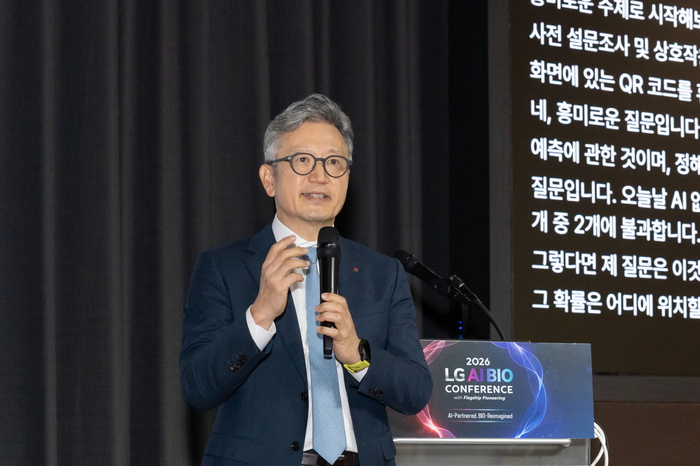
LG Chem announced on the 21st that it held the "2026 LG AI Bio Conference" at LG Science Park in Gangseo-gu, Seoul, on the 20th. The event was organized with the LG AI Research Institute and US biotech venture capital firm Flagship Pioneering. It was the first event of its kind and aimed to build an AI-driven biotechnology innovation community in South Korea and strengthen global cooperation. More than 140 officials from leading AI and biotechnology companies in South Korea and other countries attended.
"AI is becoming a key force that determines competitiveness, rather than just a tool for developing new drugs," said Son Ji-woong, head of LG Chem's Life Sciences Business Division, in his opening speech. "The future of new drug development will depend not only on finding drugs with better structures, but also on using AI to identify patients who are most likely to benefit from treatment."
LG Chem plans to focus on using AI in the clinical development of cancer treatments. Tumors have complex biological features, so the company plans to improve patient selection in clinical trials based on biomarkers, which are signs of changes or conditions in the body. It also plans to make greater use of AI when deciding on treatment strategies. The goal is to use AI to support decisions not only when finding possible drug candidates but also during clinical development, increasing the chances of successfully developing new drugs.
AI is also being used to develop personalized mRNA cancer vaccines. As a key part of its AI drug development project, LG Chem is building and improving an AI model that can accurately predict new antigens that trigger immune responses against cancer cells in individual patients. This approach aims to find the best treatment target for each patient. The company aims to begin full clinical development in 2029, following preclinical studies planned for 2027.
The event also presented examples of AI-based drug development by global biotechnology companies. Andre Andonian, chairman of Flagship Pioneering Asia-Pacific, said, "LG Chem and Flagship Pioneering are expanding their cooperation in life sciences by using AI as a shared driver of innovation."
Zhou Wang, head of global business development at Insilico Medicine, presented a case in which a potential drug discovered using generative AI had advanced to the clinical stage. Ryan Leung, general manager of life science products at Lilah Science, explained the idea of an "Autonomous Lab," where AI agents repeatedly design experiments, carry out chemical synthesis, conduct experiments, and learn from the results.
During a panel discussion, South Korean companies also shared their plans for using AI. Lee Jung-seok, CEO of Inocras, presented a plan to select patient groups using cancer genome data. Na Kwon-jung, chief medical officer of Portray, explained strategies for finding biomarkers and selecting patients using AI technology based on spatial biology.