
OpenAI's Bold Move: Acquires Orchestra Bio to Revolutionize Drug Development with AI Agents
AI in laboratories: OpenAI uses Orchestra Bio to bring order to research. Source: OpenAI / Orchestra Bio
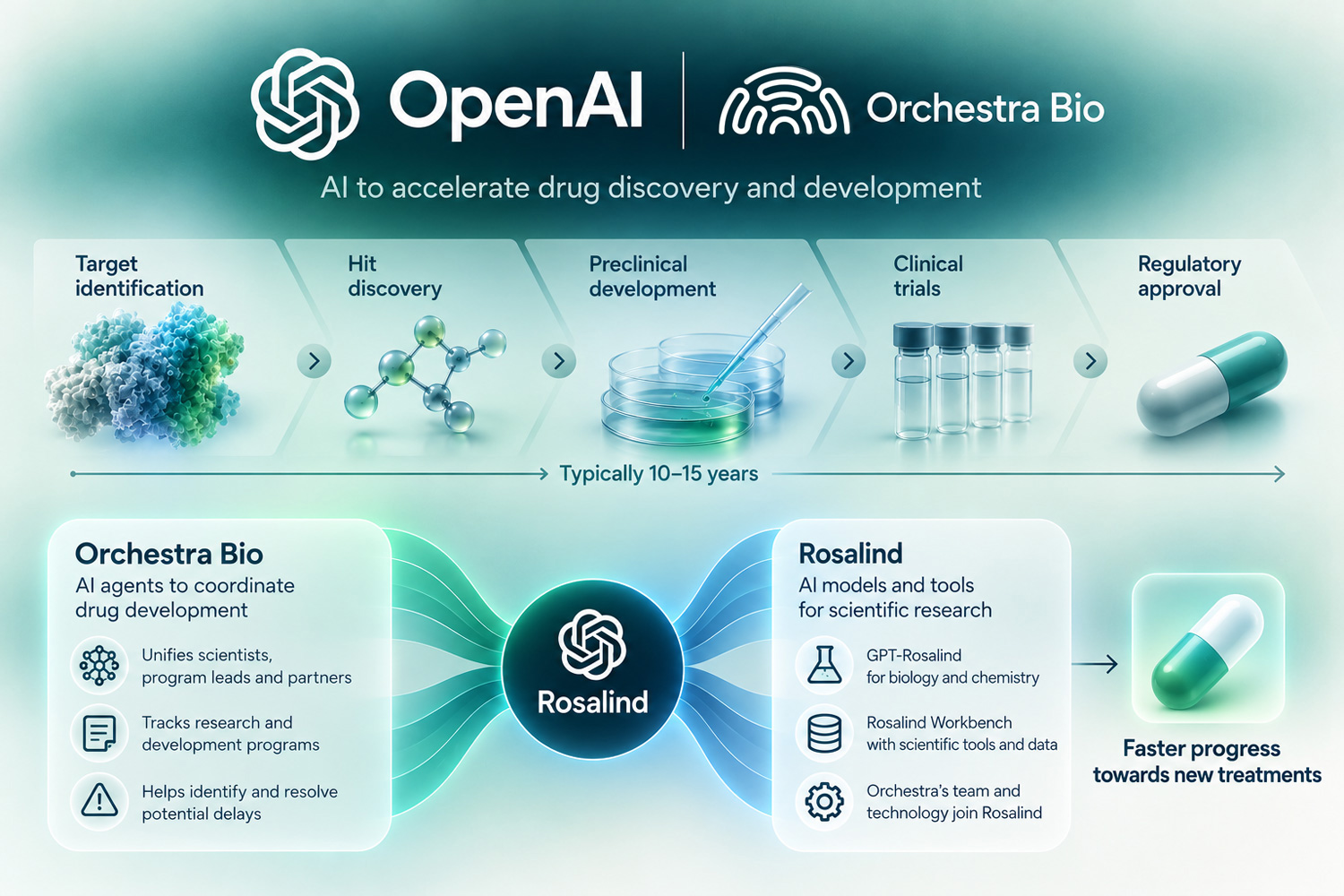
OpenAI is continuing to expand its work in basic science. The company announced that it has acquired the startup Orchestra Bio. The platform aims to make the process of developing new medicines easier to manage by using AI agents, which can help organize complex research work.
An AI Manager for Scientists
The deal took place on October 20, 2026. It is meant to strengthen OpenAI's Rosalind division, an internal team that develops tools for biology and chemistry. Orchestra Bio was founded in 2022 and had raised about $20 million (approximately 900 million UAH) from investors Andreessen Horowitz and 8VC before the acquisition.
Orchestra aims to solve a real problem. On average, it takes 10–15 years to turn a newly discovered molecule into a medicine that people can buy at a pharmacy. Much of this time is spent not on experiments themselves, but on coordinating work between different teams and partners. These groups often use systems that cannot easily work together. Orchestra is designed to connect these processes and help them run more smoothly.
How Orchestra Works
Instead of making scientists fill in endless spreadsheets, OpenAI wants them to hand some tasks over to AI agents. The platform can automatically track research progress. For example, if a batch of a medicine fails quality checks, the system can quickly work out how this might change the clinical trial schedule and suggest possible next steps.
Orchestra will work alongside OpenAI's existing tools:
- GPT-Rosalind — a specialized AI model designed to solve problems in biochemistry;
- Rosalind Workbench — a tool for analyzing genetic information and viewing the structures of biological molecules, introduced in August 2026.
Although AI agents working online sometimes raise concerns among regulators, they could become valuable assistants in laboratories by helping scientists plan experiments.
Big Money and Big Pharma
OpenAI is not the only company betting on the use of digital technology in biology. Its main competitor, Anthropic, acquired the biotech startup Coefficient Bio for $400 million (around 18 billion UAH) in the spring of 2026 . The growing interest is understandable because the market for AI in drug development is expanding quickly. It was worth $6.8 billion (307 billion UAH) in 2026 and could grow to $42.37 billion (1.9 trillion UAH) by 2035.
OpenAI, the company behind ChatGPT, has already built relationships with major pharmaceutical companies. It works with Novo Nordisk and Moderna to help them analyze complex data. As OpenAI and Anthropic prepare for possible cyber threats, their technologies are also gradually becoming part of the foundation for future medicine.