
UTC computer science team’s AI research paper accepted to NeurIPS 2026
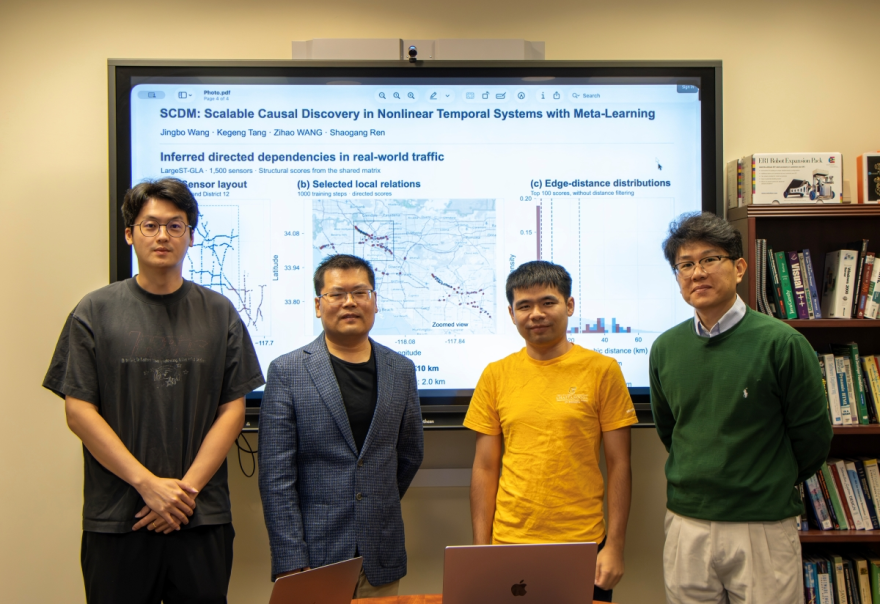
UTC Department of Computer Science and Engineering researchers Jingbo Wang, on the left, Dr. Shaogang Ren, Kegeng Tang and Dr. Zihao Wang stand in front of a presentation about their paper accepted to NeurIPS. The paper is titled “SCDM: Scalable Causal Discovery in Nonlinear Temporal Systems with Meta-Learning.” Photo by Hannah Godel.
A research team from the University of Tennessee at Chattanooga (UTC) Department of Computer Science and Engineering has had a paper accepted for the main program of NeurIPS 2026. NeurIPS is one of the world's leading conferences on artificial intelligence and machine learning.
The paper, “SCDM: Scalable Causal Discovery in Nonlinear Temporal Systems with Meta-Learning,” was accepted to the 2026 Conference on Neural Information Processing Systems (NeurIPS). The conference is scheduled to take place in Sydney, Atlanta and Paris in December.
The UTC authors are Ph.D. students Jingbo Wang and Kegeng Tang, Dr. Zihao Wang, an assistant professor and associate graduate program coordinator, and Dr. Shaogang Ren, an assistant professor and graduate program coordinator.
Ren is the paper's corresponding author. He leads the research team and supervises the project. He recently received a Ruth S. Holmberg Grant for Faculty Excellence.
“We are truly excited and proud to see this work accepted by NeurIPS, one of the world’s premier conferences in artificial intelligence and machine learning, and—to the best of my knowledge—the first NeurIPS paper from UTC,” said Dr. Mengjun Xie, a Guerry Professor, UC Foundation Professor and head of the Department of Computer Science and Engineering. “This research tackles an important challenge in understanding cause-and-effect relationships in large, complex systems while significantly improving scalability and computational efficiency. It is a wonderful achievement for our faculty and students and a strong reflection of the growing excellence and visibility of AI research at UTC.”
For the 2026 conference, NeurIPS received 30,709 valid papers for its main program and accepted 7,900. This means that 25.7% of the submissions were accepted.
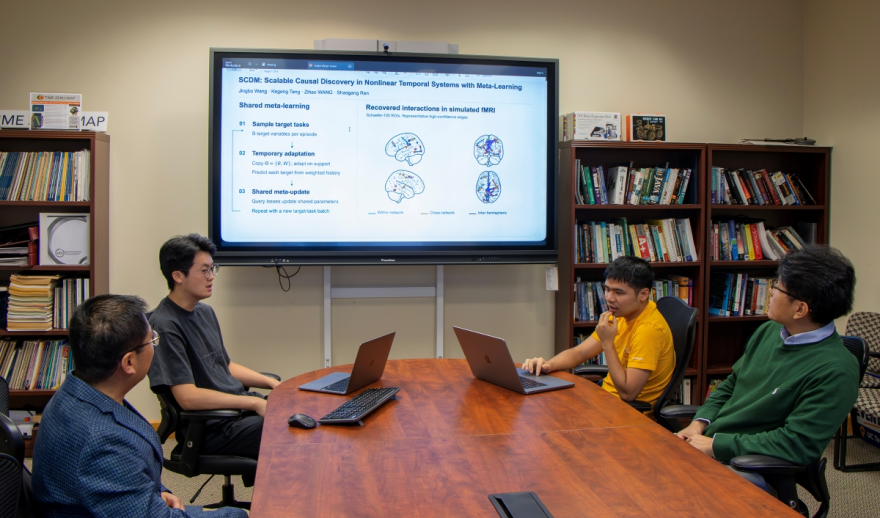
Dr. Shaogang Ren, on the left, Jingbo Wang, Kegeng Tang and Dr. Zihao Wang developed SCDM using meta-learning, an AI method that helps a model learn from related tasks to make its work more efficient. Photo by Hannah Godel.
The paper explains that studying large systems can be difficult because of the huge number of possible connections. For example, a system with 3,000 traffic sensors has nearly 9 million possible cause-and-effect links to consider. Existing methods may need a separate model for each variable or many statistical tests. This can make them too slow or require too much memory when working with large amounts of data.
The UTC team developed SCDM using meta-learning, an AI method that helps a model learn from related tasks. This makes the process more efficient. SCDM treats predicting each variable as a separate task but shares one prediction model and one map that shows how strong the cause-and-effect relationships are across the system.
Instead of processing every variable at the same time, the method uses small, randomly selected groups of data during each round of training. As training continues, it builds a picture of the whole system.
In simulated brain-imaging data based on a standard map of 100 brain regions, SCDM found known connections more accurately than six leading methods. In a larger simulation with about 1 million possible links, it found the correct connections more reliably than a leading recent method while using the same amount of computing time.
The researchers also tested SCDM on data from 3,000 sensors on Los Angeles freeways. It ran about 23 times faster than the method used for comparison and needed about one-fourteenth as much graphics-processing-unit (GPU) memory. The strongest connections were generally between nearby sensors. This was the pattern the researchers expected because traffic jams move along freeways.
This research could help scientists in neuroscience and medicine study how brain regions affect one another in healthy people and people with diseases. It could also help transportation officials understand how traffic jams spread through road networks. The method may also be useful for studying power grids, environmental monitoring, industrial equipment and financial markets. All these areas produce large amounts of data collected over time.
The team's next steps include making SCDM choose its own settings automatically and connecting it more closely with tools that predict what will happen next.
“This recognition from NeurIPS reflects the quality of research taking place at UTC,” said Dr. Kumar Yelamarthi, dean of the UTC College of Engineering and Computer Science. “Drs. Ren and Wang and their students are advancing work with the potential to help people better understand complex systems, from traffic networks to the human brain. Their achievement also shows the strength of UTC’s growing research community in artificial intelligence and machine learning.”