
The Mind-Weapon Panic: From CIA Psychics and UFOs to AI Apocalypse
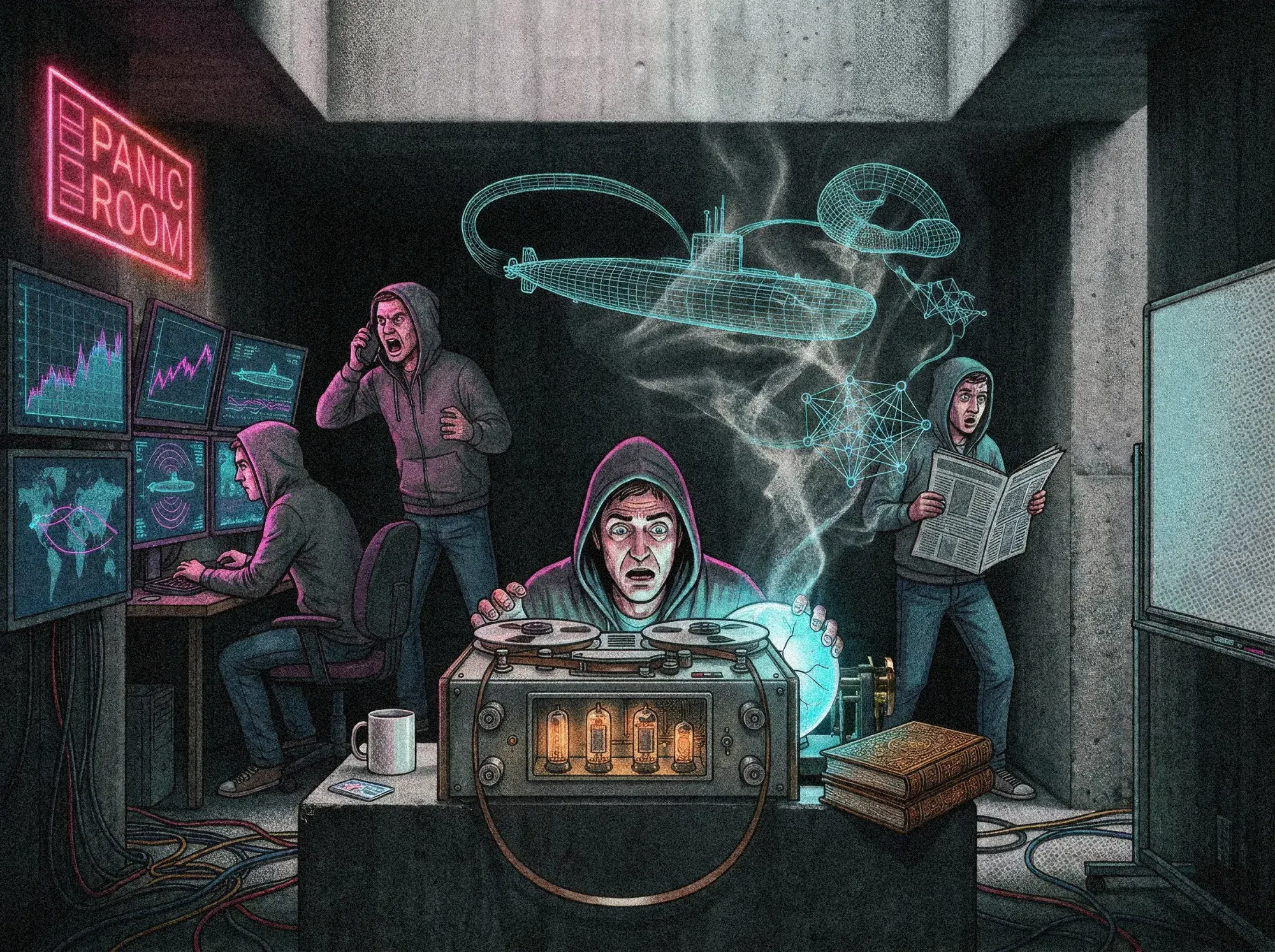
In September 2026, Jacob Coxon, a 27-year-old researcher, resigned from Anthropic and posted several warnings on 𝕏. He wrote that people building the world's most advanced AI systems truly believe these systems could kill everyone by the end of the decade. By the time Axios reported his resignation, more than 115 million people had viewed his post.
Researchers had been making similar warnings for years. What made Coxon's warning different was that he had given up real money to make it. He left Anthropic two months before his company shares were due to become his, giving up a potentially large payout. “I left before any of my equity vested,” he told Axios. “I no longer have anything to gain by juicing up Anthropic’s valuation.”
Coxon was not the only person raising these concerns. Evan Hubinger, who leads Anthropic's Alignment Science team, publicly agreed with him. “We really do earnestly believe AI could kill all humans,” Hubinger wrote. “I personally think it is >10 percent within the next decade.” Bilal Chughtai, a former AI safety engineer at Google DeepMind, resigned in July 2026, saying he believed AI could kill everyone. Joe Benton, another former member of Anthropic's safety team, raised similar concerns. All of these people had direct experience working inside AI laboratories.
Secrecy in the military can create myths that sometimes help justify more secrecy and higher defense spending.
These discussions caught my attention as I was finishing a two-year investigation into government-funded paranormal programs and UFO research in the Soviet Union. The deeper I looked into the archives, the harder it became to tell evidence apart from interpretation. Real observations that had no clear explanation appeared alongside secret aerospace projects. Scientific studies existed alongside deliberate attempts to spread false information. Military secrecy can create myths that sometimes help justify even more secrecy and higher defense spending. Institutions can also mix real information with invented facts, making it almost impossible for independent observers to understand what is actually happening.
Since the Cold War ended, the information environment has become even more complicated. It is filled with carefully constructed stories, conspiracy theories, declining trust in institutions, and competing versions of reality. The response to AI whistleblowers was immediate, but people disagreed about what it meant. Some members of Congress called for new legal protections to control AI development, while others were less convinced.
Critics pointed to a network of organizations that receive funding from one another or share connections. Dustin Moskovitz, an early investor in Anthropic, sits on the board of Coefficient Giving, a grant-making organization formerly called Open Philanthropy. Coefficient is a major funder of the Tarbell Centre for AI Journalism, which supports journalists working at large news organizations. It also funds METR, an independent organization that has evaluated AI systems and worked with Anthropic. These connections invite criticism, but receiving funding does not, by itself, prove that journalists or evaluators have lost their independence.
Anthropic has donated $40 million through two donations to Public First Action, a political action committee known as a super PAC. The group is pushing Congress to introduce new rules for AI. Anthropic's lobbying report from July 2026 showed that the company had spent $2 million on lobbying in just three months, which was $400,000 more than its April report showed. “You get a benefit from regulation because it hinders your competitors,” said James Andrew Lewis, a former U.S. diplomat. Speaking about Anthropic co-founder Dario Amodei, he added: “He might actually believe some of this stuff, but I’d say self-interest really explains it more.” This fight over lobbying raises a bigger question: how can we tell a serious warning from a story that becomes more powerful as institutions react to it?
The AI debate is not the first time a major power has been frightened into action by a threat it could not confirm. The pattern resembles another cycle I found during my research. It began with a disputed story about an American submarine. In July 1958, the USS Nautilus became the first vessel to reach the North Pole under its own power, travelling beneath the Arctic ice. For the Soviet Union, this was a major strategic shock. American submarines could now approach Soviet territory without being seen and operate very close to the country.
In December 1959, a French magazine called Constellation published an article titled “Thought Transfer as a Weapon of War.” Its author, Jacques Bergier, described a secret American program that supposedly tested psychic abilities successfully during the Nautilus mission. According to the story, a mysterious passenger named Jones boarded the submarine and spent sixteen days receiving mental images from a person at the Westinghouse laboratory in Friendship, Maryland. The report claimed that Jones received the images through telepathy with 70 percent accuracy.
The story was probably made up. The U.S. Navy denied it, and the dates did not fit. On the day the experiment was supposed to begin, the Nautilus was in dry dock in Portsmouth. Bergier may have received false information on purpose, or he may have invented the story himself. At the time, the United States was installing new underwater sound detectors. It may have wanted to distract the Soviet Union from this project.
But officials in Moscow did not laugh off the story. Professor Leonid Vasiliev had carried out telepathy experiments in the 1930s, before Stalin stopped the work. He told colleagues that the United States had “adopted telepathy as a means of communication with submarines.” In March 1960, Lieutenant Colonel Igor Poletaev, an expert in cybernetics, sent an urgent report to Defense Minister Rodion Malinovsky. He warned of a “new, unknown psychological weapon.” The Soviet government quickly provided funding for Vasiliev's Laboratory for the Study of Telepathy at Leningrad State University.
Vasiliev's 1962 book, Experiments in Mental Suggestion, became an important early text for the new Soviet approach. Other laboratories soon followed. Dr. Genady Sergeyev worked at an institute connected to the military. He developed sensitive sensors that could study Nina Kulagina, a woman who claimed she could move objects using psychokinesis, or the power of the mind. He filmed her apparently turning compass needles and recorded changes in her brain's electrical activity. James “The Amazing” Randi, a magician, later explained how she might have performed these tricks using magic. At Moscow's A.S. Popov Radio and Technical Institute, engineer I.M. Kogan tried to describe telepathy with mathematical models. He suggested it might work through extremely long electromagnetic waves and treated the human nervous system as a kind of biological radio transmitter.
Meanwhile, Americans watched Soviet research with increasing concern. A 1972 Defense Intelligence Agency report titled Controlled Offensive Behavior—USSR claimed that the Soviet Union had at least twenty centers studying parapsychology. It estimated that the country spent the equivalent of $80 million to $100 million each year on related research. It also warned that the Soviets might soon be able to read secret documents, influence the minds of American leaders, and cause “instant death” from a distance. The report caused panic in Washington.
In response, the CIA started Project SCANATE at the Stanford Research Institute. It hired physicists Russell Targ and Harold Puthoff to run tests. They studied people such as artist Ingo Swann and stage magician Uri Geller. The program went through several code names—Gondola Wish, Grill Flame, Center Lane, and Sun Streak—before finally becoming Project Stargate. Its best-known claimed success came in 1979. A remote viewer named Joe McMoneagle was given the coordinates of a building near a large body of water in northern Russia. He described a huge submarine being built there. He said it had a long, flat deck, two hulls, and twenty missile tubes. The submarine was so large that traditional intelligence analysts believed it could not be launched from that location. McMoneagle predicted that the Russians would cut a channel to the sea within months. In January 1980, spy satellite photographs confirmed the launch of the largest submarine then observed, a Typhoon-class vessel. Its appearance matched McMoneagle's drawing.
When the KGB learned that the Americans had obtained such detailed information without placing any physical agents at the site, Soviet officials drew a clear conclusion: the United States had mastered remote viewing and was forty years ahead of the Soviet Union. In 1989, the Soviet General Staff responded by approving Military Unit 10003, a team of experts and analysts led by Lieutenant General Alexey Savin. Savin was not the kind of person usually associated with telepathy or contact with aliens. He had graduated from the Bauman Moscow Higher Technical School, one of the country's most respected engineering schools. Early in his career, he worked on secret defense projects. He held a doctorate in technical sciences and also studied philosophy. This unusual combination shaped his approach.
Good skepticism means separating the thing being studied from the information system and stories that grow up around it.
Savin was not a cynic. He believed the human brain could reach what he called the “Universal Information Field,” a planetary field of consciousness first proposed by Vladimir Vernadsky in the 1920s. He rejected Western occultism because he considered it elitist and focused too much on the individual. He called his method “metacontact,” a military version of shamanic practices without their religious meaning. It drew on yoga, Buddhist meditation, qigong, and trance techniques from Siberia. These practices were stripped of their spiritual ideas and turned into a method intended for military use.
Savin said his unit achieved extraordinary results using extrasensory perception (ESP), the supposed ability to gain information without using the normal senses. He claimed that his operators remotely viewed a captured American pilot during the 1991 Gulf War. He also said they predicted an earthquake in Kamchatka in 1991 before planned military exercises. According to his account, this helped officials evacuate hundreds of people from the earthquake zone. In another rumored case, his operators supposedly prevented a nuclear disaster near Glasgow, Scotland. They remotely viewed a possible future event and sent their predictions to London through unofficial channels. The most remarkable story linked to Unit 10003 involved supposed contact with a non-human intelligence. The team allegedly exchanged information during organized telepathy sessions. This claim is directly connected to modern stories that link psychic research with UFO beliefs.
In the early 1990s, relations between the United States and Russia improved for a time. Dr. Edwin May, the last director of Project Stargate, first visited Moscow in 1992 with his colleague Larisa Vilenskaya to study ESP research. They met Savin and his team. Their initial distrust gradually faded. In May 2000, Vilenskaya and McMoneagle visited Unit 10003's headquarters in Moscow. One account of the visit says that a Russian psychic named Klimova was asked to copy a drawing made by an American in another room. The two pictures were reportedly mirror images of each other.
Savin later spoke warmly about the Americans. They shared stories, exchanged methods, and eventually contributed to a Russian book titled Psi Wars: West and East. The book credited Edwin May, Joe McMoneagle, Alexey Savin, Boris Ratnikov, and Viktor Rubel as authors. General Nikolai Sham, a former deputy chairman of the KGB, wrote its foreword. Savin even proposed creating a joint Russian-American center that would use their methods to fight terrorism and extremism.
In an interview on the Shawn Ryan Show released on July 22, 2024, Edwin May explained his connection with the Russian team. May recalled that Unit 10003 had about 120 remote viewers, ten times as many as Project Stargate had at any one time. He said he liked Savin's idea of a joint U.S.-Russian program to fight terrorism. May wrote a detailed report of thirty pages and gave it to a three-star general at the Defense Intelligence Agency (DIA) in the Pentagon. May remembered the general calling the proposal “ideal” because it was inexpensive and would not put anyone in danger. May then joked that he could almost hear the report being dropped into a “burn bag,” a bag used to destroy sensitive documents.
Project Stargate was closed in 1995 after an assessment commissioned by the CIA found that remote viewing had not proved useful for obtaining intelligence that could guide real-world decisions. Military Unit 10003 was disbanded in 2003. Officials said it had completed its assigned tasks. However, the decision came after years of public criticism from the Commission for Combating Pseudoscience and Falsification of Scientific Research. Nobel Prize winner Vitaly Ginzburg founded the commission in 1998. The Russian newspaper Izvestia quoted him as saying, “Telepathy does not exist. Remote viewing is a fraud. The sooner we stop funding this nonsense, the better.”
It is difficult to dismiss all American and Soviet psychic researchers completely because Savin and May seem to have sincerely believed in their methods. They also appear to have been willing to set aside Cold War stereotypes about each other. Jon Ronson, author of The Men Who Stare at Goats, which was later made into a major motion picture, recently told the Danny Jones podcast that McMoneagle seemed sensible and humble, not like a fraud. Ronson also said he had no direct evidence that remote viewing worked.
Today, most scientists agree that the evidence for ESP is weak. Some individual experiments and reports of unusual cases exist, but they tend to involve small studies that are difficult to repeat and vulnerable to flaws in how they are carried out. Their results often become smaller or disappear when researchers use stricter controls. In the end, Project Stargate and Unit 10003 both grew out of fears about the other country's supposed progress. Some of the claims behind these fears were exaggerated or poorly tested, but the programs themselves were real and were taken seriously by their governments for a time.
The current debate about AI seems to involve similar fears. Worries about China's progress can influence American investment and government policy, even when the meaning of that progress is uncertain. Coxon himself told Axios that fears about both OpenAI and China can become excessive and can be used to justify moving faster. This does not settle the question of how dangerous AI might be. It shows how competition can turn uncertainty into pressure to act.
The real challenge is to separate genuine evidence of danger from the pressure created when competitors, investors, laboratories, and campaigners react to one another's fears.
The same careful examination should apply to government policies and funding. In June 2026, Anthropic CEO Dario Amodei published an article supporting mandatory safety tests by outside experts for the most advanced AI models. These tests could help address real dangers. However, they could also benefit large, well-established companies with enough money and staff to meet the rules. Licensing requirements and minimum computing-power requirements could have similar effects. A rule can improve safety and also give a company a competitive advantage. We therefore need to ask who sets the standards, which companies can meet them, and how independent reviewers are chosen. Similar questions apply to funding. Dustin Moskovitz's role, Coefficient Giving's support for the Tarbell Centre, and funding links to AI evaluation raise possible conflicts of interest that should be made public and investigated. Tarbell says its funders do not control its editorial decisions. Still, a network of connected organizations is not automatically a conspiracy, but it can influence which warnings receive funding and reach a wider audience.
At the same time, there is no need to assume the worst or jump to conclusions without evidence. Coxon gave up company shares that had not yet become his, and his warning deserves serious attention. Max Nadeau of Coefficient Giving repeated Coxon's message soon after it appeared. This does not prove that they coordinated their actions. It simply shows how quickly a well-connected network can spread a warning that matches its concerns. People can be sincere and still benefit strategically from what they say. The same thing happened with the psychic research programs. Savin and May seem sincere, and they helped establish real organizations. Their sincerity did not stop a cycle of fear from developing, with each new claim strengthening the original belief. In fact, their sincere beliefs helped make the cycle more convincing.
One important difference is that remote viewing remains of doubtful practical value, while AI systems have already started performing useful tasks and continue to improve. The possible consequences are more serious, and there is greater pressure to act quickly. Coxon is not warning that AI will suddenly become alive and attack us. He is warning that businesses are racing to build systems that are more powerful but also harder to understand or control. This is a legitimate concern. The real challenge is to separate genuine evidence of danger from the pressure created when competitors, investors, laboratories, and campaigners react to one another's fears.
Like the AI panic and the psychic research battles, the modern U.S. movement to disclose information about Unidentified Anomalous Phenomena (UAP) shows how complicated this information environment has become. The movement began in 2017 with an article in The New York Times revealing the Pentagon's Advanced Aerospace Threat Identification Program (AATIP). It continued through whistleblowers and hearings in the U.S. Congress. The debate mixes real government activities with sensational claims, political ideas, religious beliefs, state secrecy, funding interests, and competing stories.
In the end, we should not decide in advance that psychic abilities are impossible, that UAPs must be extraordinary, or that AI poses a risk to human survival. Instead, good skepticism means separating the thing being studied from the information system and stories that grow up around it. Even when people are deeply sincere, their belief does not count as evidence. People caught in these cycles of fear may be completely convinced that their stories are true, and their confidence can make those stories seem believable. The real challenge is to hold back from making an immediate judgment and examine what the evidence actually shows after the surrounding stories have been stripped away.