
Processor IP brings generative AI to edge devices
BrainChip’s Sequora processor IP core can run generative AI and large language models (LLMs) directly on battery-powered edge devices, such as earbuds and sensor nodes. It works alongside the company’s Akida neural processor IP, which handles other types of AI tasks.
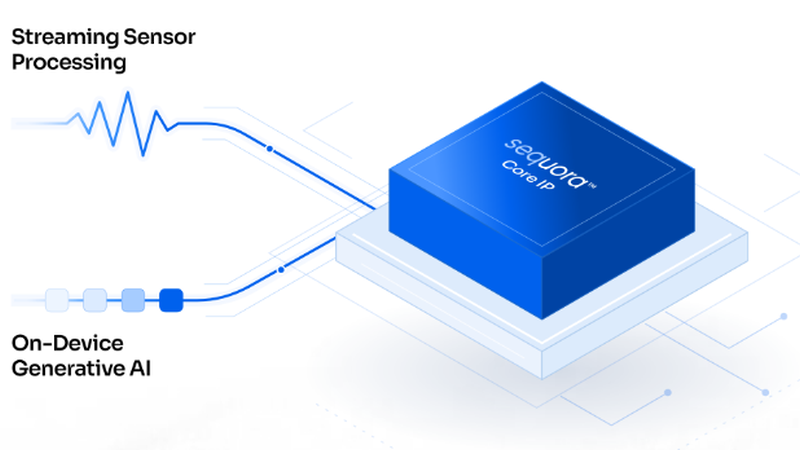
Akida processes data that comes continuously from sensors. This data can include vibrations, audio, radar, raw radio-frequency (RF) in-phase and quadrature (IQ) data, and biological signals. Sequora handles generative AI and tasks that process information in a sequence. These tasks include running large language models on the device, converting speech directly into speech, and running AI agents. Sequora is designed to work well with state-space models (SSMs). These models keep a fixed-size record of past input, so the memory they need stays the same no matter how long the input sequence becomes. This makes them suitable for generative AI on edge devices with limited resources.
Sequora uses one multiply-accumulate (MAC) array for both signal processing and neural-network calculations. This removes the need for a separate digital signal processor (DSP) stage to prepare data before processing. Its instruction-set architecture (ISA) also makes it possible to add new algorithms through software updates.
Sequora is available now as semiconductor IP that companies can license. It is provided as register-transfer-level (RTL) code that can be synthesized for different semiconductor manufacturing processes. The package includes verification IP, synthesis scripts, and a software development kit (SDK). The SDK contains a compiler, a C++ runtime library, and a model zoo, which is a collection of AI models.