
OpenAI deploys nearly 2,000 GPT-Rosalind agents to generate biological research leads in 32 minutes
By Brian Buntz |
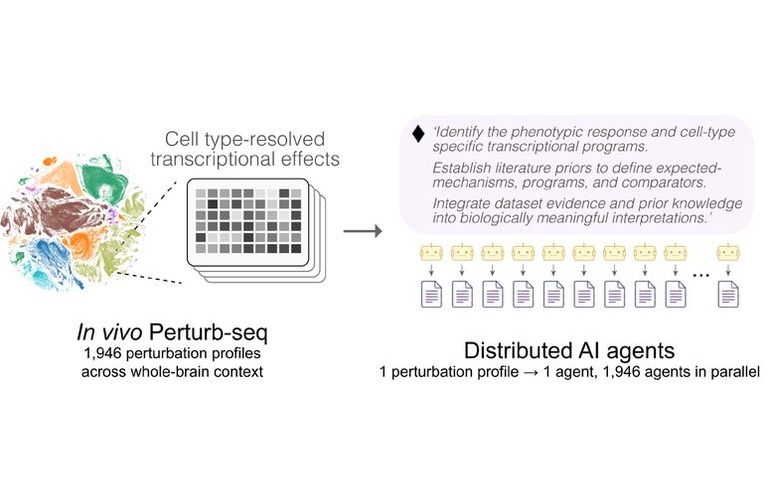
Image: Sun et al., bioRxiv (2026), CC BY 4.0.
Scientists cannot quickly gather a thousand colleagues to solve a problem. But AI systems can now bring together thousands of digital workers to do similar tasks. OpenAI says it used thousands of AI agents to study biological data and suggest possible explanations that scientists can test.
The announcement follows OpenAI's introduction of GPT-Rosalind earlier this year, an AI model designed to help with life sciences research.
On October 21, OpenAI, the drug discovery company PerturbAI, and Scripps Research reported that 1,946 GPT-Rosalind agents worked at the same time to analyze existing data from millions of mouse brain cells in 32 minutes. The team estimated that people doing similar analysis and reading research papers might need months to a year. This was an example estimate based on assumptions that each gene disruption would take 15 minutes to analyze and each paper would take 10 minutes to read.
The work is described in a bioRxiv preprint. The researchers used a method they call distributed biological reasoning to study a map of gene disruptions across the whole brain, known as a CRISPR atlas. In these experiments, researchers switch off genes and measure how cells change as a result. The experiments can produce more observations than a research team can easily study in detail.
This is one reason scientists share maps of cells, called cell atlases. “We build cell atlases so that other scientists can make discoveries we haven’t imagined yet,” said Sarah Teichmann, chair in stem cell medicine at the University of Cambridge and founding co-chair of the Human Cell Atlas, in OpenAI's announcement. “AI could help more researchers explore these resources and turn unexpected observations into new questions to test.”
The researchers' software gives each gene disruption to a separate AI agent. Each agent studies the changes in cells, searches scientific papers, and suggests possible explanations. The system then combines the agents' reports to find connections and rank ideas for further research.
The study shows how a scientist could use hundreds or thousands of AI agents to read research papers and interpret results at the same time. To compare approaches, the team used the same model, instructions, tools, and data access. When the workload was largest, runs using just one agent kept an average of about 11 references. The system using many agents kept 7,586 references, about 711 times as many, according to the project's public data.
To check the agents' reports, the team asked 30 biologists with doctoral-level training to review them without knowing which results they were assessing. Their reviews generally supported the agents' rankings of promising research ideas. The agents also matched or improved on 48 of the 55 findings from the original atlas study that could be worked out from the data they received. They did this without seeing the original study's manuscript. Human reviewers graded the agents' reports, while the comparison with the time people might need was based on the estimate described above.
The study's test using just one agent also produced an idea that caught the experts' attention. Switching off DCTN1, a gene linked to neurodegeneration, increased activity in genes involved in making cholesterol. The agent suggested that if neurons have trouble moving cholesterol around inside themselves, they might respond by making more. Three reviewers who did not know the source of the finding gave it an average score of 4.3 out of 5 for how much it deserved further study.