
Claude Duet: What Anthropic's Proactive Agent Actually Does
Author
Rowan SterlingDate Published
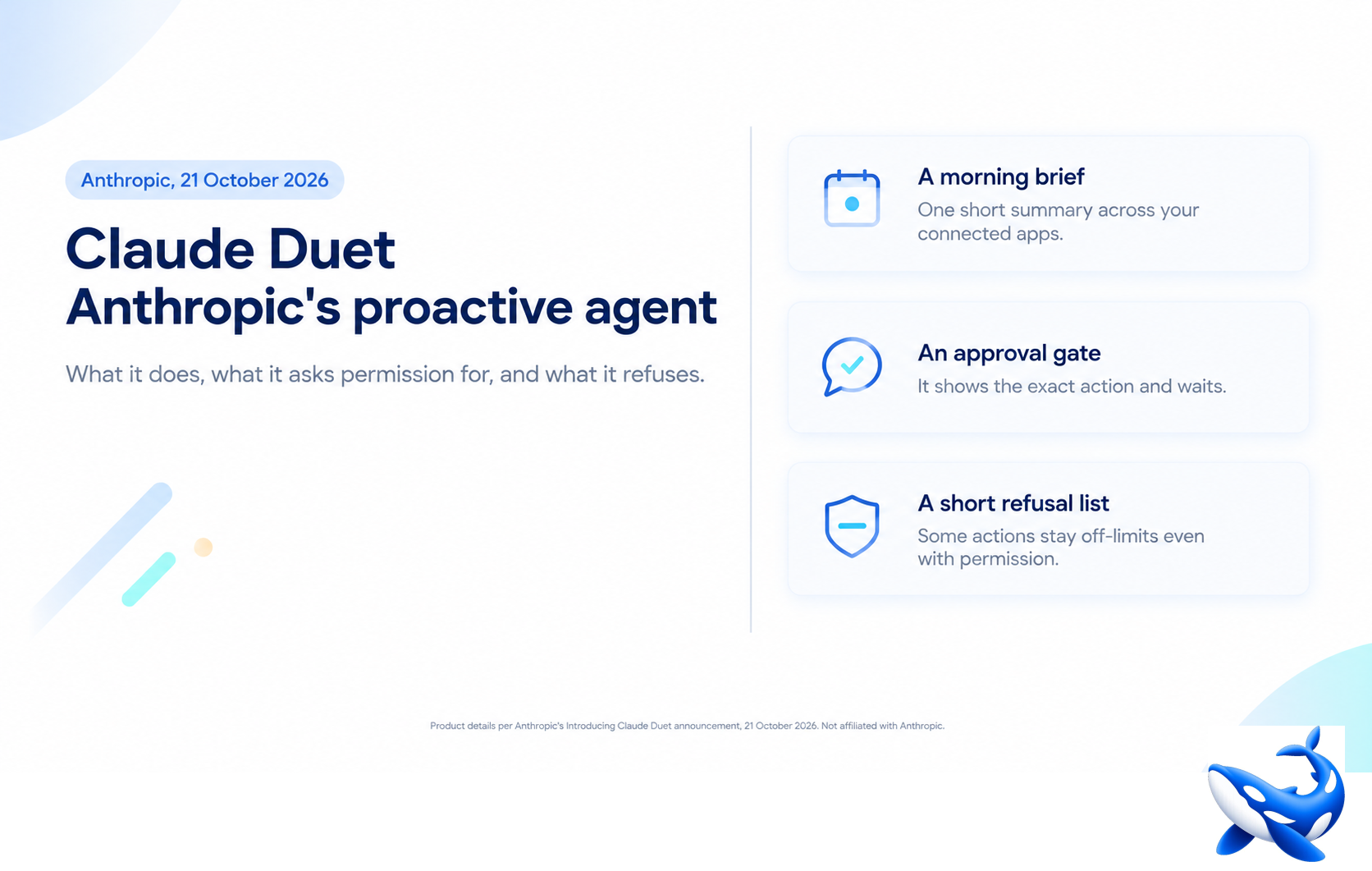
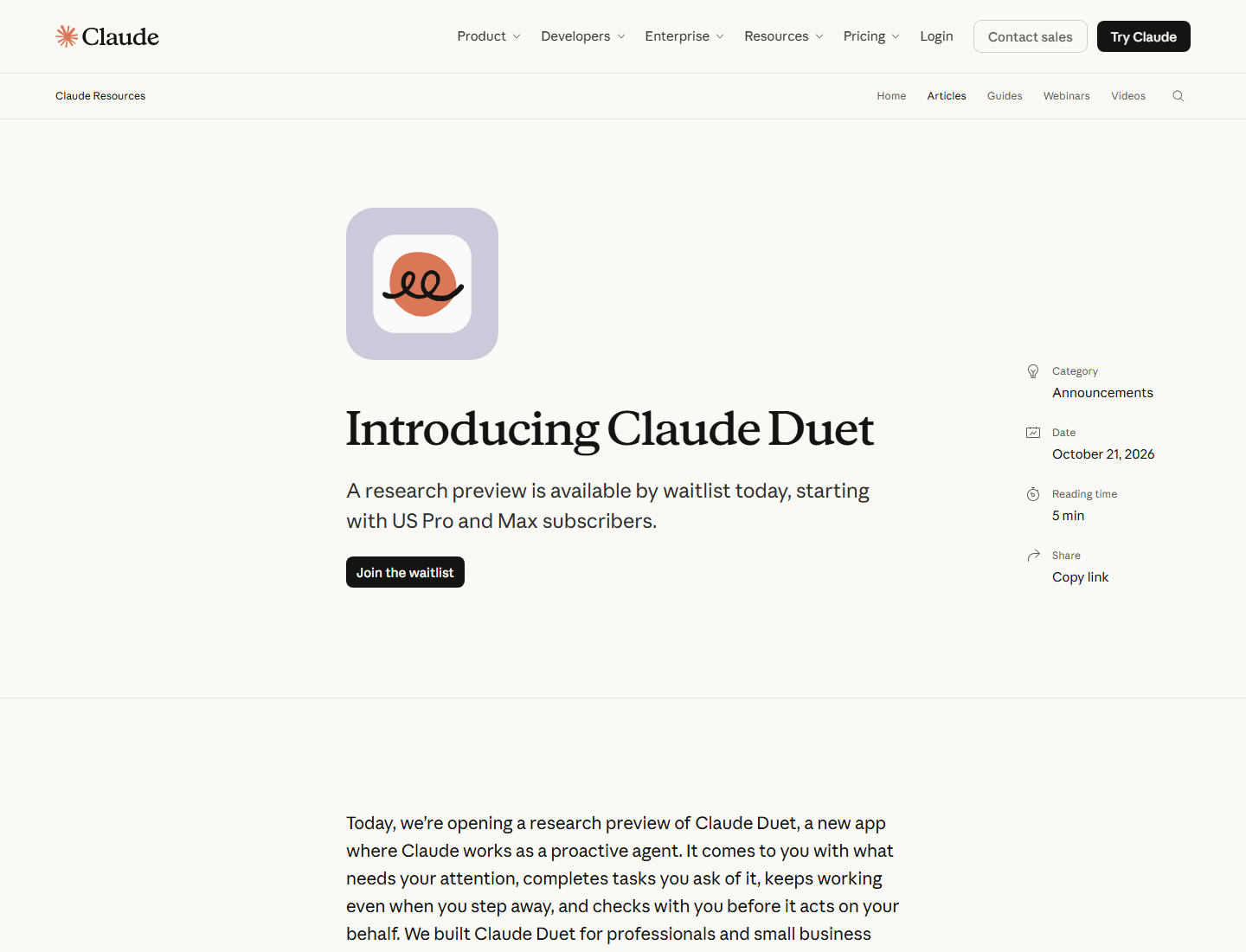
Most product announcements list what a system can do. Anthropic's announcement of Claude Duet, published on 21 October 2026, is more useful if you read it as a list of things the system will not do. It will not watch your connected accounts all the time. Instead, it checks them every few hours. The company explains why in simple terms: checking nonstop "would use up your plan's limits much faster." It will not trade securities or move money between your accounts, even if you approve the action yourself. It will not send credit card numbers or government identification through a message at all. And it will not send a message, make a payment, sign a document or delete anything without first showing you exactly what it plans to do and waiting for your approval. The app is built around Claude Opus 5.5, and these limits tell us a lot about how it was designed.
The simple answer for people searching for Claude Duet is this: it is a separate Anthropic app available on iOS, Android and claude.ai. In this app, Claude acts as a proactive agent rather than a chat window that you must return to yourself. It brings important things to your attention, completes tasks you give it, keeps working while you are away from your laptop and checks with you before acting on your behalf. Anthropic says it designed the product for "professionals and small business owners with more on their plates than they can track." It is a research preview that people can join through a waitlist. At first, it is available to Pro and Max subscribers in the United States.
What it does that a chat window does not
Two things make Duet different from the Claude you already know. The first is a morning brief: each day, it sends you a short summary of the most important things across the apps you have connected. The second is that it stays quiet unless something needs your attention. During the rest of the day, it checks those apps and contacts you only when something important comes up, such as a calendar conflict, an unpaid invoice or a message thread where someone is still waiting for a reply. The important part of the product is deciding what needs your attention. Sending you a message is simply how it tells you.
The second difference is that Duet keeps working when you are away. It runs on a virtual machine with its own browser, so you can shut your laptop and put your phone away. You describe a task in a short message. Duet figures out which apps to use and what steps to take, then works in the background. It sends you a notification when the task is done or when it needs you to review something. This is different from an agent that uses the browser tab already open on your computer, because Duet does not need you to stay at your desk while it works.
You can talk to Duet in one ongoing conversation, either by typing or speaking. That means you can use the same place for a quick two-line reply or a project that lasts a week, rather than opening separate chats. Anthropic says Duet can handle tasks ranging from scheduling meetings to "building dashboards with dozens of tools, creating financial or sales forecasts, prototyping, and building web apps." It can do many different kinds of work, so the more important question is how people supervise it. That is what the rest of this article explores.
The first refusal: every few hours, not every second
Over the past two years, agent products have competed to see how closely they can monitor things. Claude Duet deliberately takes a different approach. The announcement says, "Claude Duet checks your connected accounts every few hours, because checking nonstop would use up your plan's limits much faster." This is an engineering choice, not just a cautious statement. A system that checks every thirty seconds can quietly turn a fixed monthly plan into a service that uses up its allowance very quickly. Anthropic has chosen a schedule that helps people keep using their plan instead of one that makes the product look more alert in a demonstration.
The same limits apply to all the other work the app does in the background. Its checks count toward the same usage limits as other Claude tasks. Bigger jobs, such as building a financial model or putting together a presentation, "require more model turns and background work." None of this work is unlimited. If you have used an agent that seemed to work for free, someone was paying for it somewhere. Duet explains where the cost falls before you connect your accounts.
Instead of watching constantly, Duet lets you control and adjust what it checks. You can tell it what you want to hear about and how often you want updates. Anthropic says it is still testing how well the system decides when to message users and will keep improving those decisions based on feedback from testers. This is an important admission: how often Duet interrupts you is still being worked out. The first month of a research preview is too early to judge what the final schedule will be.
The approval gate, and what sits behind it
Duet can read information, write drafts and prepare work on its own. But it must stop before taking four specific actions. Before it sends a message, makes a payment, signs a document or deletes something, it shows you exactly what it plans to do and waits for your approval. You must approve each action separately. You cannot turn off this rule just to make things faster.
There is also a second, shorter list of things Duet cannot do. The announcement says, "A few things are off-limits even with your approval, like trading securities or moving money between accounts." This is what makes Duet different from a general-purpose agent that simply asks you to confirm an action. A normal confirmation step assumes that the user has the final say and that anything the user approves is acceptable. Anthropic has decided that some actions are not allowed even when the user agrees. In these cases, the company takes responsibility for the product, and a mistake may be impossible to fix simply by apologizing. Trading through a brokerage account and transferring money between accounts are the examples it gives. You can also disconnect any app that Duet can access. This supports the same idea: you can remove its access to an account, not just reject a single request.
The classifier that decides what leaves
The third restriction is about information rather than actions. It is also the one users may accidentally test without meaning to. Anthropic has given Duet a new, dedicated classifier and safety prompt that checks every message for sensitive information that might be shared by mistake. The announcement explains, "An agent that reads email and sends messages for you is constantly deciding where information should go." This is the reason for the system. The new classifier is designed to reject requests to share information in Anthropic's strictest category, "including credit card numbers and government identification." Health information and personal financial information follow different rules. Duet can share them only if you have clearly told it to do so.
Passwords and other sign-in details are handled separately, using a design from Claude Managed Agents. Anthropic says Duet "never directly sees your passwords or sign-in tokens." It uses these credentials to act without reading them directly. This means that if a conversation record is exposed, the password is not automatically exposed with it. Anthropic also uses safety methods developed through its browser-use research to defend against hidden instructions and prompt injection, which are especially relevant because Duet works through a browser. The company says it has tested the system with internal red teams, arranged a security test by an outside company and included Duet in its public bug bounty program, which lets security researchers report problems. Anthropic also says it will publish more information about Duet's safety design in the coming days. So what is available now is an explanation of the approach, not a complete technical description.
What it connects to
Duet can use "over 6,000 connectors and plugins in the Claude Marketplace." Anthropic gives examples that closely match the everyday work of a small business. It is useful to think about these as jobs Duet can help with, rather than just a list of connected apps:
• Inbox and messages — Find Gmail and Slack messages you missed and help you write replies.
• Money in — Check Intuit QuickBooks or Stripe for unpaid invoices and draft reminder messages.
• Payroll — Prepare and run payroll in Gusto, with employee hours, bonuses and reimbursements filled in.
• Hiring — Write a job posting and, after you edit and approve it, publish it on LinkedIn.
• Contracts — Prepare agreements and send them through Docusign for review and signature.
• Sales follow-up — Draft emails using contact details and deal history from HubSpot.
• Marketing — Turn a product launch into a social media campaign in Canva, and set up, design and manage a Shopify store.
Buying things follows a separate process. Duet checks the item with you first. Then Stripe's Link wallet asks you to approve the purchase and pays with a virtual card, so your real card number is never shared with Duet. Shop Pay from Shopify can be used for online checkouts. Signing in to websites with logins saved in 1Password is listed as a feature that will arrive later.
What it cannot do, in Anthropic's own words
Anthropic's explanation of Duet's limits is unusually direct for a product launch. It is the section people should read to understand what to expect during the first few weeks. The company says Duet "still might misread a thread or miscalibrate what's urgent." The app was mainly designed for work, so "personal errands, such as booking tickets, aren't quite as strong." It "can't yet show you its browser," which means you can see the result but not watch a replay of how it got there. It also "lives in its own app, separate from the main Claude app." Anthropic says feedback from early users will help decide how the two apps work together in the future.
Two other missing features are worth mentioning because people are likely to ask about them. First, Anthropic has not published a Claude Duet API. It is a consumer app, and the announcement does not suggest that this will change. Second, there is no independent benchmark showing how often Duet completes tasks correctly. The stories Anthropic shares come from people who work at the company or received early access. One broker had a property viewing flagged on the wrong day. A restaurant owner with about 110 employees says he no longer needs a hundred browser tabs. A brand strategist had a client call flagged because it was scheduled just before a flight. These examples help explain what Duet is designed to do. But they do not show how often it gets things right, and no one has published a figure for that.
Where the model underneath comes from
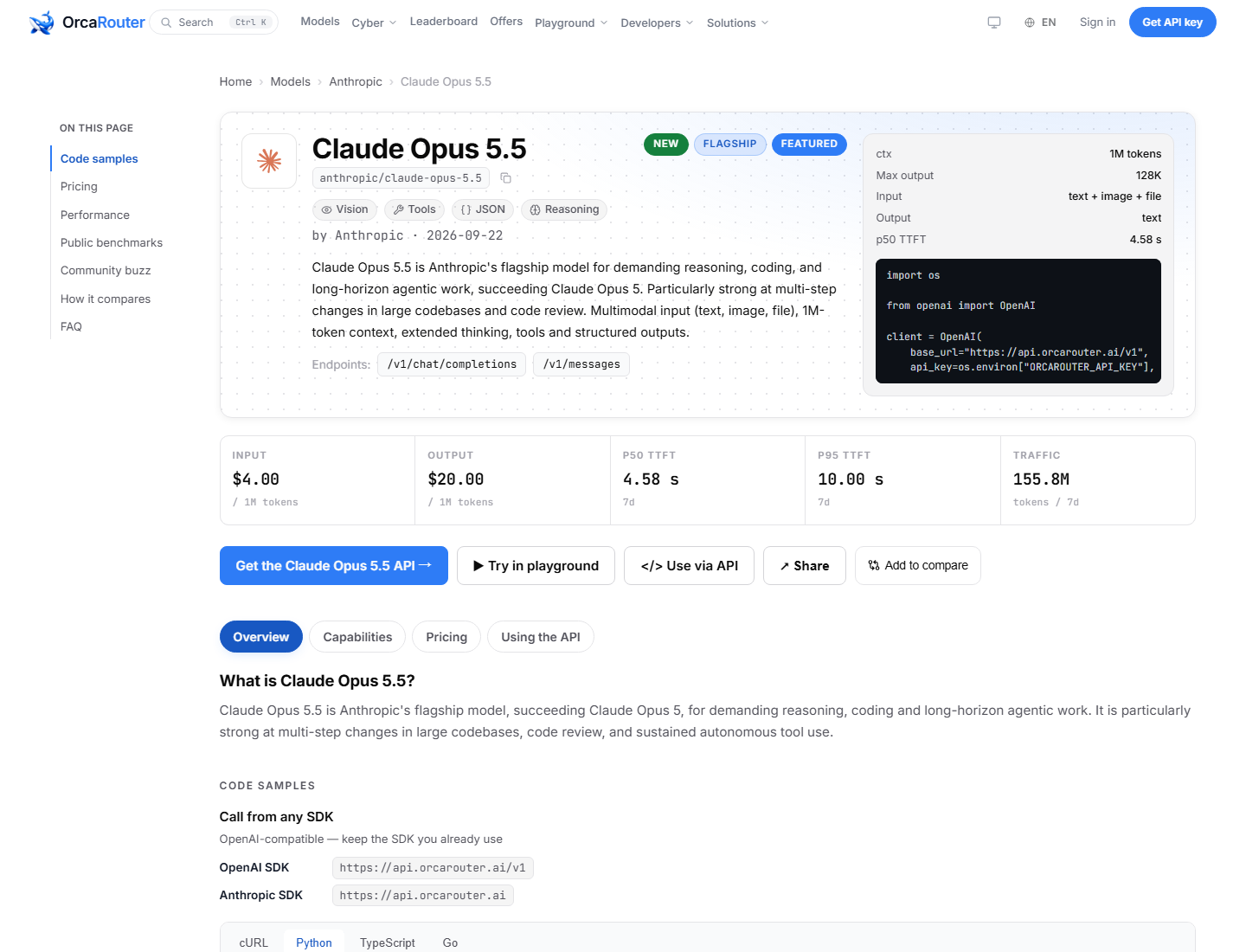
Anthropic says it designed Claude Duet around Claude Opus 5.5 and built it "to be resourceful and to decide what needs you, what can wait, and when to check with you first." This model is also available in our catalogue. That matters if you want to build your own agent instead of waiting for an invitation to use the consumer app. Claude Opus 5.5 costs $4.00 per million input tokens and $20.00 per million output tokens. It has a context window of 1 million tokens, and cache reads cost $0.20 per million tokens. It is available through one OpenAI-compatible endpoint, using one API key that also provides access to more than 200 other models. We pass through the provider's listed price without adding a markup, so if the provider changes its price, our price changes the same day.
To be clear about the difference: we provide access to the model, not the app. Claude Duet is Anthropic's consumer product, and Anthropic offers it to its own subscribers. Nothing here means that you can get access to Duet through a third party.
How to get it
You need to join a waitlist to get access. Anthropic is starting with Pro and Max subscribers in the United States. The preview is included in these plans, rather than being sold as a separate product. The company says it will email you when Duet is ready for you. It has not announced a timeline. We also have a separate article explaining what access looks like now and what you may want to decide before an invitation arrives.
There are three things worth watching next. First, Anthropic has promised to publish more details about safety. This matters because people outside the company will find it difficult to check the classifier and credential system without more information. Second, watch how often Duet checks in with users. Will its schedule of "every few hours" work for people who want to hear about things sooner? Third, watch whether the list of forbidden actions changes. A product that refuses to trade securities or move your money even when you ask is betting that people will see these limits as protection rather than as missing features. We will not know whether that choice works until ordinary users, not just testers, have used the product for some time.