
Claude Duet launches as Anthropic's agent that messages you first
Claude Duet is an app from Anthropic where Claude works as an agent that takes action on its own. Every morning, it sends you a summary of what matters. During the day, it checks your connected apps and contacts you only when you need to make a decision. Anthropic announced it on October 21, 2026, as a research preview. For now, you must join a waitlist, and the app is available only to Pro and Max subscribers in the United States.
The announcement included a post from the official @claudeai account. It explains the project in four main points: Duet tells you what needs your attention, completes the tasks you give it, keeps working when you leave, and asks for your approval before acting for you.
We’re opening a research preview of Claude Duet, a new app where Claude works as a proactive agent.
— Claude (@claudeai) October 21, 2026
It comes to you with what needs your attention, completes tasks you ask of it, keeps working when you step away, and checks with you before it acts on your behalf. https://t.co/kt8gAbWuX8
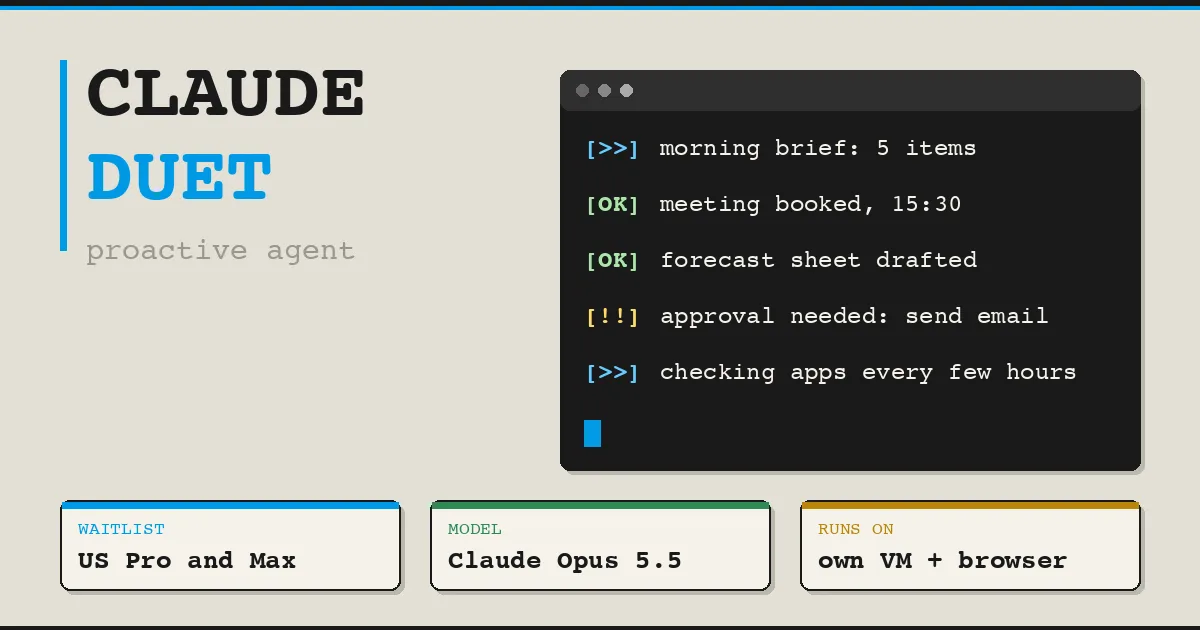
To join, you need a Claude Pro or Max subscription and a US address. You can find the waitlist on the product page. Team and Enterprise plans are not included yet, and no other countries are listed. There is no extra charge because Duet is included in your subscription.
What Claude Duet does every day
A day with Duet starts with a morning briefing, a short list of the most important things across all your connected apps. After that, the agent watches those services and contacts you only when something needs your attention, as 9to5Google explained. You do not have to open a chat first. The agent contacts you on its own.
Anthropic lists several practical tasks Duet can handle. It can schedule meetings, create financial or sales forecasts, build dashboards that bring information from different tools into one place, and make early versions of web apps. Digital Trends also mentions writing follow-up emails, which are the messages people often send after meetings. According to 9to5Google, Duet is aimed at professionals and small business owners who have too many things to keep track of.
You can talk to Duet by typing or speaking in one ongoing conversation. Your memory, skills and connected apps carry over from Claude, so people who already use Claude Pro or Max do not have to set everything up again. Duet is a separate app from the main Claude app on iOS, Android and claude.ai. Anthropic says how the two apps will work together in the future will depend on the feedback it receives.
How it works while you're away
This is what makes Duet different from a normal chatbot. It runs on a virtual machine with its own browser. This is like a computer running in Anthropic's cloud, so your laptop or phone does not need to stay on. We saw a similar idea with Cowork, which has run in the cloud for Pro and Max users since October 6. Duet goes further because it can take action without waiting for you to ask.
However, Duet does not check everything all the time. It checks your connected accounts every few hours to avoid using up your subscription's usage limits too quickly. Digital Trends points out a drawback: Duet might miss an update that arrives between checks. This means it cannot act as a real-time alert system.
Duet can connect to more than 6,000 services through plugins and integrations in the Claude Marketplace. Examples include Gmail, Slack, QuickBooks, Stripe, Gusto for payroll, LinkedIn, Docusign, HubSpot, Canva and Shopify. Duet can already manage a Shopify store. A visual editor for Shopify is listed as a feature that is “coming soon.”
What it asks before acting, and what it never does
The rule is simple: before sending messages, making payments, signing documents or deleting anything, Duet shows you what it plans to do and waits for your approval. These approvals use the auto mode classifier. Anthropic also uses this system in Claude Code and Claude in Chrome to decide which actions can happen automatically and which must wait for the user's approval.
Even with your permission, Duet cannot do two things: trade securities or move money between accounts. Purchases use Link, Stripe's digital wallet, with a virtual card, or Shopify's Shop Pay service. Logging in with passwords saved in 1Password is listed as a feature that will arrive later, and it will also require your consent. To learn which assistants can already buy things for people, see the guide to AI shopping assistants.
Security, according to Anthropic
Duet handles login details using the same approach as Claude Managed Agents, Anthropic's platform for agents hosted in the cloud. The agent never sees passwords or access tokens directly. To defend against hidden instructions in web pages and documents, known as prompt injection, the company says it uses protections developed through its research on agents that use browsers. The project was tested by trying to attack it, including through red-team exercises and a security test carried out by an outside company. It is also covered by the public bug bounty program on HackerOne, which lets people report security problems.
Duet also has a system that checks for sensitive information. It refuses to share the most sensitive types of data, such as credit card numbers and identity documents. Personal health or financial information can be shared only when you clearly ask it to do so. Other companies have already taken steps over concerns about AI agents accessing data. The article on Apple putting the brakes on Full Disk Access for AI agents explains Apple's response. Websites are also starting to block these agents, as described in the article about Amazon, Yelp, Delta and JPMorgan blocking agents.
Limitations to keep in mind
- The security claims come from Anthropic itself. The announcement mentions red-team exercises, outside testing and a bug bounty program, but does not share the results. For now, the company's protection against prompt injection is a promise, not a claim confirmed by published results from independent testers.
- The figure of 6,000 connectors refers to the number listed in the Marketplace. It does not mean Duet can use all of them well. Before relying on it for a service you use every day, check that the service is supported and find out what Duet can actually do with it.
- Anthropic admits that Duet can misunderstand a conversation or get the level of urgency wrong. Personal tasks, such as booking tickets, are not as well developed yet. For now, Duet also does not show you its own browser, so you can see the result of its work but not each step it takes.
- Anthropic has not given exact usage limits or a separate price. Duet's background checks use your subscription allowance, and large tasks, such as building a financial model, use more. As a result, it is not yet clear how much Duet will use up from a monthly allowance.
Which model it runs on, and who got there first
Duet uses Claude Opus 5.5. Anthropic chose this model to judge how urgent something is and when it should contact you. However, Duet is not the first agent to act without being asked. It arrives a few weeks after OpenAI's dots, an agent that calls and writes messages for users. We have already compared assistants of this kind in the article on Gemini agent, Autopilot, dots and Grok Bot. According to 9to5Google, Duet is launching in a market where Meta's Muse has also become popular quickly.
Anthropic is betting that giving users control will make Duet stand out. It is a separate app with one ongoing conversation, its own virtual machine and required approval for actions involving money, signatures and deletions. People who have used Claude Code for years know that the company often chooses caution over speed. With Duet, that caution is a central part of the product.
Frequently asked questions
1. Is Claude Duet available outside the US?
Not yet. The research preview starts with a waitlist and is limited to Pro and Max subscribers in the United States. Anthropic has not named any other countries or given a date for general availability. People outside the US must wait for an announcement that has not yet been made.
2. How much does Claude Duet cost?
There is no extra charge. Duet is included in the Pro and Max plans and uses the same usage limits as the rest of Claude. Existing subscribers do not pay more, but background checks and long tasks count toward their usage allowance.
3. Can it spend my money without asking?
No. Every payment requires your clear approval. Purchases are made using Link's virtual card from Stripe or Shop Pay. Duet can never trade securities or move money between accounts, even if you ask it to.
4. Does it replace the Claude app?
No, at least for now. Duet has its own separate app. Anthropic says how the two apps will work together in the future will depend on feedback from users during the preview.
Permission matters more than intelligence
Duet's big change is not about intelligence. It is about permission. For years, AI assistants waited for people to ask questions. Now Duet asks for access to your email, calendar and books, and it can contact you first. This could help people who have too many things to keep track of. But giving an agent this much access also requires a lot of trust, so it is best to start slowly. The most important part of the announcement may be the least exciting: the list of things Duet will never do on its own.