
Toss Securities Co., Ltd. "Il gave up the lead in semiconductor manufacturing competition, but...So-jang is still the key."
 Enlarge image
As the artificial intelligence (AI) semiconductor market grows quickly, Japanese companies that make semiconductor materials, parts, and equipment are attracting attention again. Analysts say Japan has lost its former leading position in semiconductor manufacturing, but it still has important technologies in materials and equipment that are hard to replace. In particular, as production of AI semiconductors increases, supplies of materials and parts used in advanced packaging and high-bandwidth memory (HBM) may fall short of demand.
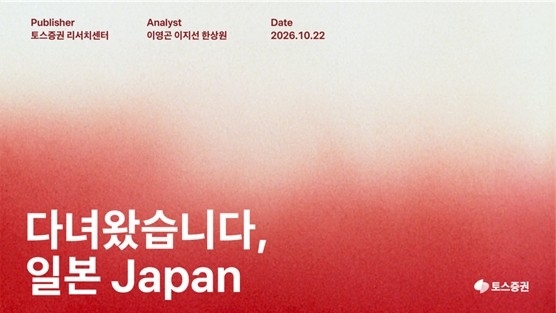
On the 22nd, the Toss Securities Research Center announced that it had published a report titled "I'm Back, Japan." The report examines the strengths of Japan's semiconductor materials, parts, and equipment industry and its role in the global AI supply chain.
According to Toss Securities, researchers Lee Young-gon, Lee Ji-sun, and Han Sang-won visited more than 10 major Japanese semiconductor materials, parts, and equipment companies, including Tokyo Electron (TEL), Lasertec, and Yviden. Their report covers these companies' business trends and technological strengths. The researchers also exchanged views with local researchers to understand changes in Japan's semiconductor industry and what they could mean for investors.
The research center described Japan as a key country that supports the global AI semiconductor industry.
"Japan accounts for about 50% of the market for major semiconductor materials and about 30% of the equipment market," the research center said.
Taiwan, which the center examined in an earlier report, acts as a "hub" that brings different parts together to make a finished product. Japan, by contrast, serves as a "base" that supplies the key materials and equipment needed to make semiconductors.
The center highlighted the long history of technical knowledge and customer trust built by Japanese materials, parts, and equipment companies. Semiconductor makers do not easily switch suppliers whose products have already been tested and proven reliable. This makes it difficult for new companies to enter the market.
The center said Tokyo Electron, Lasertec, and Tokuyoka Industrial Co. (TOK) have strong competitive advantages in certain types of equipment and materials needed to make advanced semiconductors.
The report also examined how advances in AI semiconductor technology are changing supply chains. Analysts said supply shortages, which previously focused on advanced packaging and high-bandwidth memory (HBM), could spread to materials and parts. In fact, the companies the researchers visited appeared more focused on increasing production capacity than on finding customers for their products.
The report described the semiconductor industries of South Korea and Japan as having both cooperation and competition. As South Korean memory makers increase HBM production, demand for equipment and materials from Japanese companies also rises. However, companies in both countries are competing to lead the market. The research center said new manufacturing methods, such as hybrid bonding, could create future growth opportunities for South Korean companies.
"Japan has given up its leading position in the competition to manufacture semiconductors, but it still has competitive strengths in materials and equipment that are difficult to replace," said Lee Young-gon, head of the research center at Toss Securities. "During this visit, we were able to see firsthand the technologies and roles of Japanese companies that support the growth of the AI industry."
Meanwhile, Toss Securities recently added a new "Market" tab to its app. Users can check major South Korean and international market indexes and trading flows in this section. The "AI (Artificial Intelligence) Market Summary" is updated every hour and highlights the day's most important market developments.