
Anthropic’s Jack Clark tells policymakers the singularity has begun
Jack Clark says the singularity has begun. Recent improvements in AI's ability to solve math and science problems give economic policymakers real reasons to take his claim seriously.
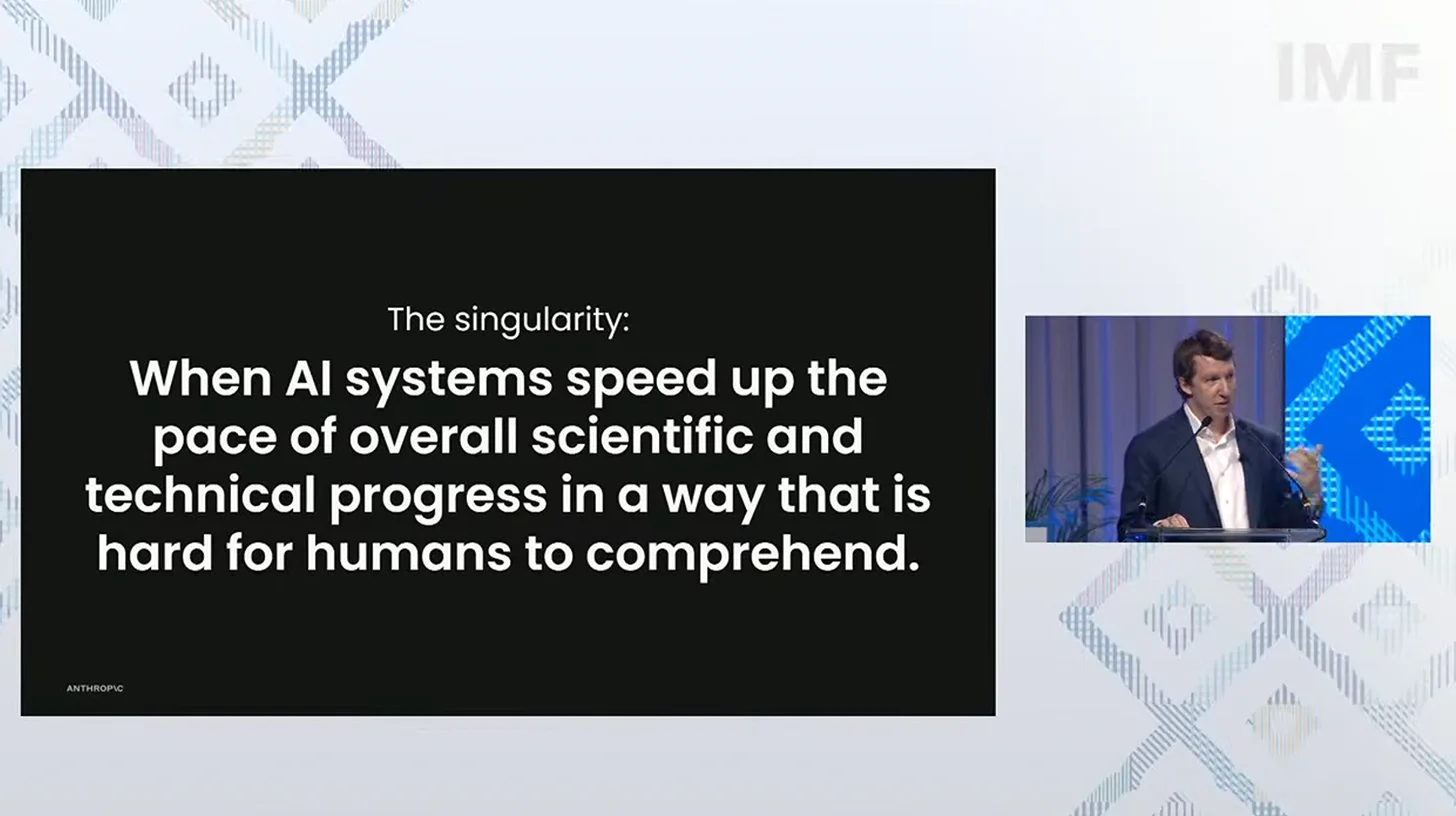
Anthropic co-founder Jack Clark told economists and policymakers at the IMF and World Bank's yearly meetings in Bangkok on October 17 that the singularity has 'now begun,' as The Rundown reported. He said AI is starting to help people make new discoveries faster than humans can keep up with them.
In prepared remarks published on October 19, Clark pointed to AI's improving results on difficult tests and imagined a future with 'a billion virtual scientists.' He urged countries to build laboratories, robots and scientific equipment to get ready for a possible surge in research.
The numbers behind the claim
Clark pointed to AI's results on Humanity's Last Exam, a test of expert knowledge. AI scores on the test rose from 8% in 2025 to 67.7%. He also cited FrontierMath, where scores rose from 2% in November 2024 to 94%.
Anthropic reports a score of 67.7% on Humanity's Last Exam for Claude Opus 5.5 when it uses tools. However, it is not clear whether the two scores were measured under exactly the same testing conditions. Anthropic also warns that small differences in benchmark scores are becoming less useful for judging how much better one AI system performs in real-world tasks than another.
Clark's example of possible economic growth also depends on certain assumptions. Anthropic's most extreme scenario estimates that U.S. GDP could reach $44.4 trillion in 2030, measured in 2025 dollars. That is 32.4% higher than the size of the economy in its model without AI. This scenario assumes AI systems that are extremely capable, can work independently and are adopted quickly.
Why it matters
Recent results in math and science give Clark's argument meaningful support. Someone helping to build this technology is bringing an idea long linked to science fiction directly to the organizations that help shape the world economy.
In August, Anthropic reported progress involving the Riemann zeta function, an important mathematical topic. An unreleased Claude research model raised the lower limit on the share of certain zeros that lie on the critical line from 41.6% to 67.2%. The company says its mathematicians reviewed the work and that it was formally checked using the Lean proof system, a tool for checking mathematical proofs. Anthropic stresses that this progress does not solve the Riemann hypothesis and that it does not expect these methods to prove it.
The results in physics are also striking. In a paper published on October 9, the creators of TheoPhysEval reported that GPT-6-Astra in Codex correctly answered 49 out of 50 unpublished theoretical physics problems while using tools. The average cost was less than $3 per problem. The test set checks whether AI can carry out new calculations using methods scientists already know. It does not include major unsolved research problems.
Research teams might be able to hand over more specialized calculations and parts of mathematical work to AI. This would let researchers spend more time choosing questions, checking results and testing ideas. But these examples do not yet show how much of the entire research process AI can handle by itself.
More powerful research AI can also create security risks. Anthropic reports that Claude Mythos Preview helped develop better attacks against HAWK, a proposed digital signature system, and a weakened version of the AES encryption algorithm. The company says neither finding required changes to systems already in use. This work shows that AI could help security experts find weaknesses, but it could also reveal new ways to attack systems. Expert checks and responsible sharing of discoveries are therefore important.
Clark's call for laboratories, robots and equipment connects these research advances to decisions governments can make today. A flood of new ideas for experiments could create a problem if there are not enough facilities or tools to test them. Investing in physical research facilities and equipment would help determine how quickly AI's scientific work leads to useful results in the real world.
Workers could also face disruption as AI increases the amount of work that can be done. In Anthropic's extreme growth scenario, wages for people who do knowledge-based work fall by more than 10%, while unemployment rises above levels usually seen during a recession. These are results from a model, not certain predictions. The model does not include government policy responses, changes in the business cycle or other disruptions. Policymakers would need to balance investment in scientific discovery with support for people changing jobs and decisions about how to share the benefits of economic growth.
Sources & further reading
- 01therundown.ai ↗
- 02importai.substack.com ↗
- 03Introducing Claude Opus 5.5 — Anthropic ↗
- 04Claude has improved on a longstanding lower bound for the fraction of zeros of the Riemann zeta function that satisfy the Riemann hypothesis — Anthropic ↗
- 05Discovering cryptographic weaknesses with Claude — Anthropic ↗
- 06TheoPhysEval: Assessing AI agents at autonomous theoretical physics problem solving ↗
- 07Scenarios for our Economic Future — Anthropic ↗
This story builds on reporting from The Rundown newsletter published on October 20, 2026.