
AI Could Deliver Humanity’s Fourth Great Ego Shock, Says Vedanta Scholar Swami Sarvapriyananda
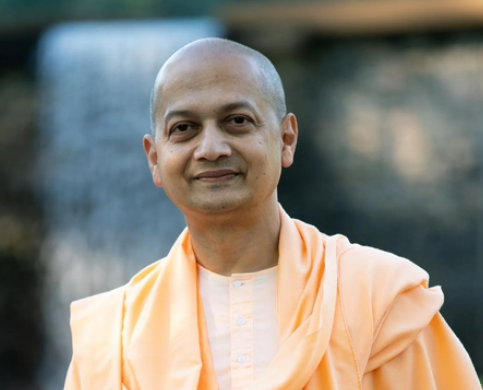
NEW DELHI — Artificial intelligence (AI) could greatly change how humans see themselves and their place in the world. It could become the fourth major scientific discovery or development to challenge people's belief that humans are special, according to Swami Sarvapriyananda, the spiritual leader of the Vedanta Society of New York.
Speaking at the NDTV World Summit 2026 on Thursday, the monk and Vedanta scholar, who is based in New York, said that AI is developing quickly and raising important questions about consciousness, intelligence, identity, and what makes humans different from machines.
Sarvapriyananda has recently spoken with researchers at Anthropic, an artificial intelligence company, about consciousness. He suggested that as AI systems become more advanced, society may need to rethink how people interact with them.
When asked whether advanced AI should be treated as a person, he gave an answer that was both yes and no.
“AI should be treated as a person,” he said. However, he explained that treating AI in a person-like way does not mean assuming that it has human consciousness or spiritual awareness.
His comments reflect a growing debate about AI and its place in society, as machines become able to do tasks that people once thought only humans could do.
Drawing on ideas linked to psychoanalyst Sigmund Freud, Sarvapriyananda explained that scientific discoveries have repeatedly challenged the idea that humans are at the center of everything.
He suggested that AI could be the latest development to challenge this belief, making people rethink the idea that human intelligence is superior.
“We thought we were the creative intelligence. Now we see that AI can do what the greatest human mind can do, and better,” he said.
Sarvapriyananda said that the rise of increasingly capable AI is not just an important moment in technology. It also raises deep questions about what it means to be human.
“We have to ask ourselves what it is that distinguishes us, makes us unique, and where we should invest ourselves,” he said.
As AI becomes better at reasoning, creating work, and having complex conversations, he suggested that people may increasingly interact with these systems as if they were individuals.
However, he stressed that treating AI as a person does not prove that machines have consciousness or inner experiences like humans do.
This difference is at the heart of ongoing discussions among philosophers, scientists, and technology developers. They are debating whether AI can truly be aware of its own existence or whether it only copies parts of human thinking and behavior.
Sarvapriyananda also spoke about his recent conversations with researchers at Anthropic, a major developer of advanced AI systems.
He said that many researchers working on advanced AI are deeply worried about the technology's possible effects, even though they have successful careers and help develop it.
According to the monk, some researchers are paying more attention to unexpected behavior shown by advanced AI models.
One example he discussed was “persona drift.” This happens when an AI system's answers and behavior change as it takes on a particular role or identity during an interaction.
Researchers are studying this behavior to better understand how advanced AI systems work and why their responses can sometimes be unpredictable.
Sarvapriyananda suggested that these developments are opening up new areas of study that go beyond engineering and computer science.
He argued that AI is pushing humanity to look again at long-standing questions about consciousness, what makes someone a person, and what intelligence means.
His comments placed the debate about AI within a wider philosophical and spiritual setting. He suggested that the biggest questions raised by the technology are not only about what machines can do, but also about how people understand themselves in a world that increasingly relies on automation. (Source: IANS)