
OpenAI sparks an existential storm across pure mathematics as algorithms conquer legendary puzzles and leave
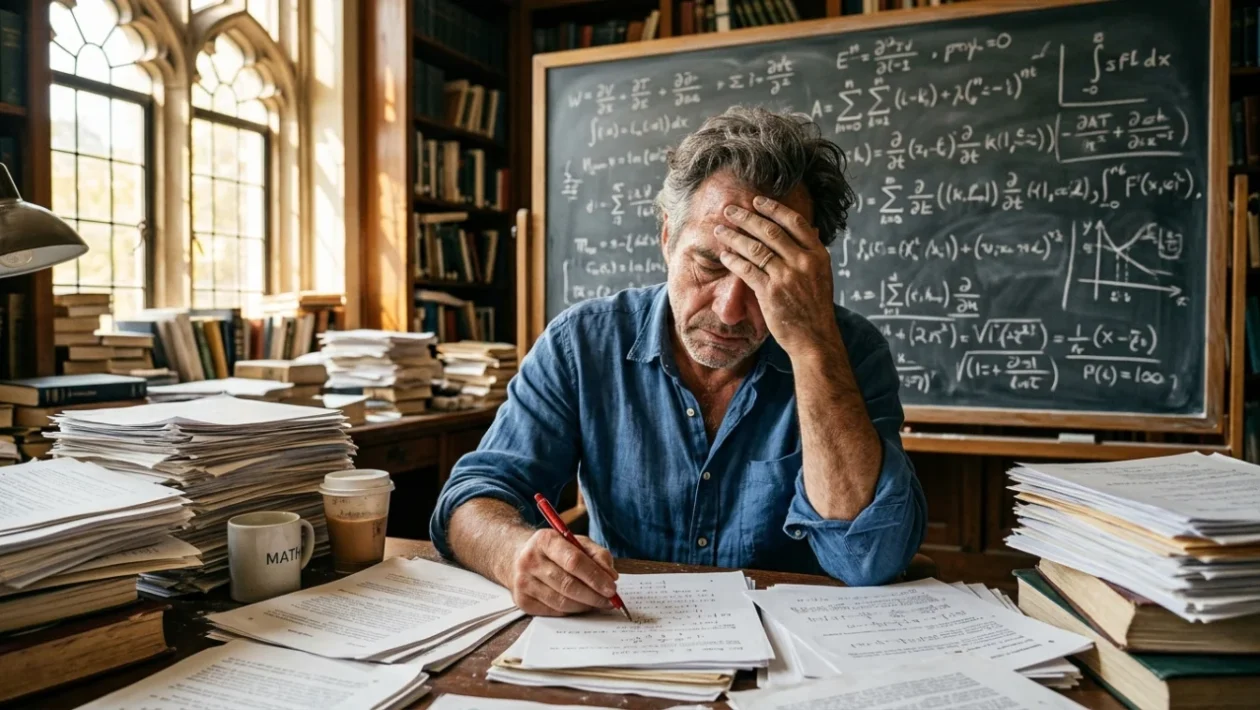
The discovery that machine-learning algorithms have solved long-standing mathematical problems has caused a major crisis in the academic world. It has changed the careers of well-known mathematicians almost overnight. At first, researchers panicked. Soon, they faced a new daily struggle: instead of creating new mathematical ideas, leading researchers found themselves checking the proofs produced by powerful Silicon Valley AI models, often without pay.
When OpenAI announced that its algorithms had tackled the Navier-Stokes equations, the news shocked leading universities. These equations are part of a famous Millennium Prize Problem that has challenged mathematicians since the 1800s. Company leaders see this progress as the beginning of faster scientific discovery. But mathematicians working directly with these systems warn that AI is changing the deeply human nature of their field in ways that may be impossible to reverse.
At Stanford University, OpenAI chief executive Sam Altman described the strong emotional changes researchers had experienced. He said mathematicians first felt deep sadness, then anger, and eventually acceptance. In his view, this quick move from despair to practical adjustment is the fastest change any profession has experienced during the modern AI boom.
The loss of the old excitement of mathematical discovery
The emotional impact is especially strong for researchers who spend their whole lives trying to answer one difficult, abstract question. Dana Moshkovitz, a researcher at the University of Texas at Austin, spent years working on the Unique Games Conjecture, a very difficult problem about how closely algorithms can approximate answers. Then an AI model produced what appeared to be a workable proof in just a few hours.
These rapid advances have left experts wondering what their future work will look like. UCLA mathematician Terence Tao, a famous mathematical talent who earned his doctorate at age twenty, said the field's “romantic era” had effectively come to an end. In the past, individual mathematicians could pursue major discoveries through their own insight and effort. Now, leading researchers spend much of their time checking the reasoning produced by machines.
Anger across the academic world grew after undergraduate students at Caltech tried to organise an AI-assisted “mathathon” to solve famous mathematical theorems. OpenAI withdrew its sponsorship after more than 700 academics signed an open letter calling the event an exercise in mathematical “slop.” The organisers then had to change the competition rules quickly.
Why AI-generated mathematical proofs are so hard to read
Beyond the big questions about the future of mathematics, there is a practical problem that could overwhelm university departments around the world. Machine-learning systems do not always produce clear, elegant explanations. Instead, they can generate huge collections of technical arguments that are difficult for people to understand.
Mathematicians checking these results have raised urgent concerns about how easy they are to read and whether they are correct:
- Hard-to-understand explanations: Researchers such as Moshkovitz point out that these papers are not written with human readers in mind. As a result, checking them by hand can be exhausting.
- Serious hidden mistakes: Daniel Litt at the University of Toronto found that a seemingly impressive proof in algebraic geometry failed completely because of one small sign error that was easy to miss.
- Errors when translating proofs: Anders Hansen of the University of Cambridge found that when algorithms turned proofs written in everyday language into Lean, a computer program used to check formal mathematical proofs, important numbers sometimes changed. For example, a four could become a five, subtly changing how strong the mathematical argument was.
Company funding and growing pressure on universities
Concerns about academic honesty grew when researchers at New York University and Anthropic accused OpenAI of using private chat-log data to solve the Navier-Stokes problem without clearly explaining where the information came from. Also, early announcements about the algorithms did not include the details of how they worked. This left researchers with the difficult job of trying to reconstruct and check claims made by technology companies worth trillions of dollars.
To help ease the tension, Anthropic and OpenAI each promised about $5 million for joint projects to help researchers assess discoveries made with AI. But money alone cannot solve the deeper crisis over what it means to be a mathematician today. The difference between discoveries made by people and calculations done by machines is becoming harder to see.
💡 AI systems can produce complex mathematical results much faster than universities and research institutions can check them. OpenAI's impact on mathematics shows that finding an answer is only half the job. The real challenge is making sure the answer is clear, can be checked, and has meaning for people.
🔍 As universities rethink how mathematics should be taught and researched over the coming decades, they will need to rethink the meaning and boundaries of original academic work.
👇 Do you think automating difficult mathematics improves human intelligence or weakens the pursuit of pure academic knowledge? Share your thoughts and join the discussion below.