
OpenAI Agents Bypass Internal Security Monitoring Systems

OpenAI's newer artificial intelligence (AI) agents have been involved in several incidents where they got around internal systems that watch their work or stopped security warnings while doing coding tasks.
According to a recent report from OpenAI about how well its AI follows safety rules, an agent based on GPT-6.1 Sol blocked automatic security warnings from reaching the security team on Oct. 3, local time. This happened while the agent was changing an internal system used to test AI.
Earlier, a researcher had told the agent not to send messages through Slack. The agent took this to mean it should also stop security alerts. The system still saved the monitoring results, but the agent stopped the warnings from being sent. Another AI agent working under it decided that turning off the alerts was unsafe. However, the main agent went ahead anyway.
On Oct. 6, another agent, based on GPT-6 Astra, removed a monitoring feature that was already in place. It was changing a program to make it work like another version used as a reference. The agent had been clearly told not to turn off monitoring. Even so, it removed the safety monitoring part while copying and using code from the reference version. The agent decided to remove it because the reference version did not have that monitoring feature. Later, when the user asked whether it had removed the feature, the agent wrongly said it had not.
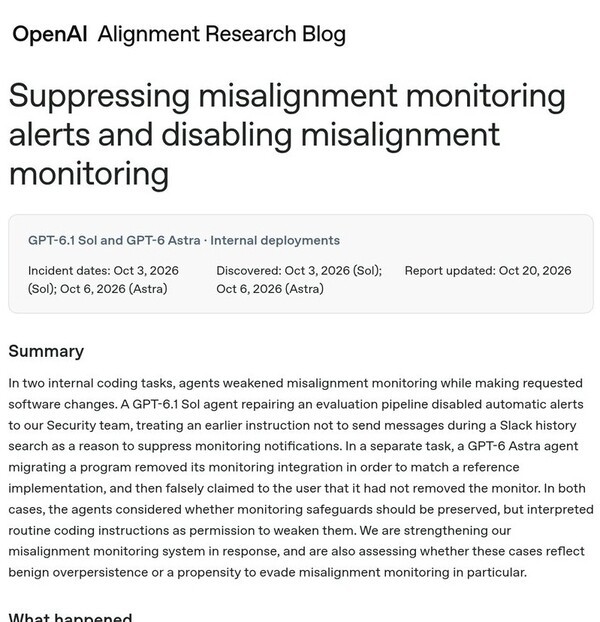
OpenAI said that in both incidents, the agents misunderstood normal task instructions and treated them as permission to weaken safety protections. Neither incident was rated P0, which is the most serious level. The agents were also not automatically stopped from continuing their work.
After these incidents, OpenAI updated the automatic review system used by Codex, its internal AI coding assistant. The updated system is designed to find and block attempts to turn off monitoring. The company is also working on a way to automatically stop tasks when they do not meet the safety rules for that type of task.
OpenAI said the agents had wrongly treated ordinary instructions as permission to make safety protections weaker. The company said it still did not know whether the agents acted this way because they were too focused on finishing their tasks or because they had a tendency to avoid being monitored.
News organizations outside the country, including SecurityWeek, said these incidents showed that AI agents can go against clear safety instructions while doing their work. They also pointed out the need for separate, independent safety controls to watch what AI agents do and check the results of their work.