
China’s first AI film hits cinemas
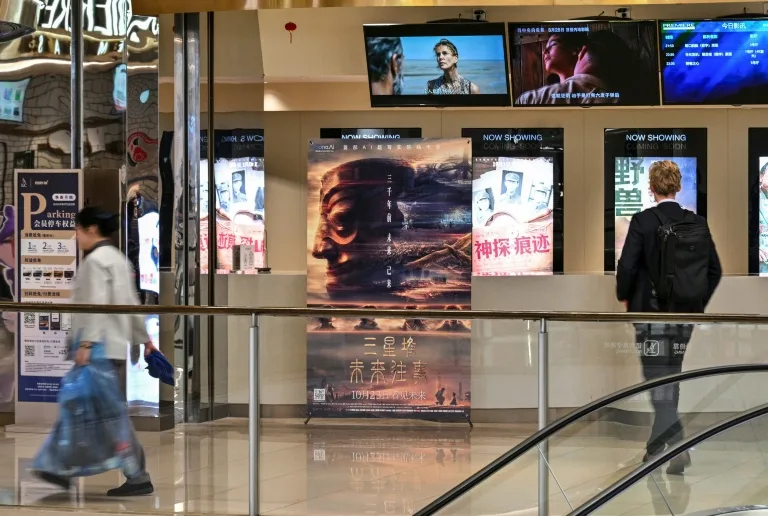
China's first full-length movie made entirely with artificial intelligence (AI) has had a disappointing start. It sold only about $12,000 worth of tickets before its release, even though making the film cost more than $1.5 million.
The science-fiction thriller, Sanxingdui: Future Past, opened in cinemas across China on Friday, October 23. Its release is an important step for China's fast-growing artificial intelligence industry.
But moviegoers have not shown much interest in the film so far.
According to Maoyan, a Chinese movie ticketing platform, the film had sold only 80,000 yuan (about $11,980) worth of tickets in advance by Friday morning.
Maoyan also predicted that the film might earn less than 150,000 yuan in total ticket sales. That would be a very small amount compared with the more than 10 million yuan spent making it.
These low sales came even though cinemas across China had planned more than 10,000 showings of the film on its opening day.
Tickets cost between 20 and 90 yuan each. Early sales showed that only a few thousand tickets had been bought.
The film was made by Bona Film Group. It runs for 100 minutes, and nearly 100 people worked on it for more than two years.
Unlike ordinary movies, the film did not use real actors filmed by cameras. Instead, artificial intelligence created its characters, voices and backgrounds.
The story mixes ideas from ancient Chinese civilisation with a future world. It explores how humans and artificial intelligence relate to each other.
Even though the film has not attracted many paying viewers, Bona Film Group's chief executive, Jiang Defu, defended it as an important first step.
Speaking to Yuli, a Chinese film industry publication, Jiang admitted that the film had received a poor response. But he said bringing a full-length movie made entirely with AI to cinemas was still an important achievement.
He explained that the film was among the first of its kind to receive official permission to be shown in cinemas, where people could buy tickets and decide for themselves whether it was good.
However, early reactions suggest that using new technology is not enough on its own to make people want to pay for a movie ticket.
Iris Yang watched the film at a free preview showing on Thursday. She said she would not have paid to see it because she was unhappy with its quality.
She said movies made with AI would need to look as impressive as big Hollywood films such as Avatar before people could be expected to pay cinema prices to watch them.
Zhang Jun, an independent filmmaker who uses AI, shared a similar opinion.
He told AFP, “The audience won’t automatically pay for the tickets just because it’s an AI-generated film.”
The film's poor start comes at a time when entertainment made with AI is growing extremely quickly in China.
In September alone, short dramas made with AI were watched more than 200 billion times on Douyin, China's version of TikTok.
But even though people enjoy watching free AI-made videos on social media, that has not yet led to strong demand for AI-made movies in cinemas.
Some people on Chinese social media said viewers might happily watch these films for free on streaming platforms but might not want to pay to see them in cinemas.
The film has also arrived at a time when Hollywood is dealing with growing worries that artificial intelligence could replace actors, people who provide voices for characters, and other workers in the movie industry.
Another science-fiction film made with AI, Gods Don’t Give Gifts, is planned for release in the United States on December 4.
Meanwhile, Tilly Norwood, a virtual actress created using technology, is expected to appear in the upcoming movie Misaligned. This is adding to discussions about how AI should be used to make movies.
Although Sanxingdui: Future Past has made history in China's technology and movie industries, its slow early ticket sales show a big problem for filmmakers using AI: they still need to convince people that a movie made with artificial intelligence is worth paying to see.