
AI And The US Midterms: How Anthropic Is Approaching Political Bias And Election Integrity

Anthropic is adding stronger protections to Claude before the 2026 US midterm elections. The company wants to reduce political bias, stop false information and prevent people from using AI to interfere with elections.

More people are using artificial intelligence (AI) to learn about politics. Because of this, Anthropic is making its Claude chatbot safer before the November 2026 US midterm elections. The company is focusing on political fairness, voting information and stopping people from using AI to create misleading political content.
Anthropic says these new protections will help people understand political issues without pushing them toward one political opinion. The company also wants to stop people with harmful intentions from using its AI tools to spread false information or damage trust in elections.
In an update released before the elections, Anthropic explained how it checks Claude for political bias, helps voters find official election information and looks for groups working together to misuse the chatbot. The company also shared examples of people operating from other countries who allegedly used Claude to create fake political news.
These steps come as more people in the United States worry about political content made by AI. News organisations and researchers are studying how chatbots, AI-made images and videos, and automatically written content might change the information voters see during election campaigns.
What People Actually Ask Claude About Politics
Anthropic studied 250,000 conversations on Claude.ai from one recent week. The company wanted to understand how people use the chatbot to ask about politics and elections.
According to Anthropic, about 5.75 per cent of all US conversations on Claude.ai involved politics, government policies or social issues. About 0.51 per cent were specifically about elections or voting.
Questions asking Claude which person or option someone should vote for were much less common. They made up about 0.01 per cent of US conversations in the study. Anthropic said about 0.002 per cent of conversations included requests that broke its rules for protecting elections.
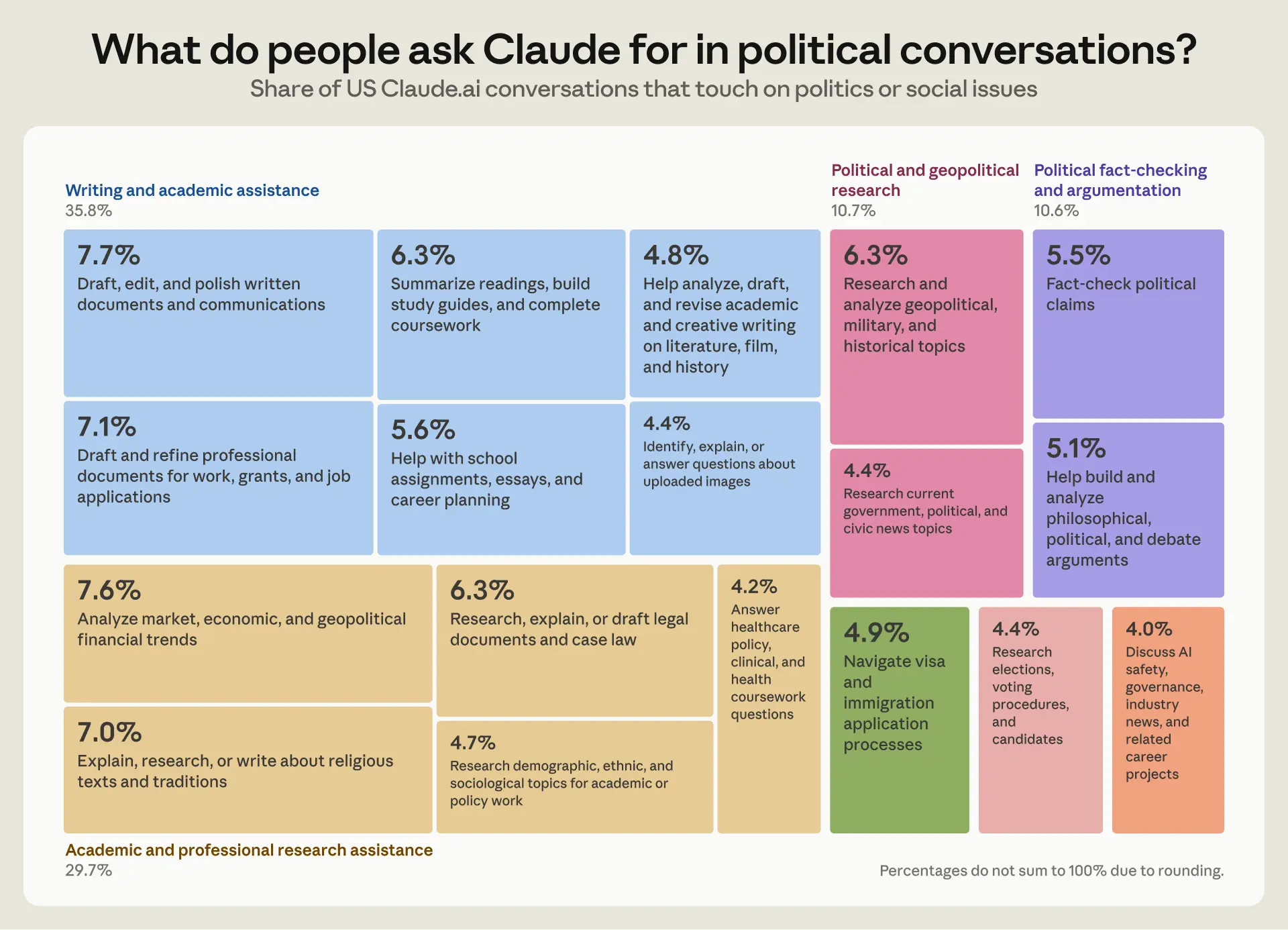
The company also shared a chart showing the different ways people use Claude for political topics. Help with writing and schoolwork made up 35.8 per cent of the conversations shown in the chart. Help with academic and professional research made up 29.7 per cent.
Research about politics and relationships between countries made up 10.7 per cent. Checking political facts and discussing arguments made up another 10.6 per cent.
People also used Claude to learn about elections and voting rules, study economic trends and financial issues involving different countries, and explore political or philosophical arguments.
These findings suggest that people use AI for much more than asking which candidate to support. They also use it to understand government decisions, research public issues, compare different opinions and find information that helps them take part in public life.
How Anthropic Checks Claude for Political Bias
Anthropic says it checks its AI models for political bias before releasing them. It tests whether Claude explains different political opinions with similar levels of detail, fairness and careful reasoning.
In its latest update before the midterm elections, Anthropic said Claude Opus 5.5, Sonnet 5.5 and Haiku 5.5 scored 99 per cent on its test of political fairness.
The company also asked three independent groups to study how Claude responds to political discussions and other subjects that people strongly disagree about.
These groups included The Future of Free Speech, an independent research organisation at Vanderbilt University; the Foundation for American Innovation; and the Collective Intelligence Project. The Collective Intelligence Project surveyed more than 2,000 people in the United States, the United Kingdom and India while creating a way to evaluate Claude.
Anthropic said the studies generally found that Claude gave meaningful answers to people's requests. However, the researchers also found some problems.
According to the company, Claude sometimes added warnings, extra explanations or opposing opinions that users had not asked for. For example, it sometimes included arguments from the other side when someone wanted help writing an email supporting a particular cause.
Another study found that an older model, Claude Sonnet 4.5, was more likely to make arguments supporting politically right-leaning views sound less strong.
Anthropic said it has since worked to make Claude better at answering simple yes-or-no questions and short requests. It has also tried to improve how Claude decides when to add warnings, extra details or opposing views.
The company is also expanding its tests. Instead of mainly checking how Claude discusses broad government policies, it now wants to test more real conversations, questions about political candidates and requests for voting information.
Official Voting Information Directly Inside Claude
Another part of Anthropic's plan is to help people find trustworthy election information without leaving Claude.
The company said Claude would start using official US voting information from Democracy Works. This nonprofit organisation collects publicly available information from state and local election authorities.
The goal is to help Claude answer practical questions about how to register to vote, where to vote and what identification voters need. The answers would be based on the rules in each user's state.
Anthropic also said Claude will continue showing a notice that sends people asking about voting rules or election dates to TurboVote. TurboVote is a service from Democracy Works that does not support any political party.
The company also plans to give users updated election results on election night and during the following days. This would let people ask Claude for the latest official vote numbers.
Reuters reported on October 14 that Anthropic planned to add official voting information and election results before the November midterm elections.
How Anthropic Plans to Stop Election Manipulation
Anthropic's safety rules also focus on stopping people from using Claude to trick voters or run dishonest political campaigns.
The company's rules do not allow people to spread false information about candidates or voting rules, pretend to be election officials, discourage people from voting through deceptive methods or create fake political activity to make something seem more popular than it really is.
Anthropic says people can still use Claude for normal campaign work, as long as they follow its rules. This includes writing press statements, preparing for debates, studying voter turnout numbers and creating materials to communicate with voters.
However, the rules do not allow people to create fake social media identities, produce large numbers of comments to make political posts appear more popular, or write content for websites that falsely claim to be independent news organisations.
To find people breaking these rules, Anthropic uses automatic computer systems called classifiers. These systems look for signs that Claude is being misused in connection with elections. The company's teams that investigate online threats and enforce its rules then examine suspicious activity. They can ban accounts that break the rules.
Anthropic also worked with the Institute for Strategic Dialogue and the McCain Institute to test how well Claude could defend against dishonest political campaigns and other election-related misuse in the United States, Israel and Brazil.
According to Anthropic, these tests found that Claude usually refused individual requests that could cause harm. However, it sometimes failed to notice a larger, organised harmful campaign when the people behind it divided their work into smaller tasks that appeared harmless on their own.
Anthropic said it has added more automatic detection systems to spot these patterns across several steps. These include attempts to create fake social media accounts and fake political news websites.
The company has also improved its ability to find election-related misuse by people working for foreign governments. It has strengthened protections against cyberattacks targeting election systems and political campaigns.
Fake News Websites and Foreign Attempts to Influence Elections
Anthropic revealed that people operating a fake news website from outside the United States had used Claude to create stories about the US midterm elections. These stories supported political messages that favoured Russia, Iran and North Korea.
The company said it banned the accounts involved and improved its systems for finding similar activity.
Anthropic also found people trying to make money from the election period. These people used Claude to create fake news and other content designed to attract American readers and earn money from advertisements.
AFP separately reported on an organised propaganda effort that Anthropic linked to a French advertising agency.
According to AFP, the operation used Claude to produce large numbers of political articles for about 70 fake news websites. The articles appeared in roughly 20 languages, and at least 8,913 stories were published. The operation reportedly targeted several countries, including the United States, Brazil and France.
Meanwhile, The Associated Press reported that political advertisements made or improved using AI are appearing during the 2026 US midterm election period. The report said the rules requiring campaigns to tell people about AI use were not being followed consistently.
The Associated Press report referred to research by the Wesleyan Media Project. Researchers identified at least 164 political advertisements that were made or changed using AI. Of these advertisements, 69 per cent did not tell viewers that AI had been used.
Researchers and political experts have also warned that AI-made content presented without clear labels could trick voters and make people trust political messages less.