
Claude News: Seven Anthropic Announcements in October 2026
Author
Rowan SterlingPublished
Anthropic published seven announcements between October 7 and 22, according to its news page checked on October 23, 2026. Only one announcement was about a new AI model: Claude Haiku 5.5, announced on October 7. Claude Opus 5.5, the main model many people use through an API, was not among them. The announcements covered a smaller AI model, three document tools becoming available to everyone, a code-review tool becoming fully available to businesses, company shares being set aside for a new fund, a new AI assistant with a waiting list, a security tool entering public testing, and an open standard being given to a foundation. These are different kinds of news. Some concern products people can use, while others concern company decisions and shared technology rules.
What these announcements tell us, and what they do not
Each section below gives Anthropic's announcement date, explains what changed, and points out important details that Anthropic has not shared. Any numbers come from Anthropic or its teams, and their source is named. We did not run our own tests or guess numbers from product pages.
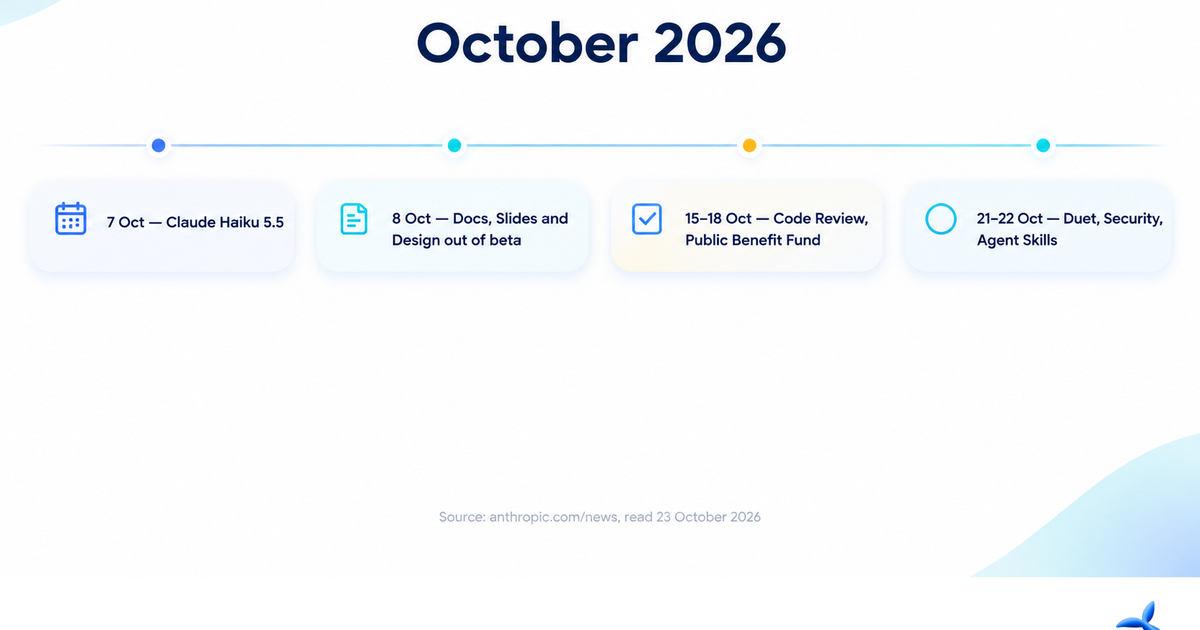
Anthropic's news page shows announcements as cards, with the newest first. Each card has a category and a publication date. This makes the page useful for seeing what Anthropic announced, but it does not always tell us when a product will actually become available. That is why some sections say that information has not been published. When Anthropic only provides a short announcement card, we do not pretend to know more.
The October 7 announcement appears on the right in the image above. It gives a short description of Claude Haiku 5.5 and names three kinds of work it is meant to do. But is that enough information for someone deciding whether to use it? Not really. The next section explains what is missing.
October 7: Claude Haiku 5.5 and its three main uses
Anthropic says Claude Haiku 5.5 is its fastest and most capable small AI model. The company says it is designed for summarizing information, working as a subagent, and using web browsers. A subagent is an AI helper that handles part of a bigger task. These three uses have something important in common: they often require the AI to do many small jobs. It might summarize hundreds of documents, complete many subagent steps, or visit many web pages. Because the work repeats, the cost and waiting time for each step can add up quickly. The cost of the thousandth request matters much more than the cost of just the first one.
These are also tasks where mistakes made by a smaller model can be relatively easy to spot. You can compare a short summary with the original document. Another step can check or use the result of a subagent's work. And when an AI clicks something in a browser, you can see whether the page changes as expected. A cheaper model can be especially useful for tasks that happen many times, as long as its mistakes are easy to find.
Anthropic's claim that Haiku 5.5 is its fastest and most capable small model is a comparison with Anthropic's own models. The announcement does not include independent test results. It also leaves out information that someone would need before using the model for large amounts of work. There is no published price per million tokens, context window size, feature list, or date when developers can use it through an API. A context window is the amount of information a model can handle in one request. Since the announcement does not provide these details, we cannot give them here.
October 8: Docs, Slides and Design become available on every plan, including Free
Three Claude tools, Docs, Slides and Design, finished their beta testing period on October 8. They became available on every Claude plan, including the free plan. This change was mainly about giving more people access, rather than adding a new feature. Tools that had been in testing, and sometimes limited to paying customers, became part of the regular product. People choosing between Free and Pro no longer need to wonder whether these three tools are included.
Two other tools, Claude Dashboards and Claude Motion, started beta testing on the same day. Anthropic announced access changes for all five tools, but it did not explain exactly what each plan allows users to do. It confirmed that Docs, Slides and Design are available on every plan, without giving usage limits or other plan details. It also did not say which plans can use Dashboards and Motion during beta testing.
October 15: Code Review becomes fully available, with results from Anthropic's team
Claude Code Review became generally available for Team and Enterprise customers. General availability means a product has moved beyond its early testing stage and is being offered as a regular product. This matters to businesses because they usually expect more reliable support for a fully released product. However, the announcement does not explain the support promises or give a price for Code Review. It only confirms availability on Team and Enterprise, without saying whether other plans will get it.
On the same day, the Claude Code team published a more detailed article on claude.dev called "How the Claude Code team does code review." It is a 14-minute engineering article written by Addy Osmani, Morgan Westlee Lunt and Qing Wang. The team shared two important numbers. According to the team, Claude writes about 90% of Claude Code's own code. Between June and September, the number of pull requests that were merged more than doubled, while the percentage of changes that had to be undone fell by more than 40%. A pull request is a proposed code change that developers review before adding it to a project.
These numbers describe one team working on one product in its own way. They come from the people who built the product. They do not mean other teams will get the same results, and no independent audit of the numbers has been published. The article also gives a rare look at how Anthropic checks code for a product when most of that code is written by Claude itself. It explains how code can be reviewed when the AI writing it and the AI checking it are the same system working with different settings.
October 18: Anthropic promises 5% of its shares to a fund, with a way to add more
Anthropic announced that it would give part of its company shares to the Anthropic Public Benefit Fund. The fund is described as a new limited liability company, or LLC, fully owned by Anthropic. If shareholders approve, 5% of Anthropic's shares will be committed to the fund. The company's board can also choose to add another 2% for every 50% increase in Anthropic's value above a starting level. This extra amount is not automatic; it is up to the board.
The important part is how the fund could grow. Anthropic says the arrangement is meant to increase the fund's stake as the company grows. The starting commitment is 5%, but the board can add more shares when the company's value reaches certain levels. This is different from giving the fund a fixed amount at the beginning. Whether the fund actually receives more shares depends on information Anthropic has not yet shared.
Several important details have not been published. Anthropic has not said what starting company value will be used to measure each 50% increase. It has not announced when shareholders will vote. It also has not explained how the LLC will be run, who will make its decisions, what it can or cannot do with the shares, or who will check those decisions. The announcement gives the percentages and explains the basic plan, but it does not provide enough information for readers to check how the plan works later.
October 21, part one: Claude Duet opens a waiting list
Claude Duet opened as a research preview for Pro and Max subscribers in the United States. Interested users must join a waiting list. A research preview means the product is still being tested with users, and its design may change. A waiting list means even people who qualify cannot necessarily use it right away. Signing up does not guarantee immediate access. Anthropic also has not said how it will decide who gets access first.
For people outside the United States, Anthropic has shared no plans at all. There is no release date, no waiting list, and no announcement about when the product might reach other countries. This is not simply a confirmed release that has been delayed. Anthropic has not provided any international availability plan, leaving a major question unanswered.
October 21, part two: Claude Security starts public beta testing, with two other announcements
Claude Security entered public beta testing for Claude Enterprise on October 21. A public beta is a stage where a product is available for people to try but can still change before its full release. Anthropic has not explained how close Claude Security is to being finished. It has confirmed that the beta is for Enterprise customers, not Team customers or people on personal Claude plans.
Anthropic also announced two other changes on October 21. Christopher Stubbs, a physicist, joined Anthropic's Long-Term Benefit Trust. HCLTech joined the Claude Partner Network as a Global Premier partner. Neither announcement gave much more information. Anthropic did not share the terms of its partnership with HCLTech. It also did not explain what Christopher Stubbs's appointment changes about the Trust or list the Trust's other members.
October 22: Agent Skills moves to a foundation, and Anthropic invites guest investigators
Anthropic donated the Agent Skills standard to the Agentic AI Foundation, which is part of the Linux Foundation. A standard is a shared set of rules that helps different tools work together. Anthropic did not just hand over the computer code. It also transferred the Agent Skills name, logo, GitHub organization and agentskills.io website address. This matters because developers who already use the standard can continue to recognize it by the same name and find it in the same place, even though a different organization will now own it.
Giving an open standard to a foundation changes who is responsible for it, rather than directly changing a product people use. That raises questions about how decisions will be made. Anthropic has not published the date when the transfer will be completed. It also has not explained how the foundation will manage Agent Skills or whether the standard will cover different things now that Anthropic is one participant instead of its owner.
On the same day, Anthropic invited people working in the life sciences to apply to become guest investigators. These investigators would work with Anthropic on special projects. The announcement did not say how many people would be accepted, how much funding would be available, or when applications would close.
What October's announcements still leave unanswered
Looking at all seven main announcements together shows a clear pattern. Anthropic has shared its plans and some important changes, but many practical details are still missing. Those details often arrive weeks after the first announcement, sometimes without getting their own news post.
• Claude Haiku 5.5 has a clear purpose and three suggested uses, but no published price, context window size or benchmark results.
• Claude Duet has a waiting list for Pro and Max subscribers in the United States, but no published availability plans for other countries.
• Claude Security is in public beta for Enterprise, but Anthropic has not published a full release date or price.
• The Public Benefit Fund has a promised 5% share commitment and a plan that could increase it, but Anthropic has not published the starting company value, shareholder vote date or rules for managing the LLC.
• Code Review is available for Team and Enterprise, but Anthropic has not said whether Pro or Max users will get it.
• Docs, Slides and Design are available on every plan, but Anthropic has not published how much each plan can use them.
• Agent Skills has been donated to a new owner, but Anthropic has not published the date when the transfer will be completed.
That is what October's news tells us so far: seven announcements made on specific dates, covering several very different kinds of changes, with more information still to come. The useful way to understand each announcement is to know when it happened, what actually changed, and which important questions Anthropic has not yet answered.
If you use Claude through an API instead of its apps
None of these seven announcements changes how developers make API requests to AI models. Our service provides access to AI models, not Anthropic's apps or AI assistants. Claude Duet, Claude Security, Docs, Slides and Design are not available through our endpoint. What we do offer is Claude Opus 5.5. It costs $4.00 per million input tokens and $20.00 per million output tokens. It has a context window of 1 million tokens, and reading information from the cache costs $0.20 per million tokens. Developers can access it through one endpoint that works with OpenAI-compatible software. That endpoint provides more than 200 models using one API key. OrcaRouter says it adds no extra charge to the provider's listed price, meaning a 0% markup, and can automatically switch between providers if one fails.
Announcements about Claude's apps and other products do not change the prices of the underlying AI models. Those model prices were already set before October's announcements began, and developers can use the existing API offering now.