
AI research on sports injury prediction has exploded, a new map shows
Artificial intelligence (AI) has become a big part of sports medicine very quickly. A new study shows just how fast research in this area has grown. Published on 23 October 2026 in Discover Artificial Intelligence, the study looked at 809 research publications about using AI to predict and prevent sports injuries, as well as closely related research on sports performance. The number of publications grew from just 13 in 2018 to 204 in 2025. That is about 15 times as many in only seven years. K. Moorthi and colleagues led the study. It is the first study to carefully map how research in this field is organized and how different topics connect. Before this, the research was spread across sports science, biomechanics, sports medicine, data science, and engineering. The researchers explain that their study shows what has been published and how the field has changed. It does not prove that AI tools actually work well at preventing injuries in real sports settings.
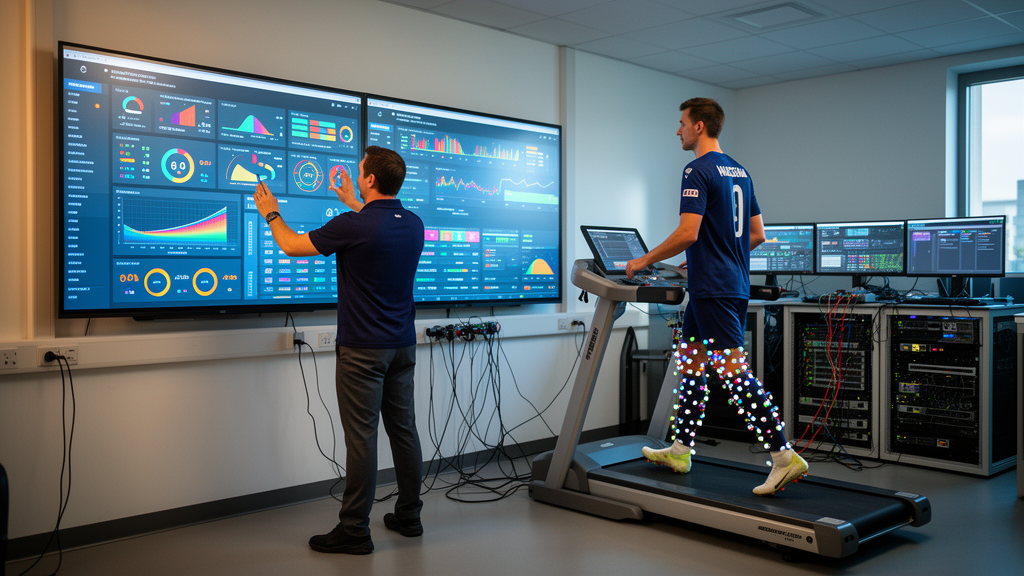
This fast growth is partly happening because sports injuries are difficult to predict using traditional methods. Older approaches usually look at a small number of risk factors and use standard statistical methods. These methods have often struggled to make accurate predictions. One reason is that injuries happen through complicated, changing connections between body movement, physical health, training demands, and other conditions. These connections do not always follow simple patterns. AI and machine learning can learn from information, find complicated patterns, make predictions, and work with large amounts of different kinds of data without needing people to guide every step. Modern sports now produce huge amounts of information from games, training sessions, and athlete monitoring. Wearable devices, GPS trackers, and sensors that measure body movement can collect information almost continuously and in nearly real time. Because injury risk is closely connected to how athletes perform, train, and are monitored, research on predicting performance, studying performance, and monitoring athletes is also an important part of this field.
To create their research map, the team searched the Scopus research database on 11 July 2026. They did not limit the search to any particular publication year. They combined three groups of search terms. The first covered AI, including machine learning, deep learning, and neural networks. The second covered sports and athletes. The third covered injury prediction, injury prevention, and related sports performance topics. The search found 1,048 records from journal articles and reviews written in English. After checking their titles and summaries, the researchers removed 239 records that were not relevant. These included 137 about medical injuries outside sports, 42 about vehicle and traffic injuries, 34 about workplace and industrial injuries, and 26 about other unrelated topics. This left 809 publications: 694 research articles and 115 reviews, with publication dates ranging from 1997 to 2027. The team studied these publications using the Bibliometrix package for the R programming language through its Biblioshiny interface, along with VOSviewer version 1.6.18. They followed a systematic method for mapping scientific research. They did not carry out co-citation analysis, which looks at publications cited together, or bibliographic coupling analysis, which looks at publications that cite the same sources.
The number of publications each year shows that the field was very quiet at first, then grew extremely quickly. From 1997 to 2015, most years had fewer than four publications. Growth then became more steady, with seven publications in 2016, 13 in 2018, 18 in 2019, 29 in 2020, 55 in 2021, and 83 in 2022. After that, the numbers jumped to 86 in 2023, 150 in 2024, and 204 in 2025. Because the researchers searched the database in July 2026, they treated the 147 records dated 2026 and 2027 differently. These were papers made available early or accepted for publication but not yet fully published. The researchers left them out of the yearly growth figures. This means the yearly trend uses 662 publications from the complete years between 1997 and 2025. All the other measurements in the study use the full set of 809 publications.
The research covers many subjects and has been cited many times by other researchers. The 809 publications came from 371 journals and other publication sources and involved 3,226 researchers. Together, they received 13,295 citations, or an average of 16.4 citations per publication. Liu Y had the most publications, with 13. Li Y and Wang Z followed with 12 each. Wang X, Wang Y, and Zhang Y each had 10. The study's authors warn that some of these family names are very common. Even though they used Scopus Author Identifiers and manually checked where researchers worked to tell people apart, some names may still have been mixed up. The journals publishing the most research were Scientific Reports, with 25 articles, Sensors, with 23, and MCB Molecular and Cellular Biomechanics, with 22. The pattern generally followed Bradford's law. This is the idea that a small group of important journals publishes a much larger share of research than other journals. The results also show that this research is spread across several different scientific fields.
Most of the research came from a relatively small group of countries. The researchers counted every country connected to a publication through an author's workplace or institution. Using this method, China contributed to 477 publications and the United States to 467, making them the two leading countries with very similar levels of research activity. They were followed by the United Kingdom with 112, Spain with 92, Canada with 90, Italy with 86, France with 85, Australia with 71, India with 67, and Portugal with 65. In total, 73 countries were represented. Because a publication involving researchers from several countries is counted once for each country, these country totals add up to more than 809. They show how much research each country helped produce, not the number of separate publications. The map of researchers working together showed two main groups. China had strong research connections across Asia and the Middle East. Its strongest connection was with South Korea, which was also the strongest connection between any two countries in the network. China's other connections included Malaysia, Iran, Turkey, India, and Saudi Arabia. The United States was at the center of another group, mainly involving English-speaking countries such as the United Kingdom, Australia, Canada, and New Zealand, along with Qatar. A third group was centered on mainland Europe but also included Japan, Brazil, and Chile. These countries worked more closely with this group than with some of their nearby neighbors. This suggests that researchers often work together because of existing professional relationships rather than simply because their countries are close together. One important finding was that China and the United States had a relatively weak research connection compared with their connections inside their own groups. This means the two biggest contributors are largely developing their research through separate networks rather than working together as one connected group.
The researchers also looked at which publications had been cited most often. The most influential works mainly studied how machine learning could help predict and prevent injuries in team sports. A small number of highly cited publications covered related subjects, such as recognizing human activities in general and designing wearable technology. These remained in the dataset even though they were not directly focused on sports injury prediction and prevention. A publication by Claudino and colleagues had the most citations, with 319. Van Eetvelde and colleagues followed with 290, and Rossi and colleagues had 269. To understand how research topics connect, the team looked at keywords that appeared together. There were 2,152 different keywords chosen by the authors of the publications. Of these, 44 appeared at least eight times, the minimum needed for this part of the analysis. These keywords formed six groups connected by 320 links, with a combined link strength of 761, a measure of how strongly the keywords were connected. Machine learning was the most common and most central keyword, followed by artificial intelligence and deep learning. One group focused on machine learning in team sports and connected topics such as football, soccer, injury, prevention, prediction, training load, and classification. Another connected deep learning with computer methods for studying images and movement, including motion capture, estimating body positions, kinematics, biomechanics, inertial measurement units, and neural networks. A third connected injury prediction with athlete monitoring, prediction models, wearable technology, random forest methods, and risk factors. The other groups connected artificial intelligence with sports and athletes; concussion with traumatic brain injury and wearable devices; and wearable sensors with sports data analysis and data mining, which means finding useful patterns in large amounts of information.
The researchers also mapped which topics were most important and how far they had developed. Injury prevention, injury risk, and wearable technology formed the most developed and central group of topics. The researchers called this a motor theme because it was helping drive the field forward. Topics such as artificial intelligence, sports medicine, machine learning, injury prediction, soccer, deep learning, biomechanics, and wearable sensors were basic and cross-cutting themes. They were strongly connected to many other subjects but were not as fully developed. Sports performance, sports analytics, and data mining were well-developed topics but were less connected to the main direction of the field. These were called niche themes. Sports injury, concussion, and neural network appeared in a category for topics that might be newly developing or becoming less important. The authors explain that this category alone cannot show whether a topic is growing or declining. The team also studied how the main topics changed over three periods. From 1997 to 2018, the field was small and mainly focused on soccer, concussion, machine learning, and injury prevention. From 2019 to 2022, it became much more varied. New topics included random forest methods, computer vision, long short-term memory networks, and the Internet of Things, alongside research focused on particular sports. Long short-term memory networks are AI systems designed to learn patterns in sequences of information, while the Internet of Things involves connected devices that collect and share data. From 2023 to 2025, research became more concentrated around machine learning, football, injury prevention, athletes, neural networks, data science, and sports medicine. This showed a move toward using data analysis in sports and monitoring athletes in practical settings.
The authors strongly emphasize that their study maps published research. It does not test how accurate AI models are, how well they work, or whether they are useful in medical practice. The study also has several limitations. First, it used only Scopus, so it may have missed relevant research found only in other databases, such as Web of Science, PubMed, or IEEE Xplore. Second, it included only publications written in English. Third, newer publications have had less time to be cited by other researchers. Fourth, the publication years 2026 and 2027 were not complete when the search took place. Fifth, the publications included depended on the exact search terms and on how Scopus organizes and labels research. Sixth, only one reviewer checked the titles and summaries, which could have increased the chance of including or excluding publications by mistake. Seventh, the study gave equal weight to all publications that met its rules, no matter how the research was designed, how many people it studied, or how well its AI models performed. The authors also explain that looking at keywords and citations cannot tell whether a study only suggests a new AI method or actually uses or tests that method in real sports settings. Looking to the future, the research shows a need for AI models in sports to be more transparent, easier to understand, and able to work well in different situations. Explainable AI could help sports professionals understand why a model makes a particular prediction. Combining several different types of data could also help give a more complete picture of an athlete's injury risk. The authors say that more high-quality original studies and intervention studies are needed to find out whether these systems actually improve results in practice. They present their research map as a guide to help other scientists understand and explore a field that is growing faster than ever.
Subject of Research: A study mapping published research on artificial intelligence for predicting and preventing sports injuries
Article Title: A bibliometric analysis of artificial intelligence in sports injury prediction and prevention
Article References: Moorthi, K., Sivachandiran, S., Chakravarthy, A., Uvais, M. O., & Ajmal, P. M. (2026). A bibliometric analysis of artificial intelligence in sports injury prediction and prevention. Discover Artificial Intelligence, 6(1), Article 1616. https://doi.org/10.1007/s44163-026-02572-7
Image Credits: AI Generated
DOI: 10.1007/s44163-026-02572-7
Keywords: artificial intelligence, machine learning, sports injuries, injury prediction, injury prevention, bibliometric analysis, wearable technology, athlete monitoring, sports analytics, biomechanics, deep learning, Scopus