
OpenAI Cuts $150 Billion Valuation as Anthropic Reports $80 Billion Loss: Is the AI Boom Cracking?
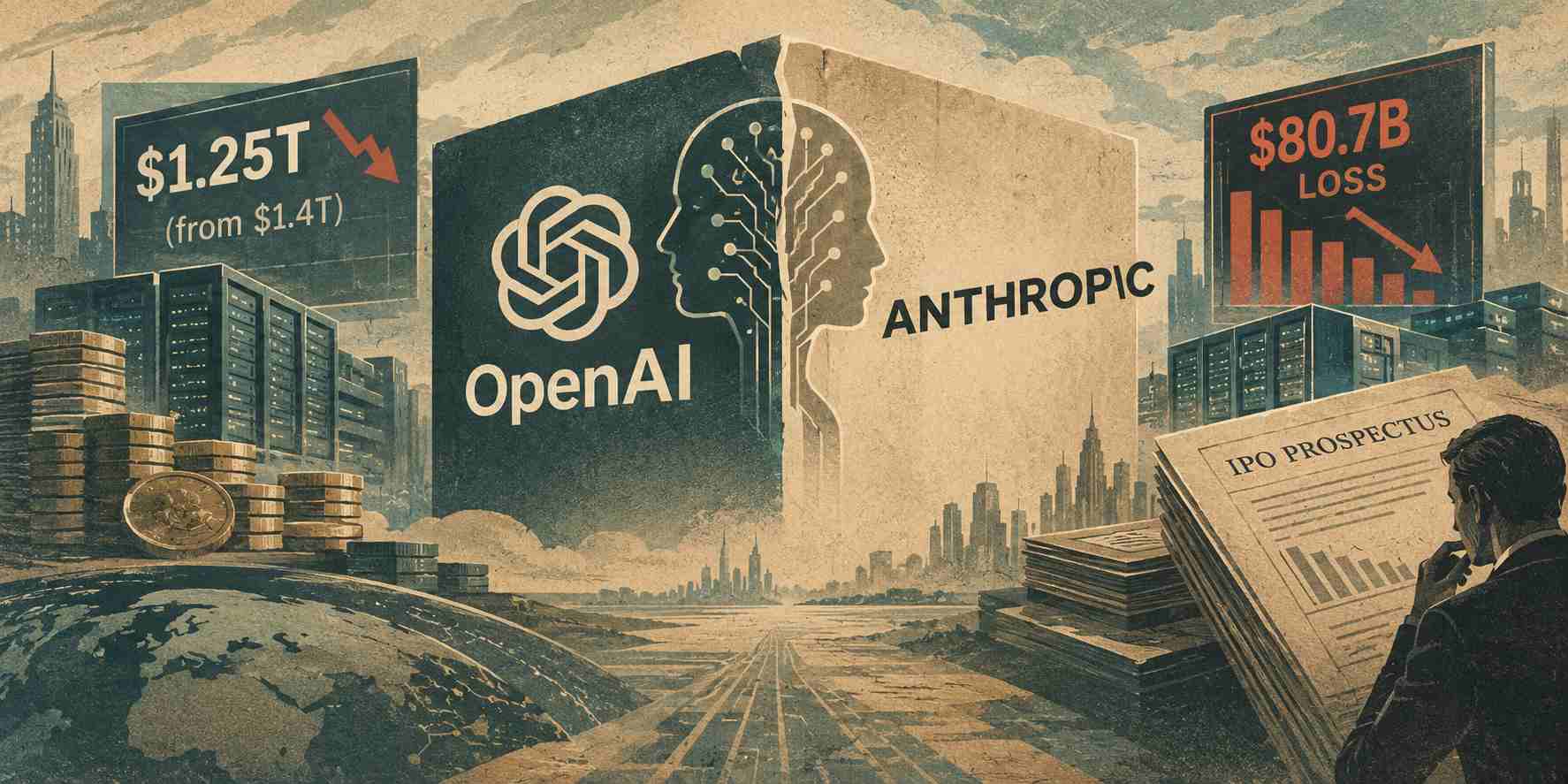
OpenAI has reportedly lowered the value it wants investors to place on the company by $150 billion, bringing it to $1.25 trillion. Meanwhile, a draft document for rival company Anthropic's planned stock market listing shows an $80.7 billion net loss in the first half of 2026. These figures show the huge money problems facing companies during the artificial intelligence boom.
Investors are now looking more closely at how much AI companies spend on computer systems, why computing costs keep rising, and how these companies plan to make a profit. Both OpenAI and Anthropic still attract a lot of interest from investors. But their latest financial information raises an important question: Can these companies earn enough money from AI to pay for the enormous cost of building and running advanced AI models?
Key Points
- OpenAI lowered its proposed company value from $1.4 trillion to $1.25 trillion while trying to raise about $30 billion in new funding.
- Anthropic reported $16.3 billion in revenue during the first half of 2026, but also an $80.7 billion net loss, according to its draft IPO document.
- About $72 billion of Anthropic's reported loss came from accounting changes involving financial agreements that can turn into company shares. This was not money actually paid out.
- Higher computing costs, long-term promises to pay for computer systems, and uncertainty about future profits are making investors examine AI companies more carefully before they sell shares to the public.
OpenAI's Proposed Value Falls by $150 Billion: Is the AI Boom in Trouble?
OpenAI has lowered the value it wants investors to place on the company from $1.4 trillion to $1.25 trillion. This change comes as the company discusses raising about $30 billion in new funding, according to a Bloomberg report published on October 23, 2026. The $150 billion decrease is about 10.7% of its earlier target.
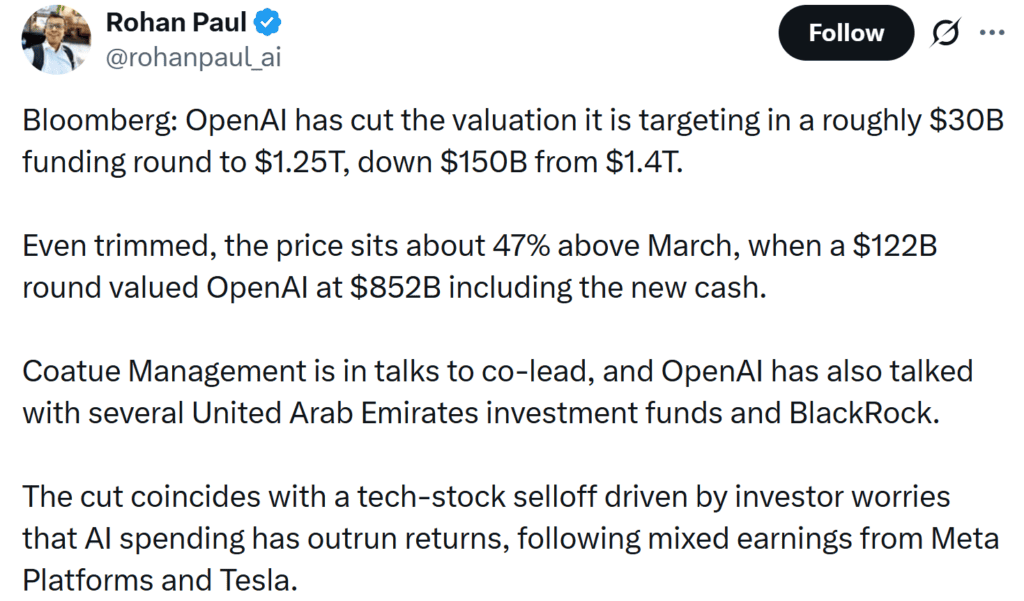
OpenAI lowered its proposed value by $150 billion to $1.25 trillion while discussing a $30 billion funding round. The talks are still happening. Source: Rohan Paul via X
Even after this decrease, OpenAI's proposed value is much higher than the $852 billion value it reached in March 2026, after reportedly raising $122 billion. The new target is about 47% higher than that earlier value. This shows that OpenAI is still aiming to raise large amounts of money, even after lowering its target.
This change does not mean OpenAI actually lost $150 billion in market value. It means the company lowered the value it is asking investors to accept during private funding talks. Those talks are not finished.
The timing matters. Technology stocks have faced selling pressure after companies including Meta Platforms and Tesla reported mixed financial results. This has made investors more worried that companies may be spending money on AI computer systems faster than they can earn it back.
Building advanced AI systems costs a lot of money. Companies need special computer chips, data centers, electricity, and large amounts of computing power. Investors are asking whether AI companies can earn money from customers quickly enough to pay these bills and support their high company values.
Why Is OpenAI Lowering Its Proposed Value?
According to the Financial Times, OpenAI lowered its target after investors pushed back against its earlier $1.4 trillion value. The lower target may make it easier for OpenAI and investors to agree on how much the company is worth and how much new money investors are willing to provide.
The wider fall in technology stock prices has added pressure. Investors are thinking again about how much money AI investments might earn. However, the available information does not prove that worries about spending on computer systems were the only reason OpenAI lowered its proposed value.
There is an important difference between a proposed company value and a value agreed upon when a funding deal is completed. Private companies do not have stock prices that change every day on a public market. Instead, their values depend on what investors and companies agree to, including the terms of the deal and hopes for future growth. Until the funding deal is finished, OpenAI's $1.25 trillion target could still change.
OpenAI Wants $30 Billion Before a Possible Stock Market Listing
OpenAI is still trying to raise about $30 billion to help it grow. Bloomberg reported that Coatue Management was discussing becoming one of the main investors leading the funding deal. BlackRock and investment funds from the United Arab Emirates were also involved in discussions about providing money.
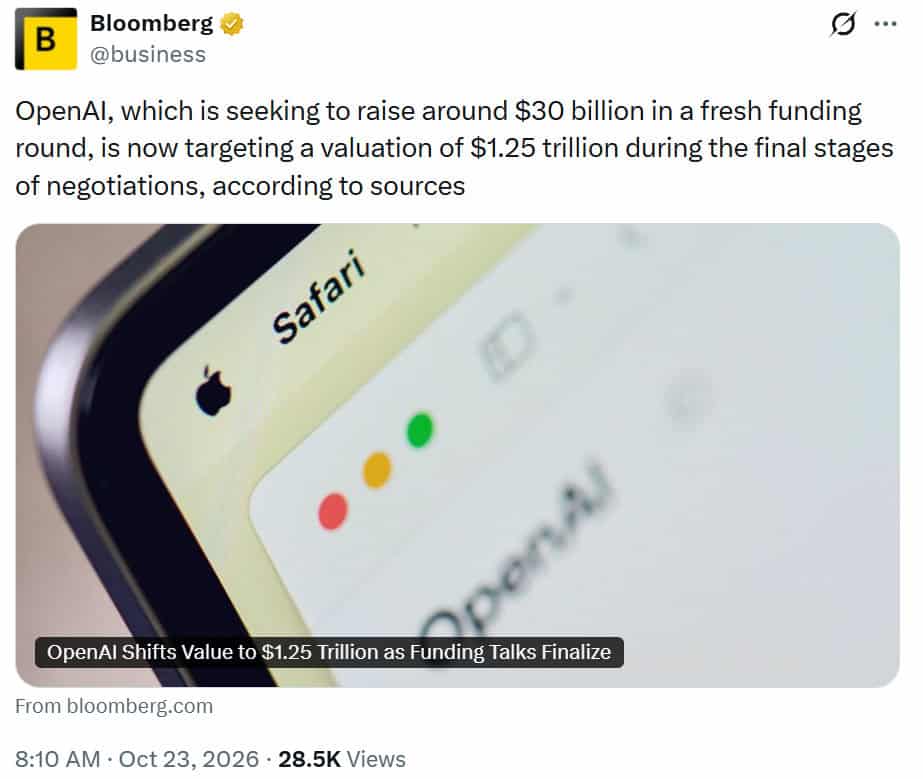
Bloomberg reports that OpenAI lowered its proposed value from $1.4 trillion to $1.25 trillion for a $30 billion funding round after investors pushed back against the earlier figure. Source: @business via X
Investors could finish agreeing to provide the money by the end of the following week. However, the final amount raised and the company's agreed value were still uncertain.
These discussions are happening as OpenAI prepares for a possible initial public offering, or IPO, in 2027. An IPO is when a company starts selling its shares to the public on the stock market. If OpenAI does this, investors will look much more closely at its financial results, how much money it needs, and whether it is moving toward making steady profits.
OpenAI faces a difficult balancing act. It needs to keep spending money to build better AI models and increase its computing power. At the same time, it must show that its products can bring in enough regular income to pay for those costs. Reports that OpenAI expects to spend about $278 billion in cash through 2030 show how big this challenge is.
The result of OpenAI's funding talks could also affect what investors expect from Anthropic, which is preparing for its own possible IPO. Both companies need to convince investors that their fast growth can eventually lead to profits that last.
Anthropic's IPO Document Shows Fast Growth, Big Risks, and Huge Computing Costs
Anthropic's draft IPO document gives another look at the money problems facing AI companies. According to The Wall Street Journal's review of the document, Anthropic earned $16.3 billion in revenue during the first six months of 2026. That was up from $1.1 billion during the same six months in 2025.

Anthropic's draft IPO document shows $16.3 billion in revenue and an $80.7 billion net loss in the first half of 2026. About $72 billion of that loss came from accounting charges involving changes in the value of financial agreements that can turn into shares, rather than money actually spent. Source: @WSJ via X
Even though Anthropic's revenue grew quickly, the company reported an $80.7 billion net loss. A year earlier, its net loss was $13 billion. About $72 billion of the latest loss came from accounting charges that did not involve paying out cash. These charges were linked to changes in the estimated value of financial agreements that can later be turned into company shares.
These accounting changes do not mean Anthropic actually spent the same amount of cash running its everyday business. Investors therefore need to look separately at its reported net loss, its real operating costs, and the money flowing in and out of the company to understand its financial health.
The cost of computer systems gives a clearer picture of what Anthropic needs to run its business. During the first half of 2026, Anthropic spent almost $9 billion on computing and related infrastructure. A year earlier, it spent $2.3 billion. Its spending during just the first six months of 2026 was also greater than its reported spending on infrastructure during all of 2025.
Long-term agreements create more financial risks. Reports based on Anthropic's draft IPO document say the company has promised to spend more than $600 billion on cloud services, computing, and infrastructure. Some estimates reach $750 billion when agreements that might happen in the future are included. Much of this spending is connected to contracts that are difficult to cancel.
These agreements help Anthropic make sure it has enough computing power to meet customer demand. But they also make it harder for the company to change its spending plans if revenue grows more slowly or its computing needs change.
Growth That Most Companies Never Experience
Anthropic's revenue growth is still very large. Its revenue for the first six months of the year grew from $1.1 billion in 2025 to $16.3 billion in 2026. This shows that more customers want its AI products and services.
Anthropic's Claude Code assistant helps people write computer code. It has attracted software developers and business customers who want tools to help build software and complete technical tasks automatically. By focusing on businesses, Anthropic can earn regular income when customers make its AI tools part of their everyday work.
Anthropic's revenue reportedly rose 45% in the third quarter, reaching $16.8 billion, up from $11.6 billion in the second quarter. That is still a large increase. But its growth from one quarter to the next was slower than in the previous period, when revenue more than doubled between the first and second quarters.
This slowdown in the rate of growth matters. Investors need to know whether Anthropic can keep increasing its revenue fast enough to pay for its growing computer system costs. Even a company that is growing very quickly can face money problems if its expenses grow just as fast or faster.
Investors have reportedly discussed valuing Anthropic at around $1.5 trillion. That is below earlier expectations of about $2 trillion. Even the lower figure is extremely high. It means investors would be counting on Anthropic to keep growing and to earn more profit from each dollar of revenue after paying its costs.
The High Cost of Not Having Enough Computing Power
Getting enough computing power is one of the biggest challenges for companies building advanced AI. Training AI models and running them for large numbers of users requires special computer chips, data centers, electricity, and cloud services. Companies need enough of these resources to operate, but competition to get them can make growth expensive.
Anthropic's reported promises to spend money on infrastructure show how difficult this can be. Estimates of the company's total future payments differ, but its draft IPO document and related reports point to possible spending of hundreds of billions of dollars over the coming years.
Contracts that cannot be cancelled can help Anthropic know it will have access to the computing power it needs. But these contracts also mean it must keep paying certain costs. If customers start buying less, Anthropic might not be able to cut its expenses quickly enough to protect its profits.
Its relationships with companies that provide computer systems make things more complicated. Amazon, Google, and Microsoft provide cloud computing services to Anthropic, but they also build their own AI products. This means they are both business partners and competitors. Their different business goals could affect how much computing power Anthropic can get, how much it pays, and the rules in its contracts.
Anthropic must make sure it has enough computing power to serve customers without letting the cost of that power grow faster than the money it earns from using it.
Why the Entire AI Industry Is Paying Attention
Anthropic's possible IPO could show how willing investors are to put money into AI companies that are growing quickly but have also promised to spend huge amounts on computer systems. Its financial documents give potential investors a clearer picture of both the chance to make money and the costs of competing in the AI industry.
How investors respond to Anthropic could also affect what they expect from OpenAI and other AI companies thinking about selling shares to the public. Investors will watch to see whether strong revenue growth can support the high company values being proposed, especially as computer systems require more and more money.
OpenAI's expected cash spending of about $278 billion through 2030 shows how much investment is needed to build and operate advanced AI systems. It also helps explain why investors are paying more attention to how companies use their money and how long it will take for those investments to earn returns.
Unstable prices in the wider technology stock market add more uncertainty. If investors become less willing to pay for expensive growth plans, AI companies may have to accept lower company values, spend less money, or show a clearer plan for becoming profitable.
Is the AI Boom Starting to Break Down?
OpenAI's lower proposed value and Anthropic's reported $80.7 billion loss in the first half of 2026 do not prove that the AI boom is ending. OpenAI's new proposed value is still higher than the value set during its previous funding round. Anthropic's fast revenue growth also shows that customers are willing to spend large amounts of money on AI products.
Instead, these developments show that investors are changing what they care about most. Growth and better technology still matter, but investors increasingly want proof that AI companies can earn enough money to pay their computing bills, meet their long-term promises to spend on infrastructure, and keep building more advanced AI models.
OpenAI needs to raise money through agreements that will help it continue growing. Anthropic faces close questions about its everyday business costs and long-term infrastructure payments before a possible IPO. Both companies will need to show that their businesses can support the enormous amounts of money they require.
The next stage of the AI market may depend less on how much money companies can raise and more on how well they turn that money into profits and a steady flow of cash. The latest financial reports show that investors are asking tougher questions. But whether this leads to a wider drop in AI company values will depend on how well the companies actually perform, how much investors still want to invest, and whether the industry can keep delivering financial returns over time.