
‘Bouncing Back’ in AI. OpenAI, Anthropic & Mr. Market. ARD #191
OpenAI lowers its target value, Anthropic changes how it talks to investors, banks prepare for AI risks, and AI helps bring old video games back to life.
Michael Parekh · October 23, 2026
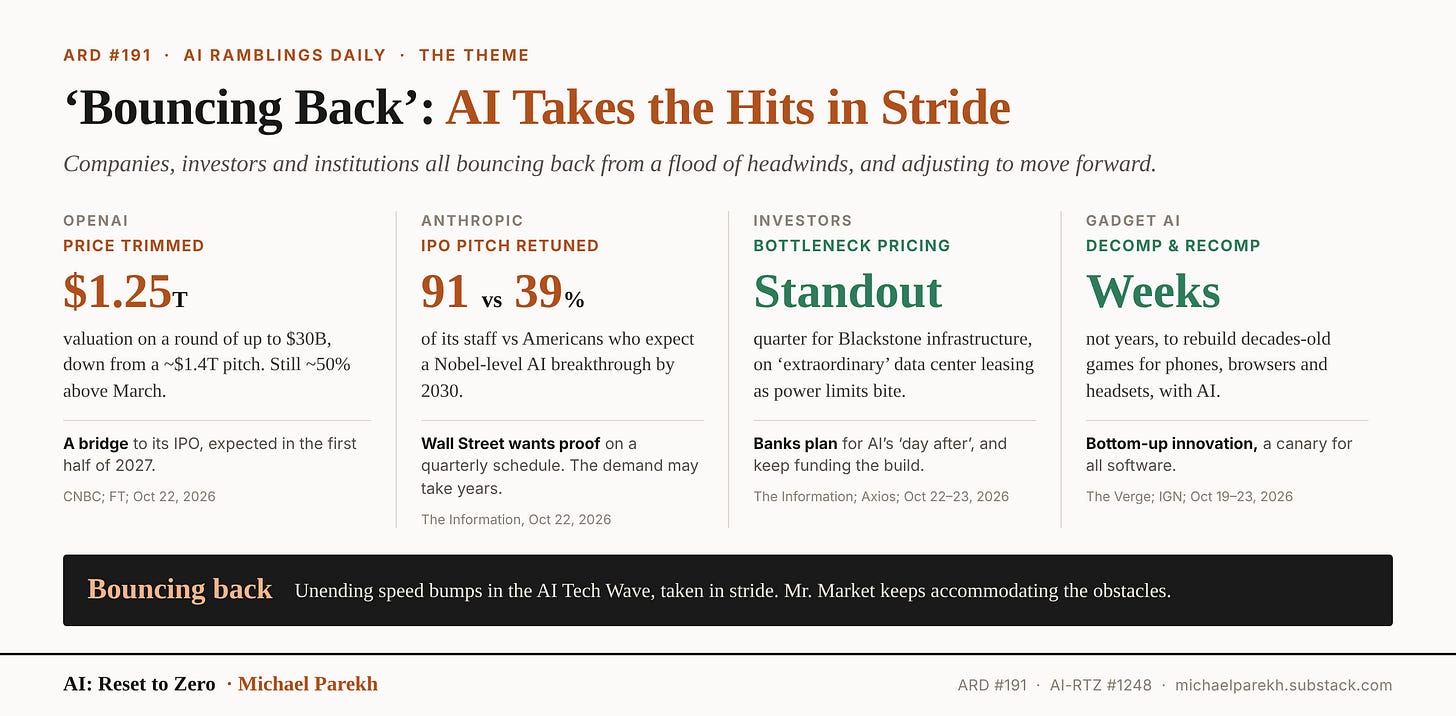
It's Friday, and today's theme is 'Bouncing Back.' Many companies, investors, and organizations are finding ways to recover from the problems coming their way during this AI Tech Wave. On Tuesday, it felt like taking one step forward and two steps backward. Today, the focus is on recovering and moving ahead.
We'll look at three developments. First, OpenAI is lowering its target value before what could be its last big private fundraising round ahead of its stock market debut, but it is still raising a huge amount of money. Second, Anthropic is changing how it presents its plans to investors before its own expected stock market debut. Third, investors in both private and public markets are adjusting to AI-related challenges. Then, in Gadget AI, we'll explore how AI is helping old video games run on modern devices.
(1) OpenAI lowers its target value but still raises a lot of money.
OpenAI is close to raising as much as $30 billion from private investors. The company would be valued at $1.25 trillion before adding the new money. Investors from the United Arab Emirates and investment firm Coatue are leading the deal, according to CNBC's report on OpenAI's funding round. OpenAI had previously suggested a value of about $1.4 trillion, including when talking to wealthy private investors, according to the Financial Times in its report on the lower target. Even at $1.25 trillion, OpenAI would be worth about 50 percent more than at its previous fundraising round in March, when it was valued at about $852 billion. Investors have until October 30 to decide whether to take part. This fundraising is meant to help OpenAI reach its initial public offering, or IPO, when its shares become available to public investors. That IPO is now expected in the first half of next year. Meanwhile, its biggest rival, Anthropic, hopes to complete its own IPO by Thanksgiving, with a target value of $1.5 trillion to more than $2 trillion.
The lower target suggests that some investors are getting tired of putting so much money into AI. Companies have already raised hundreds of billions of dollars from private and public investors, both by selling ownership stakes and by borrowing money. But the fundraising continues. Google has raised more than $80 billion, even though it spent over 20 years making so much cash that borrowing money once seemed unnecessary. This week, Meta created a new type of share that gives owners no voting rights. This could help it raise more money to support over $140 billion in yearly spending on AI infrastructure, as discussed in ARD #190. OpenAI also has commitments worth more than $850 billion, while Anthropic has commitments exceeding $750 billion, as I discussed in AI-RTZ #1246.
At the same time, OpenAI is holding major talks in the UAE about computing resources. Investors in the Middle East are very interested in financing AI projects, especially when companies agree to build data centers in their countries. But the situation has become more difficult. Saudi Arabia has postponed its major 'Davos in the Desert' investment conference until 2027 because of the war with Iran. The conflict has included deadly attacks on Riyadh's airport by the Iran-backed Houthis, according to Al Jazeera. Despite these problems, OpenAI continues finding ways to move forward in unusually difficult circumstances.
MP Take: I think OpenAI has shown the determination and ability to adjust that it needs to get things done. This fundraising round is another example. Back in March, I looked at OpenAI's IPO prospects six months ahead of time in RTZ #1021. The big question was whether public investors would be willing to value the company at more than $1 trillion. In September, I compared OpenAI to Pepsi and Anthropic to Coke in ARD #166. My point was that OpenAI could be a strong second-place competitor. For a company in that position, raising tens of billions of dollars at a value of $1.25 trillion fits the picture. I expect OpenAI to keep making changes when needed, especially as new information comes from Anthropic's expected IPO in the coming weeks.
Sources: CNBC, 'OpenAI nears up to $30 billion funding round at $1.25 trillion valuation led by UAE investors' · Financial Times, 'OpenAI trims valuation target to $1.25tn after pitching higher price' · Al Jazeera, 'Saudi Arabia cancels 2026 Davos in the Desert amid Houthi attacks'.
(2) Anthropic changes how it explains its huge IPO plans.
Anthropic's biggest challenge before its IPO may be convincing Wall Street investors that its plans make sense, according to The Information in 'Anthropic's Elevator Problem: Persuading Investors to Share Its AI Dream'. Some investors worry that a very small group of people, perhaps few enough to fit inside one elevator, are making decisions that could shape the future of the world through AI. This concern is especially important because Anthropic's founder and CEO, Dario Amodei, has been a leading voice in debates about whether AI will bring great benefits or serious dangers. Anthropic's employees are very confident about AI's future. In one company survey, 91 percent said they expect AI to make a discovery worthy of a Nobel Prize by 2030. Only 39 percent of Americans shared that expectation. Wall Street is much less confident. Investor confidence in AI is at its lowest level this year. Some investors who attended Anthropic's investor day last week felt that its growth did not support a value close to $2 trillion. This was despite the company's revenue growing 45 percent from the previous quarter to almost $17 billion in the third quarter, as discussed in ARD #186.
When a company presents itself to investors before an IPO, it normally tries to sound hopeful about its future. It must also explain the risks. As I've written before, about 30 percent of Anthropic's draft S-1, the document companies prepare before selling shares to the public, is expected to contain detailed warnings about risks. But investors mainly want clear evidence that customers will buy enough AI products and services in the near future.
MP Take: I think many people generally believe that demand for AI will grow. The problem is timing. Wall Street likes to see results every three months, but AI demand might take years to develop fully, possibly five years or longer. Anthropic is doing what it needs to do in the near term. It may also need to change its target value and financial forecasts, especially if investors question whether its very fast revenue growth can continue. Even slightly lowering those growth expectations would require more explanation. In August, I wrote in AI-RTZ #1181 that Anthropic's IPO calculations depend heavily on what happens in 2028. I still think that is the right way to look at the situation. We'll see how things change.
Source: The Information, 'Anthropic's Elevator Problem: Persuading Investors to Share Its AI Dream'.
(3) Investors change their plans to deal with AI problems.
Investors in both private companies and publicly traded companies are changing what they expect as they deal with AI-related problems. Some are technical and practical, such as delays in connecting data centers to electricity supplies. Others are political. Politicians from both major US parties are facing opposition to new data centers ahead of the midterm elections. Banks are also taking steps to protect themselves from risks involving AI agents, which are AI systems that can carry out tasks on their own. As I discussed earlier this week, America's biggest banks are now preparing for what they would do after a major AI disaster, rather than only trying to prevent one. Axios described this in 'Wall Street prepares for AI's day after'. JPMorgan CEO Jamie Dimon said stopping AI is not a realistic choice. Instead, organizations must work extremely hard to manage it. I think that is an important message.
Meanwhile, Blackstone, one of the world's largest private equity firms, said its infrastructure business performed especially well in its latest quarterly report. The company pointed to unusually strong demand from businesses wanting to rent data center space, according to The Information in 'Why Blackstone Thinks AI Bottlenecks Could Work in its Favor'. Electricity shortages and local opposition are making new data centers harder to build. Blackstone believes this makes the data centers it can finish sooner more valuable. This is important because Blackstone operates on a huge scale, with enormous amounts of private and public investment involved. But Blackstone also faces problems. It has lent billions of dollars to CoreWeave, whose share price fell another 10 percent on Thursday. It also supported Firmus, which canceled its planned IPO. Meanwhile, SoftBank's SB Energy, which is building an OpenAI data center in Ohio, had been considering abandoning its IPO. It is now looking at December or a later date instead.
MP Take: Financial markets are continuing to adjust to all kinds of problems affecting AI companies and investors. These include technology problems, public concerns, government decisions, and international conflicts. Blackstone, in particular, is finding ways to earn more money because data center capacity is difficult to obtain. It is bringing together many investors who can invest through funds and other investment structures that Blackstone manages. The company may not yet know exactly who all those investors will be or how many there will be, but it is confident it can attract enough of them. This is the challenge facing Blackstone, the banks helping companies go public, and the AI companies trying to carry out their plans in an uncertain environment. I previously wrote about Wall Street increasing its investments in AI computing in RTZ #544, and about banks helping finance the enormous AI buildout in AI-RTZ #1244.
Sources: Axios, 'Wall Street prepares for AI's day after' · The Information, 'Why Blackstone Thinks AI Bottlenecks Could Work in its Favor'.
My overall take
These three stories show how important it is for AI companies and investors to keep recovering from problems. They must show up every day, change their plans when necessary, and keep making progress. The obstacles in this AI Tech Wave seem endless, as I discussed in ARD #106. But companies and investors are learning to deal with them and move forward.
Gadget AI: AI helps old video games work on modern devices.
As someone who loves video games, I find this trend exciting. Gaming fans, developers, and programmers are using AI to rebuild old games that were originally made for computers and game systems from decades ago. They can then make those games work on newer devices. Examples include Halo running in a web browser, The Wind Waker running on an iPhone, and Super Smash Bros. working in mixed reality, which combines digital objects with the real world. The Verge described these projects in 'Retro gaming is being overrun with AI'. One developer used Anthropic's Claude to make the original 2003 game engine for Command & Conquer: Generals Zero Hour run directly on an iPhone and iPad, as shown in a post on X. This work built on EA's decision to make the source code for Command & Conquer, Red Alert, Renegade, and Generals publicly available, as reported by The Verge in 'EA open-sources four more Command & Conquer games'.
The two important technical terms are decomp and recomp. Decomp means decompiling. Imagine you have a finished video game, but not the original instructions used to build it. A computer stores the game as ones and zeros. Decompiling means working backward from those ones and zeros to create code that programmers can read, understand, and change. Recomp means recompiling. After getting the code, developers rebuild it so the game can run on a different device, such as an iPad, phone, web browser, or headset. Gaming fans have been doing this for many years, but doing it by hand takes a huge amount of time. One group spent years decompiling the original Animal Crossing game. Now AI tools running online or on people's own computers can work with traditional programming tools to make the process much faster.
AI is also changing game mods, which are changes that fans make to existing games. One modder used AI, including Claude Code to help write scripts and build game systems, to bring the Nemesis System from Shadow of War into Red Dead Redemption 2. IGN covered the project in 'Modder Uses AI to Put Shadow of War's Nemesis System in Rockstar's Red Dead Redemption 2'. With this system, each character has a name, personality, special traits, beliefs, and a job. Characters can also remember how the player treated them. But there are problems. One community website that followed game decompiling projects shut down because people were using AI to quickly copy other people's work. Some game companies have also sent legal notices demanding that certain projects be taken down. At the same time, a major company is exploring these possibilities. Microsoft's Xbox division has created Xbox Labs to investigate this area.
MP Take: I think what is happening with old video games is an early warning of much bigger changes coming to the entire software industry.
I expect these methods to be used across many kinds of software, including programs for ordinary people and businesses. One similar example is how OpenAI's models are getting better at working with old COBOL programming code, which I discussed on Tuesday in ARD #188. There are clearly many legal questions to solve, including government rules and copyright ownership. But these changes have already started, and it will be very difficult to reverse them. Developers are excited about what AI tools allow them to do. They are already updating games I love for modern devices, including Red Alert and Red Dead Redemption 2. Red Dead Redemption 2 is one of my favorite games ever, as I mentioned in ARD #184. This kind of innovation, which starts with individual developers and small groups rather than large companies, will be very hard to stop. There will be resistance and problems to solve, but people will keep experimenting. We have seen this happen many times before in software. If you would like a separate article explaining decompiling and recompiling, tell me in the comments, and I'll write one.
Sources: The Verge, 'Retro gaming is being overrun with AI' · IGN, 'Modder Uses AI to Put Shadow of War's Nemesis System in Rockstar's Red Dead Redemption 2' · The Verge, 'EA open-sources four more Command & Conquer games'.
Questions and answers
What do I think about AI changing video games, starting with old games?
I love it, and I find it fascinating. I've been trying the enRage mod for Red Dead Redemption 2. It's a lot of fun to watch the game become something very different. Characters who originally had only small roles can suddenly create their own stories and behave in new ways. As someone who has loved technology since its early days, I'm excited to try these developments.
What problems could slow this down?
Legal disagreements and negotiations are almost certain. The big question is how to turn personal experiments and hobby projects into businesses that can make money. Right now, these tools are especially interesting to technology enthusiasts and people who enjoy trying new things early. Finding ways to turn them into businesses that can grow and serve many customers will take more work from everyone involved, including established companies and newcomers. They will have to keep finding ways around opposition to these techniques.
Clips from today
AI Gives Retro Games New Life
Decompiling and recompiling: how AI helps rebuild video games from decades ago so they work on modern devices.
MP Take: Gamers have been doing this for a long time, but it used to take a lot of slow, careful work. AI makes it much faster.
Retro Gaming Is an Early Sign of Bigger AI Changes
The changes happening to old video games are likely to happen throughout the software industry.
MP Take: These changes have already begun and will be difficult to reverse. Innovation led by individual developers and small groups will be very hard to stop.
Manage AI Instead of Trying to Stop It
Jamie Dimon explains why organizations need to manage AI carefully, while Blackstone explains how shortages and delays in building data centers can create business opportunities.
MP Take: Investors and financial markets continue adjusting to obstacles involving technology, society, governments, and international conflicts.
Today's AI-RTZ #1248, 'Nvidia's $170 Billion Neocloud Safety Net' looks at how Nvidia is supporting CoreWeave and several other companies that provide cloud computing services, even as investors become more cautious about them. This continues a topic we've discussed throughout the week. Nvidia is helping these companies recover from difficulties. It also shows that Nvidia CEO Jensen Huang strongly believes this business trend will continue over the next two to three years.
AI Ramblings Daily on AI-RTZ is a place to think carefully about AI and look at developments with a fresh perspective, together.
Tomorrow brings the Saturday Weekend Roundup, followed by the Bigger Picture on Sunday. On Monday, we'll return with ARD #192 and AI-RTZ #1251. Have a wonderful weekend.
Thank you for joining us, everyone curious about AI. Stay tuned.
Note: These discussions are for information only. They are not investment advice. Thank you for joining us.