
Few Americans Say They Are Asking AI Chatbots for 2026 Election Information
About this research
We did this survey to learn if Americans are using AI chatbots to find information about the 2026 midterm elections, and how they are using them.
Why did we do this?
Pew Research Center studies important topics to help everyday people, news organizations and leaders understand them. We have studied what Americans think about politics for many years. In recent years, we have also studied what people think about artificial intelligence (AI) and chatbots.
You can learn more about Pew Research Center and our research on politics.
How did we do this?
We asked 5,273 adults in the United States questions between October 12 and 18, 2026. Everyone who answered belongs to Pew Research Center's American Trends Panel, a group of people who take part in surveys. The survey was designed to represent the views of all adults in the United States.
You can read the questions we asked, the detailed answers and an explanation of how we did the survey.
Many more Americans are using AI chatbots, such as ChatGPT, Copilot and Gemini, than just a few years ago. Today, about half of all U.S. adults use these tools for different tasks. But with the 2026 midterm elections coming soon, only a small number of Americans say they are using chatbots to learn about the elections.
Not many Americans use AI chatbots to learn about the midterm elections. Those who do mostly look for information about candidates and check whether things they have heard are true.
Percentage of Americans who say they use AI chatbots to find information about the 2026 elections
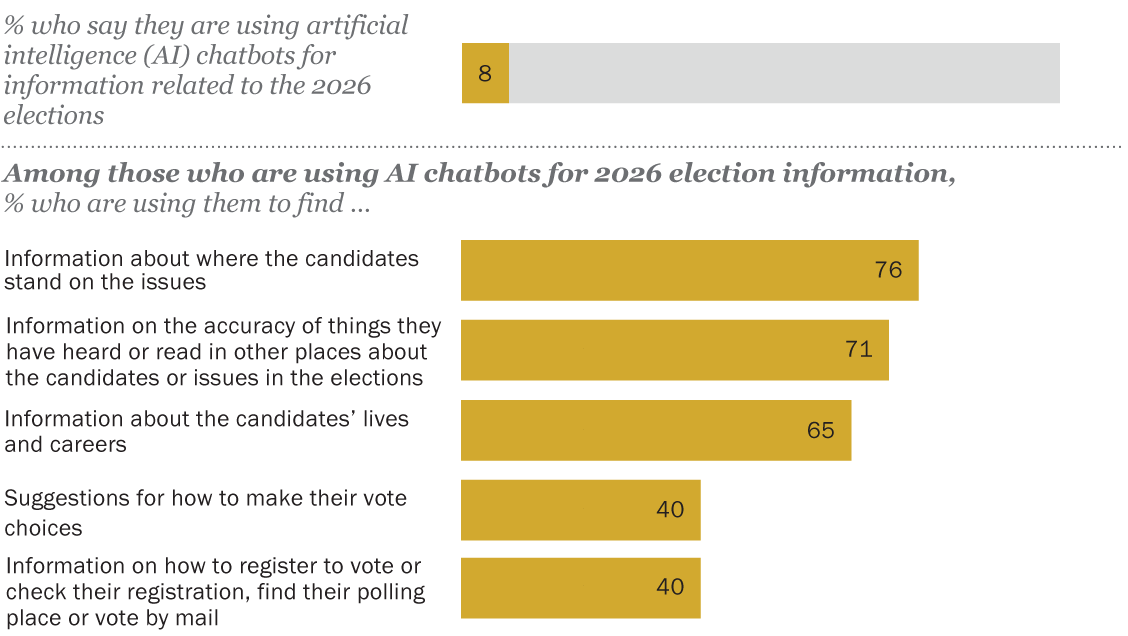
Among people who use AI chatbots to learn about the 2026 elections, the percentage who use them to find different kinds of information.
Source: Survey of U.S. adults conducted October 12–18, 2026.
PEW RESEARCH CENTER
| % | |
|---|---|
| % who say they are using artificial intelligence (AI) chatbots to find out information related to the 2026 elections | 8 |
| Among those who are using AI chatbots for 2026 election information, % who are using them to find … | |
| Information about where the candidates stand on the issues | 76 |
| Information on the accuracy of things they have heard or read in other places about the candidates or issues in the elections | 71 |
| Information about the candidates’ lives and careers | 65 |
| Suggestions for how to make their vote choices | 40 |
| Information on how to register to vote or check their registration, find their polling place or vote by mail | 40 |
Source: Survey of U.S. adults conducted October 12–18, 2026.
PEW RESEARCH CENTER
About 8% of U.S. adults, or roughly 1 in every 10, say they are using AI chatbots to find information about this year's elections. This is according to a Pew Research Center survey of 5,273 adults conducted from October 12 to 18, 2026.
For people who use chatbots, looking up information is one of the most common things they do with them. Among people who use chatbots to learn about this fall's elections, most say they have used them to find information about:
- What the candidates think about important issues and what they plan to do about them (76%).
- Whether things they have heard or read somewhere else about the candidates or election issues are true (71%).
- The candidates' personal lives and work histories (65%).
Fewer people use chatbots to get advice about how to choose who to vote for (40%). The same percentage (40%) use them to learn how to register to vote, check whether they are registered, find where to vote or learn how to vote by mail.
The groups of people who use chatbots for election information are generally the same groups that are more likely to use chatbots for other things. For example, adults younger than 50 are more likely to use chatbots in general than adults who are 50 or older. The same pattern appears with election information. About 11% of adults younger than 50 use chatbots to learn about elections, compared with only 4% of adults ages 50 and older.
Note: You can read the survey questions used in this study, the detailed answers and an explanation of how the survey was carried out.