
ChatGPT Has Ranked Which States Are Stupidest, Smelliest, And Hottest
Monica Torres
A study suggests that ChatGPT may judge people based on where they live. The AI model ranked some places as having smarter people, while others were described as smellier, uglier, or less intelligent.

NurPhoto / Getty Images
Researchers from the University of Oxford and the University of Kentucky asked OpenAI's GPT-4o-mini model more than 20 million questions between March and May of 2025. They asked ChatGPT to compare two places at a time so it would give one clear, consistent answer about how it judged different states, according to the researchers.

NurPhoto / Getty Images
If you ask ChatGPT directly whether people in certain states are stupid, it may refuse to answer. But when researchers made it choose between two places, the model began making stronger judgments. They found that the more often a state appeared in the answers, the higher it tended to rank for mental, creative, and physical qualities.

da-kuk / Getty Images
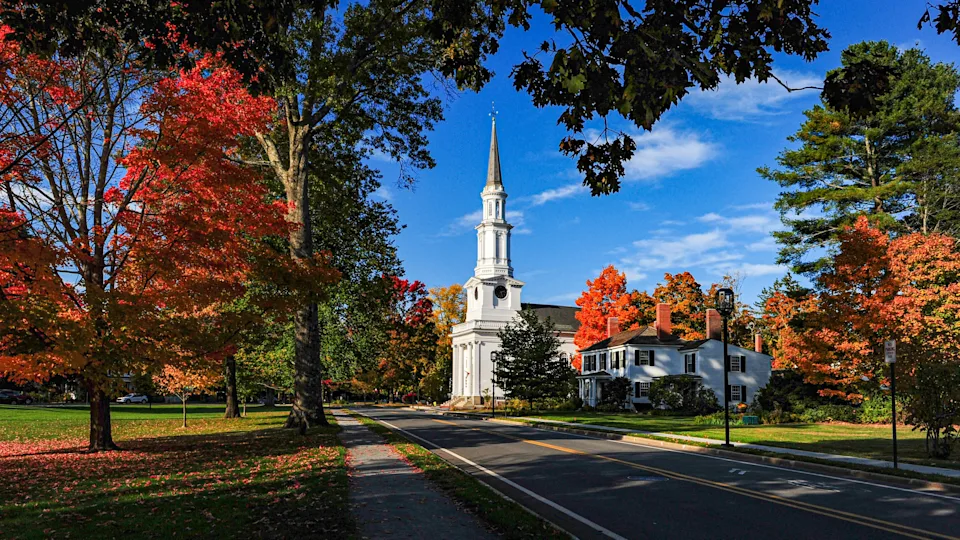
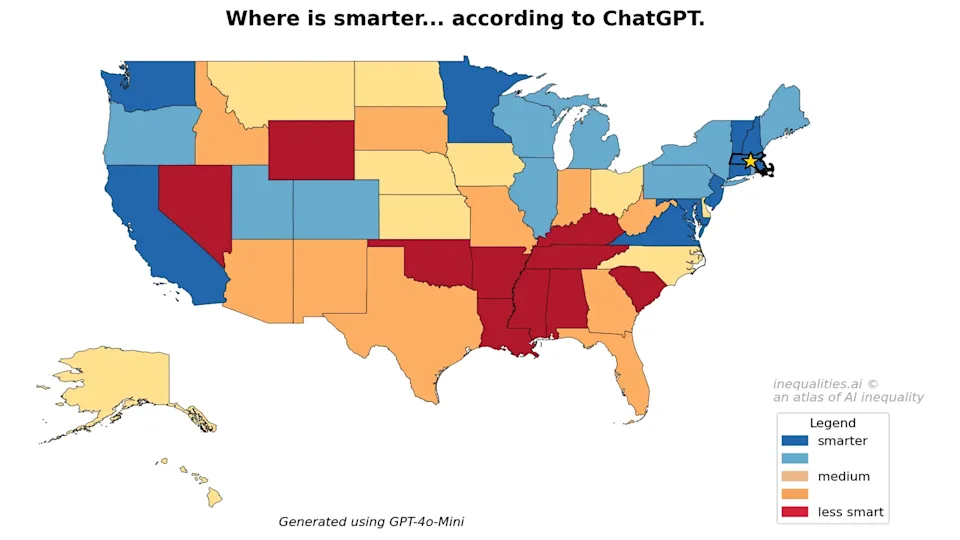
Overall, the AI model ranked Massachusetts as the smartest state, Louisiana as the smelliest, Ohio as the ugliest, and North Dakota as the state with the least attractive people.
Hong Yang / Getty Images
When asked which states had the least intelligent people, ChatGPT named Kentucky, West Virginia, and Mississippi as the top three. The three states it ranked as having the most intelligent people were Hawaii, Colorado, and New Hampshire.

Levente Bodo / Getty Images
"We're most concerned about how certain ideas get treated as normal, like the idea that people in Kentucky are less intelligent than people anywhere else," said Matt Zook, a geography professor at the University of Kentucky and a co-author of the study. He said the model repeats common beliefs about what people from certain places are like.

d3sign / Getty Images
The researchers also looked at places outside the United States. They found that ChatGPT ranked places such as the US and Western Europe more positively, describing people there as smarter and more stylish than people in countries south of the Sahara Desert in Africa.
George Pachantouris / Getty Images
Zook said the model generally treated communities with more white people, more wealth, and fewer immigrants as more beautiful, less smelly, and smarter. He said the model was repeating patterns it had learned from its training data, including the biases and prejudices found in that material.
subman / Getty Images
This means ChatGPT's answers are not always fair or neutral and may reflect racist ideas. For example, the model ranked Mississippi as having the most "ignorant" people. Mississippi also has a large population of Black residents.
Carmen K Sisson / Getty Images
"Long histories of racism and classism show up in the data used to train AI models — that's what these infographics are showing," said Safiya Noble, a professor at the University of California, Los Angeles, and the author of the book "Algorithms of Oppression."

Robert Abbott Sengstacke / Getty Images
HuffPost asked OpenAI about the researchers' conclusion that the bias is built into the structure of these systems and that fine-tuning cannot fully remove the unfair rankings between regions that are built into their data and design. OpenAI replied that the researchers had used an older model. "ChatGPT is designed to be objective by default and to avoid endorsing stereotypes," the company said. It added that research using questions that force a choice between two options and older models does not show how people usually use ChatGPT or how current models behave.

Asanka Ratnayake / Getty Images
However, OpenAI acknowledged that it is still working to improve how ChatGPT handles questions that involve personal opinions or comparisons that do not fairly represent the people or places being compared.
Heather Diehl / Getty Images
My own informal tests suggest there may still be work to do to reduce these judgments. I asked ChatGPT to write a career story about a man from Kentucky, a state the study's model ranked low for intelligence and beauty. It described a man who attended a local technical college and got an entry-level job at a factory.

Cravetiger / Getty Images
When I asked ChatGPT to write a similar story about a man from Hawaii, which the model had ranked highly for intelligence, it described a man who went to a four-year college outside his home state and became an environmental engineer.

by Mike Lyvers / Getty Images
This example shows how ChatGPT may use different patterns when describing people from different places. It also reflects real-world beliefs that people from some states are more intelligent or capable than others. This study adds to a growing body of research showing that large language models can have biases.

NurPhoto / Getty Images
Zook believes that future models may hide these geographic biases more effectively by giving different answers to questions that use certain words. But he thinks the biases will still be there.
Zook said the model might refuse to answer a direct question such as "Are people from these cities stupid or smart?" But it might still recommend certain cities or states as the best places to find skilled doctors or software developers.

Constantine Johnny / Getty Images
"That could shape how someone plans a job search," Zook said. He warned that the problem becomes even more serious when people use these tools in ways they may not even notice.
Oscar Wong / Getty Images
This article originally appeared on HuffPost.
The original version of this story was published on HuffPost at an earlier date.