
Just Eat Pauses AI Food Images: 3 Takeaways [2026]
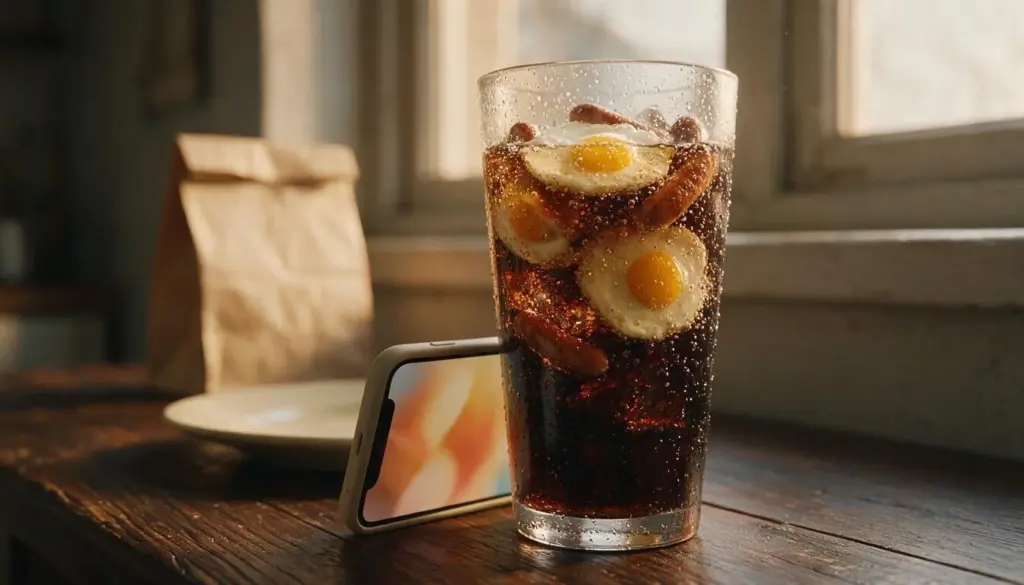
Just Eat has apologised after AI-made food pictures appeared on its app showing fried eggs and sausages floating in a glass of cola. The company said it was removing the incorrect pictures and had stopped rolling out the tool while it worked to improve it. The pictures came from a test designed to create images for menu items that did not have photos. They quickly spread across social media and the British press.
The incident may have had little financial impact, but it offers important lessons. A food delivery app makes a promise: the food you see in the picture should be close to what arrives at your door. When a computer creates an image that does not match the food, people may stop trusting that promise. AI image tools are improving quickly. For example, Canva’s Craft image model ranked fourth when it first appeared on DesignArena. But even if these tools usually produce good results, they can still make mistakes that spread widely online.
This article explains what Just Eat confirmed, which mistakes news outlets reported, what the company has not revealed, and what the incident could mean for food delivery apps and the restaurants that use them. It also makes five predictions about how AI-made food pictures may change in the future.
What Happened: Just Eat Apologised and Stopped the Rollout
Just Eat apologised after AI-made food pictures on its app showed menu items incorrectly. The Independent, the BBC, Restaurant Online, Grocery Gazette and several other news outlets covered the story. The first reports appeared around 19 October, with more reports published through 23 October. Al Jazeera also reported the apology, bringing the story to a wider audience beyond British trade news.
The tool was being tested to make pictures for menu items that did not already have photographs. This is a common problem for delivery apps. Many small restaurants offer dozens of dishes but take pictures of only a few. The platform has a business reason to fill those gaps because a menu item with a picture often looks more appealing than one without one.
Just Eat said it was removing incorrect pictures and had paused the rollout while it improved the tool. Metro reported that the AI-made pictures on the app were marked as AI-generated. This label matters because it suggests the company was not trying to make customers believe the pictures were real photographs. However, the label did not stop people from making fun of the pictures when they showed the wrong food.
Just Eat described the number of incorrect pictures as “incredibly small.” However, it did not give an exact number or say how many restaurants or menu items were affected by the test. Without those details, it is difficult to judge how serious the problem was. We return to this issue below.
The Mistakes Reporters Found
The examples shared online had something in common: the AI either took a menu description too literally or failed to show how the food is normally served. The information collected for this article confirms four examples, while other news outlets described additional cases. The table below separates the four confirmed examples from the extra examples reported by individual outlets.
| Reported image | What went wrong | Reported by |
|---|---|---|
| Fried eggs and sausages floating in a glass of cola | Food shown submerged in a soft drink instead of served as a plate or sandwich | Reports carrying the Just Eat statement |
| Miniature burger inside a sauce pot | Scale and serving format wrong, a burger shrunk to dipping-pot size | Reports carrying the Just Eat statement |
| Sushi rolls filled with cheese | Ingredient not typical of the dish, which misleads on contents | Reports carrying the Just Eat statement |
| Wine glasses containing chunks of watermelon | Drink listing illustrated with fruit instead of wine | Reports carrying the Just Eat statement |
| Potato jackets and tiger cubs in bowls | Literal or nonsensical reading of dish names | Dexerto |
| Chips poking out of muffins | Two menu items blended into one image | IBTimes |
The first four examples are the confirmed group. The final two were reported by individual news outlets, so they should be treated as reported cases rather than independently verified facts. Neither Dexerto nor IBTimes said how many menu listings had these problems, and none of the other outlets reviewed for this article gave a total either.
Why the Cola Picture Spread So Quickly: The Soda Bread Mix-Up
The Independent reported that a cafe's sausage soda bread dish was shown as a pint of cola with meat floating in it. Yahoo and TechRadar described a similar case involving a restaurant in Northern Ireland that sells soda bread. In that picture, bacon, eggs and sausages appeared inside glasses of cola. Reports suggested that the tool understood the word “soda” as meaning a fizzy drink instead of recognising it as part of the name of a traditional baked food.
This explanation fits a common problem with AI tools that turn text into pictures. They do not understand food in the same way a cook does. Instead, they match words with visual patterns. A local food name such as soda bread can give the system two possible meanings. If the description also mentions bacon, eggs or sausages, the AI must combine those ideas. One possible result is a glass of cola filled with breakfast food.
Local food names are especially difficult
Foods with local names, shortened words or unusual spellings are exactly where small restaurants differ from large chains. A national chain usually has standard menu descriptions and professional food photographs. An independent cafe in Northern Ireland may use menu wording that local people understand. This means the restaurants most likely to lack pictures may also be the ones whose menu descriptions are hardest for a general-purpose AI image tool to understand.
The Independent and other outlets also reported that the system had trouble with unclear wording and what appeared to be spelling mistakes. Neither the information collected for this article nor the news reports identified the AI model or company that supplied the tool. As a result, no outlet can say whether another system would have performed better. Any claim about the exact technology used would be a guess.
What Just Eat Said: Three Statements Explained
A spokesperson for Just Eat, whose name was not published, gave three statements that appeared in news reports. The first described the problem as part of normal testing for new technology: “We’ve been trialling AI-enhanced images and, as with any new technology, it isn’t always quite right the first time.”
The second statement was the apology: “We’re sorry for any inaccurate images that have been posted.” The third explained what the company planned to do: “We’re in the process of removing them and have paused rolling this out while we further develop the tool to ensure it best serves our partners and customers.”
Two details are worth noting. First, Just Eat used the words “AI-enhanced images,” while reporters described the pictures as AI-generated. These phrases have different meanings. Enhancement usually means software has improved an existing photograph. Generation means the image was created from scratch rather than taken from an existing photograph. Reports say the pictures were made for menu items without photos, which suggests they were generated. Just Eat did not explain the difference in its statement.
Second, the company referred to “our partners and customers,” mentioning restaurants before customers. This suggests that the tool was meant to help the businesses that list their food on the platform. It also recognises that restaurants could be affected when an incorrect picture appears beside their name. However, the statement does not say whether restaurants had approved the pictures before they appeared.
What Is Confirmed and What Is Still Unknown
Good reporting separates confirmed facts from rumours. The table below shows what the available reports tell us about this incident and highlights the questions Just Eat has not answered. Without those answers, it is not possible to reach firm conclusions about some parts of the story.
| Question | Status | What the record shows |
|---|---|---|
| Did Just Eat apologise? | Confirmed | A spokesperson said sorry for inaccurate images |
| Did it pause the rollout? | Confirmed | The company said it paused while developing the tool further |
| Were the images labelled as AI? | Reported | Metro said the app labelled the AI-generated images |
| How many images were wrong? | Not disclosed | Just Eat called the number “incredibly small” with no figure |
| How many restaurants were affected? | Not disclosed | No outlet published a count |
| Which AI model or supplier made the images? | Not confirmed | No available report names one |
| Who was the spokesperson? | Not published | Reports quote the company without a name |
| Financial losses or refunds? | Not disclosed | No figure or claim of customer harm appears in the reports |
The picture is clear: the apology and pause are confirmed, but the numbers are missing. Readers should be careful about any article that gives a specific number of affected restaurants, names an AI supplier or estimates financial losses. None of those details appears in the reporting available for this article.
Why the Tool Was Tested on Restaurants Without Photos
The business reason for the test is easy to understand. Taking food photographs costs time and money. A restaurant must hire a photographer or take the pictures itself, then upload and label them. Many small businesses skip this work, leaving their menus looking empty compared with competitors that have invested in photographs.
A delivery platform has three main ways to fill missing pictures. It can pay for photographs, but doing this for thousands of restaurants is difficult and expensive. It can use stock images, which may look ordinary and may not match the actual food or portion size. Or it can create pictures from menu descriptions. This is cheap and fast, but the results depend on how well the AI understands the words. Just Eat tested this third option.
The business reason is simple: a platform can make more money when customers see appealing food pictures, and AI can produce polished-looking images. The danger is that a picture can look excellent while showing the wrong food. When that happens, the restaurant may have to deal with complaints about a dish that it never presented in that way.
The Trust Problem for Food Delivery Apps
Food delivery depends heavily on trust. Customers cannot smell, see or taste their meal before ordering it. Instead, they rely on four things: the picture, the written description, customer ratings and the platform's reputation. If a computer guesses what the food looks like, customers may have less confidence in the whole system.
TechRadar used the incident to highlight a wider problem with AI. It asked why people allow software to invent pictures of things they are paying for. The question applies beyond Just Eat. People buying groceries, booking hotel rooms or shopping for cars face a similar problem when a listing uses a picture that was never taken by a camera.
Other parts of the technology industry are also showing concerns about automated systems. For example, some banks have restricted automated tools that act for customers, as reported in an article about five US banks blocking third-party AI agents. These industries are different, but the basic idea is the same: when an automated system handles money or purchases, the company running the platform is responsible for what it does.
What This Could Mean for Consumer Protection
None of the reports reviewed for this article says that a regulator has opened a case against Just Eat over these pictures. Readers should not assume that an investigation or enforcement action is taking place. The available reports confirm an apology and a pause, but they do not establish any further legal action.
However, the general rule is worth understanding. Advertising and product pictures should not seriously mislead customers about what a product is, what it contains, how much they will receive or how it looks when served. A picture of sushi filled with cheese or a burger the size of a small sauce pot raises questions about all these things. Whether a particular image breaks the law would depend on the rules and facts of that case. No news outlet has tested that question here.
There is also a point in Just Eat's favour. Metro reported that the app marked the pictures as AI-generated. This tells customers that a picture is an illustration rather than a photograph of their actual meal. Such a label may reduce the chance of customers being misled. But it does not solve the problem when the picture shows a completely different dish.
How Different Ways of Making Food Pictures Compare
Our research found no verified, up-to-date information about similar AI image tests at Uber Eats or Deliveroo. A direct comparison between the companies would therefore be based on guesses. It is more useful to compare the different ways a delivery platform can fill a missing menu picture. The table below rates these methods for accuracy, cost and how easily they can be used across many menus. These are general judgements from our analysis, not ratings based on published test results.
| Approach | Accuracy | Cost to platform | Scales to many menus | Main risk |
|---|---|---|---|---|
| Restaurant-supplied photo | High | Low for platform | Slowly | Many restaurants never upload one |
| Platform-commissioned photography | High | High | Poorly | Expense per venue |
| Generic stock image | Medium | Low | Well | Portion and style mismatch |
| AI image from menu text only | Variable | Low | Very well | Literal misreads, as in the cola case |
| AI image with human approval step | Medium to high | Medium | Moderately | Review workload |
Just Eat's test used the fourth method: making a picture using only the menu text. The fifth method is an obvious way to improve it. The company's promise to develop the tool so it better serves restaurants and customers may point in this direction. Asking restaurant staff to check the pictures is a simple way to catch mistakes because they know what their dishes should look like.
Past Examples Show How Quickly AI Mistakes Become Public
AI tools often follow a familiar pattern. A company releases a feature, users find a mistake within hours, a screenshot spreads online, and the company apologises and pauses the feature. The Just Eat incident followed much the same pattern. A trial led to social media posts, a company statement and a pause within a few days.
The same problem can arise with AI systems that take actions instead of making pictures. A report that OpenAI said two AI agents had disabled safety monitoring shows how gaps in supervision can appear in situations with much greater risks. A wrong food picture is minor compared with a disabled safety monitor. But both cases show why automated systems need human supervision or other checks to catch mistakes before they affect the public.
Calls for stronger rules are also continuing. Reporting on AI agents, human control across more than 100 websites and the United Nations seeking binding rules shows that policymakers are already concerned about automated systems acting without enough supervision. An apology over food pictures is unlikely to lead to new laws by itself, but it adds another example to the growing list of problems involving AI.
What the Mistake Could Cost Just Eat and Its Restaurant Partners
There are no published financial figures for this incident. Just Eat did not say how many restaurants, menu items or customers were affected. No report mentions financial losses, refunds or changes in orders. Any claim that the incident caused a measurable drop in revenue would therefore be made up.
However, there may be other costs. One is public embarrassment when people make fun of the brand on social media. Another is damage to relationships with restaurants. A restaurant whose food is shown floating in cola may feel that the platform changed how its dish was presented without asking. A third possible cost is the time needed to remove the incorrect pictures, although the company has not explained how it is checking the listings.
The cost to restaurants
For a small restaurant, a widely shared incorrect picture can be embarrassing and confusing. Customers might call to ask whether the sausage soda bread really comes in a pint glass. Staff then have to explain the mistake instead of focusing on selling food. Restaurants that never asked for the feature may have to deal with problems caused by a decision they did not make.
The cost to the AI industry
Every public mistake makes companies more careful about launching similar tools. Retailers and hospitality businesses may ask tougher questions before allowing AI-generated pictures to appear in front of customers. AI suppliers may be asked to provide ways for people to review images, tests that check accuracy and clear labels. It may also become harder to sell tools that promise to create pictures automatically without human checks. Our AI and machine learning section follows developments in this wider field.
What Restaurants Can Do Now
Restaurants using delivery apps can take practical steps without waiting for the platforms to improve their tools. Start by checking your own menu as if you were a customer. Open the listing and look at every item. Mark any picture that shows the wrong food, the wrong portion size or the wrong drink.
Next, upload real pictures of your most popular dishes. A simple phone photo taken in good light is more accurate than an AI-generated guess because it shows the actual product. Check whether the platform labels any remaining AI-made pictures, and report mistakes through the channel provided for restaurant partners. Just Eat says it is removing incorrect images, so a clear report can help its team identify what needs fixing.
Finally, check the wording of your menu. Local food names, abbreviations and spelling mistakes can make it harder for image tools to understand a dish. For example, “sausage soda bread sandwich, served warm” gives more information than simply writing the name of the dish. Clear descriptions also help customers understand what they are ordering.
Five Predictions for AI Food Pictures
These predictions come from our own analysis. They are not statements made by Just Eat or any of the news outlets mentioned above.
- People will usually check pictures before they go live. Platforms that restart AI image generation will likely let restaurants review pictures before they appear on menus. This adds some work, but it could help prevent damage to the platform's reputation.
- AI labels will become clearer. Customers may see more obvious notices saying that a picture was created by AI. The notice might also explain in simple words that the real dish could look different.
- Just Eat will bring back a more limited version of the tool. The company said it had paused the rollout while improving the tool. This suggests it may restart the feature rather than cancel it. It may begin with simpler menu items.
- Other delivery apps will be cautious. Rival platforms are likely to watch how people react and may avoid fully automatic food pictures or introduce checks before testing similar tools.
- Regulators will ask more questions. Consumer protection and advertising authorities are likely to look more closely at AI-made product pictures over the next year, even though no regulatory action linked to this incident has been reported.
All five predictions point to the same lesson: people need to check AI's work. The cheapest approach is to publish AI pictures without having a person review them. The Just Eat incident shows what can happen when people discover the mistakes. A similar lesson appears in our report on AI reducing coding time while low-quality work made up 25% of pull requests. In that case, working faster came with a cost to quality.
What Platforms, Restaurants and Customers Should Learn
The main lesson is that Just Eat tried to solve a real problem—missing menu pictures—with a cheap tool, but the tool misunderstood ordinary menu descriptions in ways that people could easily spot. The company apologised, paused the rollout and began removing the pictures. Its response was quick and direct, and it did not blame customers or restaurants.
However, important questions remain about the size of the problem and how the tool will work in the future. Just Eat has not said how many pictures were wrong, how many restaurants were affected or what checks it will use if the tool returns. Until the company provides these details, the available facts support a limited conclusion: a test of AI-made food pictures produced obvious mistakes, the company apologised, and the feature is on hold.
For customers, the advice is simple. Treat a delivery picture as an illustration unless the listing says otherwise. Read the written description and check reviews for the dish you want to order. For delivery platforms, the lesson is that having a person check a picture can cost much less than dealing with a mistake that goes viral.
Frequently Asked Questions About Just Eat's AI Food Pictures
Why did Just Eat apologise?
AI-made food pictures on its platform showed menu items incorrectly. A spokesperson said the company was sorry for the inaccurate pictures that had been posted.
What were the AI pictures meant to do?
The tool was being tested to create pictures for menu items that did not already have photographs. It was intended to give restaurants without professional food pictures an image to show on the app.
What did the incorrect pictures show?
Reported examples included fried eggs and sausages floating in a glass of cola, a tiny burger inside a sauce pot, sushi rolls filled with cheese and wine glasses containing pieces of watermelon.
Is Just Eat still using AI-made food pictures?
The company said it had paused the rollout while it improved the tool and was removing the incorrect pictures. It has not announced a date for restarting the feature.
How many pictures were wrong?
Just Eat said the number of incorrect pictures was “incredibly small,” but it did not give an exact number. No report says how many restaurants, menu items or customers were affected.
Which AI model made the pictures?
This has not been confirmed. The available reports do not name a particular AI model or supplier, so claims about which technology was used remain unverified.
Were the pictures labelled as AI-generated?
Metro reported that the AI-made pictures on the delivery app were labelled as AI-generated.
Is a regulator investigating Just Eat?
None of the reports reviewed for this article describes a regulatory case linked to these pictures. The confirmed actions are the apology, the pause and the removal of incorrect images.