
AI may be rewriting human memories, MIT scientists warn

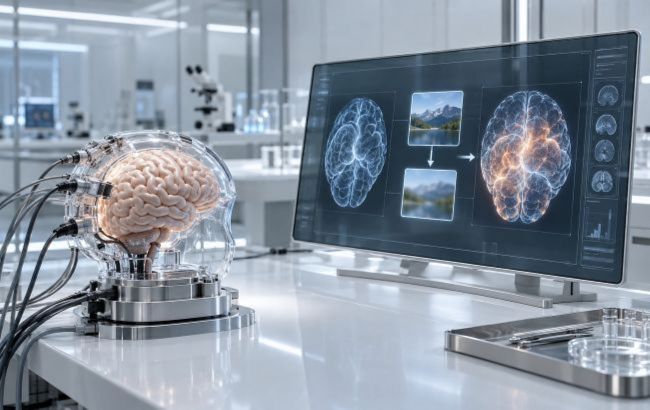 Artificial intelligence can make people believe things that are not true (illustration: RBC-Ukraine)
AI can do more than create fake pictures. It can also change how people remember their own past. Researchers have found that pictures and written descriptions created by AI can cause false memories and make people doubt their own experiences, according to The Washington Post.
MIT experiment: Believing in a past that never happened
In an experiment led by Pattie Maes, people were shown a series of real photographs. After a break, one group saw the same pictures again, while another group saw versions changed by AI.
In a later memory test, people who saw the AI-changed pictures made more mistakes when remembering the original details. They also felt completely sure that their false memories were correct.
Researchers believe that deepfakes and text created by AI can make people believe they remember events that never happened. These false memories may already be affecting political choices and making people less willing to vote.
Trusting experts too much and AI making things up
Even when no one means to cause harm, AI can threaten our ability to know what is true. This can happen when AI systems have so-called hallucinations, meaning they make up facts that are not real.
Government agencies, banks, hospitals, and military organizations are adopting a rule called "human-in-the-loop." Under this approach, a trained person must check AI-generated results before important decisions are made.
However, research shows that people often struggle to spot mistakes made by AI. When information from AI disagrees with what an expert knows, people may begin to doubt their own memories. As a result, they may judge a situation in a way that favors the AI system.
The cost of mistakes: From attacks to full independence
Scientists warn that ordinary people are no better than chance at telling AI-generated content apart from other content. At the same time, developers are trying to release fully independent AI agents more quickly, reducing the amount of human oversight.
Giving AI systems control over important decisions is already leading to tragic results.
According to an investigation by the US Department of Defense, an airstrike on an elementary school in Iran that killed more than 150 people happened partly because people relied too heavily on an AI system developed by Palantir.
The system recommended a civilian location as a target because it used old information. The people supervising the system did not question its recommendation.