
India Artificial Intelligence Market 2026-2034: Size, Share, Key Trends, Growth Opportunities & Industry Repor
India Artificial Intelligence Market 2026-2034
How Is India Artificial Intelligence Market Performing?
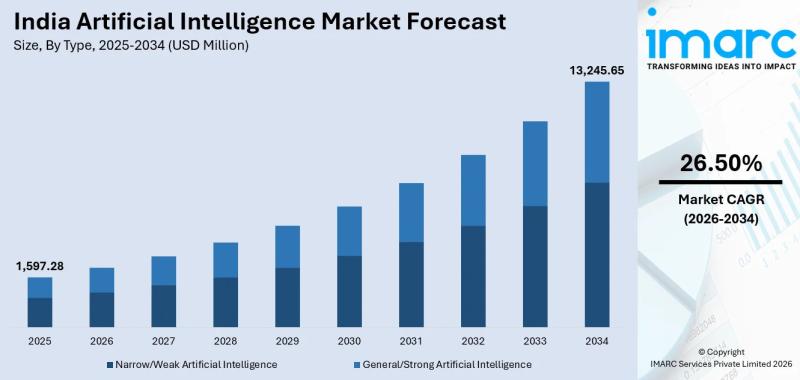
India's artificial intelligence market stands as one of the country's fastest-growing technology segments, encompassing Narrow/Weak Artificial Intelligence and General/Strong Artificial Intelligence types, Hardware, Software, and Services offerings, Machine Learning, Natural Language Processing, Context-Aware Computing, and Computer Vision technologies, Intelligence Systems, Decision Support Processing, Hybrid Systems, and Fuzzy Systems, across Healthcare, Manufacturing, Automotive, Agriculture, Retail, Security, Human Resources, Marketing, Financial Services, and Transportation and Logistics end-use industries, spanning North India, West and Central India, South India, and East India. The market was valued at USD 1,597.28 Million in 2025 and is projected to reach USD 13,245.65 Million by 2034, growing at a CAGR of 26.50% during 2026-2034.
India's artificial intelligence market is experiencing robust growth, propelled by an interconnected set of demand-side and supply-side factors. The country's rapid digital transformation, underpinned by expanding internet penetration and widespread smartphone adoption, is creating a fertile environment for AI integration across industries. In February 2026, Fractal Analytics, an Indian AI and analytics firm, announced its IPO price band targeting an approximate 144.5 billion rupees valuation, highlighting strong investor confidence in domestic AI capabilities and signalling maturing capital markets for AI companies in India.
Market Snapshot
• Current Market Size (2025): USD 1,597.28 Million
• Projected Market Size (2034): USD 13,245.65 Million
• CAGR: 26.50%
• Narrow/weak artificial intelligence dominates the type segment with an 88% share, driven by its specialized task-specific capabilities enabling rapid deployment and cost-effective productivity improvements across diverse industries.
• Software leads the offering segment with a 50% share, owing to increasing enterprise demand for AI-powered platforms and applications enabling scalable, customizable intelligent automation solutions.
• Machine learning represents the largest technology segment with a 39% share, driven by its versatile applicability across predictive analytics, pattern recognition, and data-driven decision-making.
• Intelligence systems dominate the system segment with a 35% share, owing to growing adoption of autonomous decision-making frameworks integrating multiple AI capabilities for real-time enterprise automation.
• Healthcare represents the largest end-use industry segment with an 18% share, driven by rising adoption of AI-powered diagnostics, drug discovery, patient monitoring, and precision medicine applications.
• North India leads the regional segment with a 30% share, driven by concentration of leading technology hubs, robust digital infrastructure, and strong government policy support.
Evaluate Market Opportunity with the Business Sample Report: https://www.imarcgroup.com/india-artificial-intelligence-market/requestsample
What Growth Factors Are Driving India's Artificial Intelligence Market?
• Accelerating Digital Transformation and Enterprise Adoption:
India's accelerating digital transformation across industries is serving as a fundamental growth driver for the AI market. In 2024, smartphone adoption in India nearly doubled to 938.3 million from 485.1 million in 2020, driving mobile connectivity, digital transactions, fintech growth, and supporting AI deployment across industries. Organizations spanning healthcare, manufacturing, financial services, retail, and logistics are increasingly integrating AI-powered tools to automate routine processes and improve customer experiences.
• Supportive Government Policies and National AI Strategy:
The Indian government's proactive approach to fostering AI development through dedicated policies, funding mechanisms, and institutional frameworks is significantly contributing to market growth. Strategic national initiatives focused on building AI research infrastructure, promoting public-private partnerships, and integrating AI into governance and public service delivery are creating a conducive ecosystem for technology advancement.
• Expanding Talent Pool and Growing Research Ecosystem:
India's large and growing pool of technically skilled professionals, supported by a robust network of academic institutions and research organizations, represents a critical growth driver for the AI market. In 2025, India's AI talent pool reached 416,000 professionals, though a 51% skill gap highlights the need for focused upskilling to support GenAI adoption and enterprise AI growth.
Government Policy Support
• IndiaAI Mission: The mission funds AI Centers of Excellence, sovereign AI model development, and localized speech recognition research, strengthening India's AI research infrastructure and reducing reliance on foreign AI technologies.
• BharatGen Sovereign AI Model: Backed by ₹1,293 Crore in government funding, India's first sovereign multilingual and multimodal AI Large Language Model covers 22+ Indian languages across text, speech, and vision, fostering inclusive digital growth.
• National AI Competency Framework: The framework aims to enhance AI skills among over 3.1 million civil servants, boosting public service transformation and evidence-based policymaking across government agencies.
• Public-Private Partnership Programs: Government-led programs aimed at upskilling the workforce, establishing centers of excellence, and providing financial incentives for AI startups and enterprises are strengthening the innovation pipeline.
• Digital Public Infrastructure Initiatives: Government-built digital infrastructure supporting data-driven governance, smart city management, and agricultural advisory services is expanding AI applications into public sector and governance domains.
What Are the Latest Emerging Trends in India's Artificial Intelligence Market?
• Growing Integration of AI in Enterprise Operations:
Indian enterprises across diverse sectors are increasingly embedding AI into their core business processes to drive efficiency, reduce costs, and improve decision-making capabilities. In 2025, 47% of Indian firms had multiple generative AI use cases live, reflecting a decisive shift from pilots to full enterprise deployment across operations, customer service, and marketing.
• Expansion of Vernacular and Multilingual AI Solutions:
The development of AI solutions tailored to India's linguistically diverse population is emerging as a prominent market trend. In November 2025, Dr. Jitendra Singh unveiled BharatGen, India's first sovereign multilingual and multimodal AI Large Language Model, supported by ₹1,293 Crore government funding, covering 22+ Indian languages across text, speech, and vision.
• Rise of AI-Driven Innovation in Public Sector and Governance:
The Indian public sector is increasingly adopting AI-powered tools to enhance governance efficiency, service delivery, and citizen engagement. The Government of India launched a national AI Competency Framework to enhance AI skills among over 3.1 million civil servants, boosting public service transformation and evidence-based policymaking.
How will India Artificial Intelligence Market Evolve in the Coming Years?
India's artificial intelligence market revenue is poised for substantial expansion over the forecast period, expanding from USD 1,597.28 Million in 2025 to USD 13,245.65 Million by 2034 at a 26.50% CAGR, supported by accelerating enterprise adoption, favorable government policies, and continuous evolution of AI technologies. Growing investments in digital infrastructure, coupled with rising demand for automation and intelligent analytics across healthcare, manufacturing, and financial services, are expected to sustain strong revenue growth, while expansion into precision agriculture, smart governance, and vernacular language processing will open new revenue streams.
Investment opportunities are concentrated in sovereign AI models, vernacular language processing, AI agent platforms, and healthcare diagnostics applications. In December 2025, Google announced $8 million funding for India's AI Centers of Excellence to strengthen machine learning research, skills, and deployment nationally under the IndiaAI Mission. Companies investing in multilingual AI capabilities, enterprise-grade automation, and public sector AI applications are best positioned to outperform through 2034.
How Is India's Artificial Intelligence Market Segmented?
Type Insights:
• Narrow/Weak Artificial Intelligence
• General/Strong Artificial Intelligence
Narrow/Weak Artificial Intelligence dominates with a market share of 88% of the total India artificial intelligence market in 2025.
Offering Insights:
• Hardware
• Software
• Services
Software leads with a share of 50% of the total India artificial intelligence market in 2025.
Technology Insights:
• Machine Learning
• Natural Language Processing
• Context-Aware Computing
• Computer Vision
• Others
Machine Learning dominates with a market share of 39% of the total India artificial intelligence market in 2025.
System Insights:
• Intelligence Systems
• Decision Support Processing
• Hybrid Systems
• Fuzzy Systems
Intelligence Systems lead with a share of 35% of the total India artificial intelligence market in 2025.
End-Use Industry Insights:
• Healthcare
• Manufacturing
• Automotive
• Agriculture
• Retail
• Security
• Human Resources
• Marketing
• Financial Services
• Transportation and Logistics
• Others
Healthcare dominates with a market share of 18% of the total India artificial intelligence market in 2025.
Region Insights:
• North India
• West and Central India
• South India
• East India
North India exhibits a clear dominance with a 30% share of the total India artificial intelligence market in 2025.
Competitive Landscape - India Artificial Intelligence Market
The India artificial intelligence market features a diverse and rapidly evolving competitive landscape characterized by the participation of global technology providers, domestic enterprises, and a vibrant ecosystem of startups and research-driven organizations. Market participants are pursuing growth through continuous investment in research and development, strategic collaborations, and the expansion of sector-specific AI solutions.
The report offers an in-depth examination of the competitive landscape, including market structure, key player positioning, leading strategies for success, a competitive dashboard, and a company evaluation quadrant.
Request Customized Data Tailored to Your Interest: https://www.imarcgroup.com/request?type=report&id=4046&flag=E
India Artificial Intelligence Market Recent Developments
• February 2026: Fractal Analytics, an Indian AI and analytics firm, announced its IPO price band targeting an approximate 144.5 billion rupees valuation, highlighting strong investor confidence in domestic AI capabilities and signalling maturing capital markets for AI companies in India.
• December 2025: Bengaluru-based startup Gnani.ai launched Vachana STT, an indigenous Indic speech-to-text model trained on over one million hours of voice data under the government-backed IndiaAI Mission, enhancing localized speech recognition capabilities.
• December 2025: Google announced $8 million funding for India's AI Centers of Excellence to strengthen machine learning research, skills, and deployment nationally under the IndiaAI Mission.
• November 2025: Dr. Jitendra Singh unveiled BharatGen, India's first sovereign multilingual and multimodal AI Large Language Model, supported by ₹1,293 Crore government funding, covering 22+ Indian languages across text, speech, and vision.
• June 2025: Samsung India launched its 2025 Bespoke AI appliance range, including AI-powered refrigerators, air conditioners, and laundry combos, featuring AI Home screens, Bixby voice assistant, and SmartThings integration.
Frequently Asked Questions
How big is the artificial intelligence market in India?
➤ The India artificial intelligence market size was valued at USD 1,597.28 Million in 2025, driven by rapid digital transformation across industries, supportive government policies promoting technology adoption, and a robust talent pool of skilled professionals.
What is the projected growth rate of the India artificial intelligence market?
➤ The market is expected to grow at a CAGR of 26.50% from 2026-2034 to reach USD 13,245.65 Million by 2034, driven by accelerating enterprise adoption, sovereign AI model development, and expanding AI applications across precision agriculture and smart governance.
Which type holds the largest share of the India artificial intelligence market?
➤ Narrow/Weak Artificial Intelligence held the largest share at 88% in 2025, driven by its specialized task-specific capabilities, cost-effectiveness, broad industry applicability, and ability to deliver rapid operational productivity improvements.
What are the key factors driving market growth?
➤ Key factors driving the India artificial intelligence market include accelerating digital transformation across industries, supportive government policies and national AI strategy under the IndiaAI Mission, a large and expanding skilled talent pool, and rising enterprise demand for intelligent automation.
Get Samples of Our Latest In-Depth Reports On Related Topics:
✤ India Network Security Market: https://www.imarcgroup.com/india-network-security-market/requestsample
✤ India Virtual Reality Market: https://www.imarcgroup.com/india-virtual-reality-market/requestsample
✤ India Data Center Market: https://www.imarcgroup.com/india-data-center-market/requestsample
✤ India Industrial Iot Market: https://www.imarcgroup.com/india-industrial-iot-market/requestsample
IMARC Group
134 N 4th St. Brooklyn, NY 11249, USA
Email: [email protected]
Tel: (D) +91 120 433 0800
United States: +1-201-971-6302
IMARC Group is a global management consulting firm that helps ambitious changemakers create a lasting impact. The company offers comprehensive market assessment, feasibility studies, incorporation support, regulatory assistance, branding and strategy services, and procurement research.
This release was published on openPR.