
SPASH raises 2 million euros: artificial intelligence at the heart of its strategy for padel clubs | Padel Magazine







SPASH raises €2 million: artificial intelligence at the heart of its strategy for padel clubs

Technology is playing an increasingly important role in the world of padel. Lyon-based company SPASH, specializing in automated video and sports statistics, has announced a €2 million fundraising round. Already present in nearly 450 sports centers, the company intends to accelerate the development of its artificial intelligence tools, enhance its solutions for racket sports, and continue its expansion in Europe. Beyond this financial transaction, the economic model of clubs could also evolve.
A new step for a company founded in 2018
Founded in 2018, SPASH developed around one idea: to allow practitioners to find their matches on video, access statistics and extend their sporting experience beyond the field.
The company primarily targets padel, tennis and five-a-side football centers, with solutions integrated directly into sports facilities.
According to figures released by the company in September 2026, nearly 450 centers are now equipped with its technologies.
To support this growth, SPASH announces that it finalized a €2 million Series A funding round at the beginning of the summer.
The operation brings together three new investors: Vessoa Invest, GO Ventures and CoopVenture, alongside the historical shareholders.
The amount raised represents a new way to accelerate its development, particularly in the padel sector where clubs are increasingly seeking to enrich the services offered to players.
Artificial intelligence, the next area of development
One of the main objectives of this fundraising is to strengthen research and development around artificial intelligence.
SPASH plans to launch new products dedicated to padel and other racket sports.
The issue goes beyond simply recording a match.
Automated image analysis can open the way to new functionalities: identification of game sequences, creation of summaries, exploitation of statistical data or tools designed to better understand the course of a match.
These possibilities illustrate the potential uses of AI in racquet sports. They do not mean that all these features are already available in the solutions marketed by SPASH.
For players, the benefit is being able to review their exchanges and have new resources to improve.
For coaches and academies, video can also become a complementary teaching tool to on-field sessions.
However, the evolution of these technologies raises a central question: how far can automated analysis go in a sport as complex as padel, where positioning, trajectories and interactions between partners play an essential role?
For clubs, video is also becoming a loyalty-building tool.
This is probably one of the most interesting aspects of SPASH's positioning.
For a long time, technological investments by clubs have mainly concerned track booking, payments or membership management.
The video opens up another dimension: the player's experience after their match.
Being able to recover a spectacular point, share a sequence on social media or review a match adds extra value to a booking.
For clubs, this use can offer several advantages: strengthening players' attachment to their structure, encouraging interactions within their community, and improving the visibility of their facilities.
An exchange shared on Instagram, TikTok or YouTube can also become a communication tool for the club in which it took place.
The economic benefit will nevertheless depend on the actual use of these tools by practitioners and their ability to generate more traffic, loyalty or additional income.
SPASH has already taken a step forward with Match Analyzer
Artificial intelligence is not just a future project for SPASH.
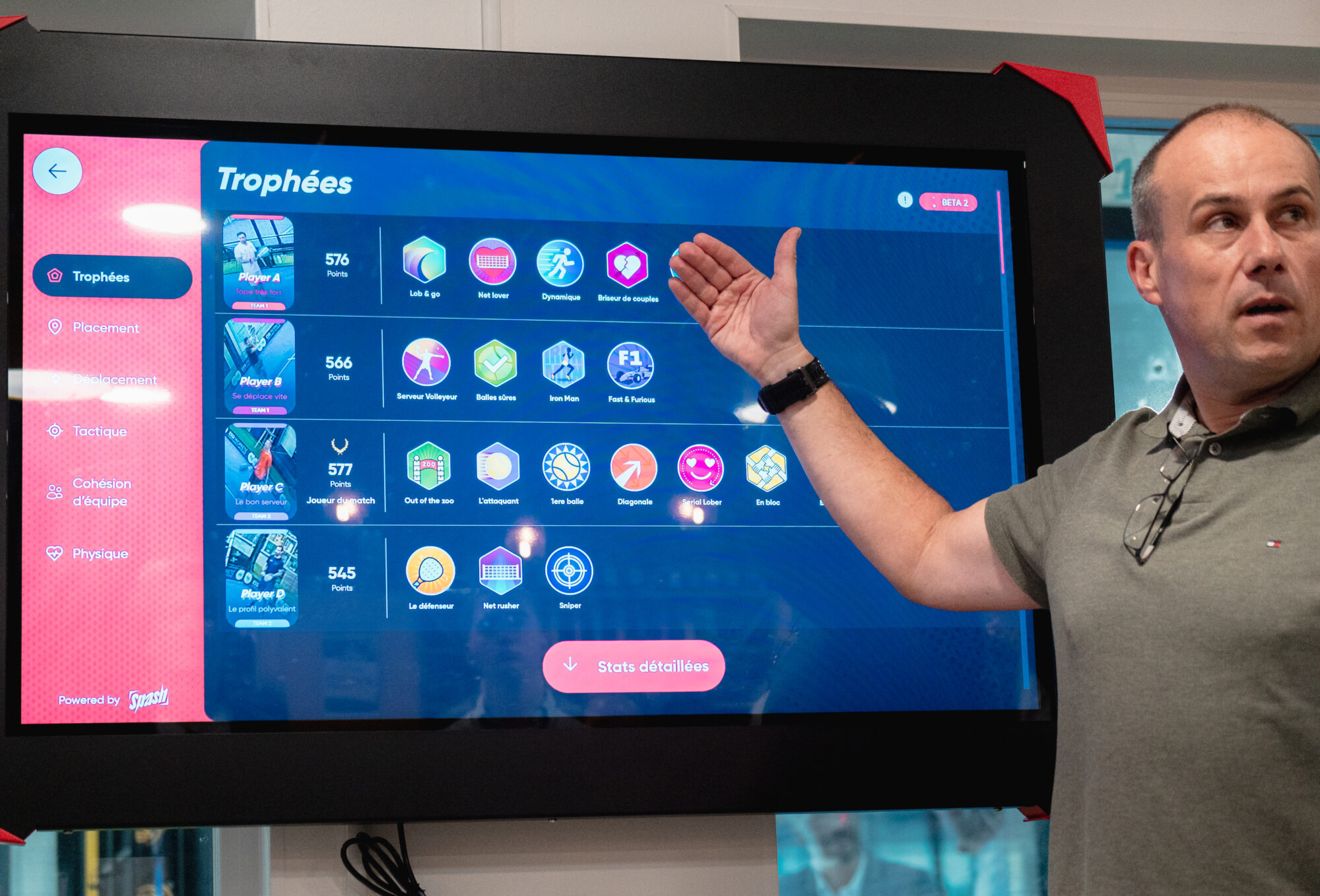
In June 2025, the company had already presented Match Analyzer, an automated padel match analysis solution, at an event held at the Esprit club. Padel, In Lyon.
The system relies on video analysis, without requiring any sensors worn by the players.
According to SPASH, it allows, in particular, the automatic detection of exchanges, recognition of players and the production of nearly 20 statistics, accessible a few minutes after a match.
The data relates in particular to positioning and movements on the track.
This technology allows for a better understanding of the company's direction. SPASH no longer simply wants to offer a video capture service, but to develop tools capable of transforming images into actionable information.
The challenge now will be to enhance these features and make them accessible enough for them to be used regularly by amateur players, coaches and clubs.
A French market that now exceeds 4,000 tracks
This fundraising comes at a time of strong growth for padel in France.
According to data currently published by the French Tennis Federation, France has:
4 050
Padel courts
1 240
Clubs
134 000
Padel licenses issued
Source: French Tennis Federation, section "Padel", accessed in October 2026.
The increase in the number of facilities mechanically expands the potential market for sports technology suppliers.
But it also leads to greater competition between resorts.
In this context, differentiation is no longer solely based on the number of tracks or the quality of infrastructure. The digital services offered to players can become an additional argument for attracting and retaining customers.
Automated video, individual statistics and shareable content thus constitute a new area of development for operators.
Europe is in the crosshairs, with several priority markets.
SPASH does not wish to limit its development to the French market.
Part of the funds raised is intended to support its international expansion, with several areas identified: Italy, Benelux, the United Kingdom and the German-speaking countries, grouped under the name DACH (Germany, Austria and Switzerland).
These territories have different profiles, but offer opportunities for technologies intended for racquet sports clubs.
The company also plans to strengthen its sales and technical teams to support the deployment of its solutions.
This international development represents an important challenge: SPASH will have to adapt its products to the expectations of operators and practitioners, but also to the different technical and economic constraints of the targeted markets.
Can technology become a criterion for choosing a club?
This is one of the questions raised by the development of SPASH.
Today, a player generally chooses their club based on its proximity, availability, prices, the quality of the slopes and the atmosphere.
Tomorrow, technology services could have a greater impact on this decision.
For a regular player, automatically finding their best points, analyzing their matches and tracking certain progress indicators can be an added value.
For clubs, the challenge will be to determine whether these services can justify an additional investment and contribute sustainably to their activity.
The development of artificial intelligence also raises concrete questions: reliability of statistics, cost of equipment, ease of use and protection of players' images.
These are all topics that will likely accompany the rise of video technologies in clubs.
SPASH wants to accelerate, but the market will have to confirm.
For Tristan Vernay, co-founder of SPASH, this new step should allow the company to accelerate simultaneously on several fronts.
"Our mission is to gamify the sports experience and boost the economics of clubs," he explains in the company's press release.
It also confirms the commitment to developing new products incorporating artificial intelligence and to strengthening international business.
With an additional 2 million euros, nearly 450 equipped centers and a first match analysis solution already presented, SPASH has several levers to continue its growth.
It remains to be seen how quickly padel clubs will adopt these new tools and, above all, to what extent they will be able to transform a technological innovation into a real service used by players.
This is an evolution to watch as French padel continues to structure itself and competition between operators intensifies.
On the same subject
