
‘Counting the Ways’ in AI. OpenAI, Anthropic & AI Compute. ARD #182
…OpenAI vs Anthropic revenue math, AI token budgets, GPUs in the wine cellar, and ChatGPT’s delusion fix.

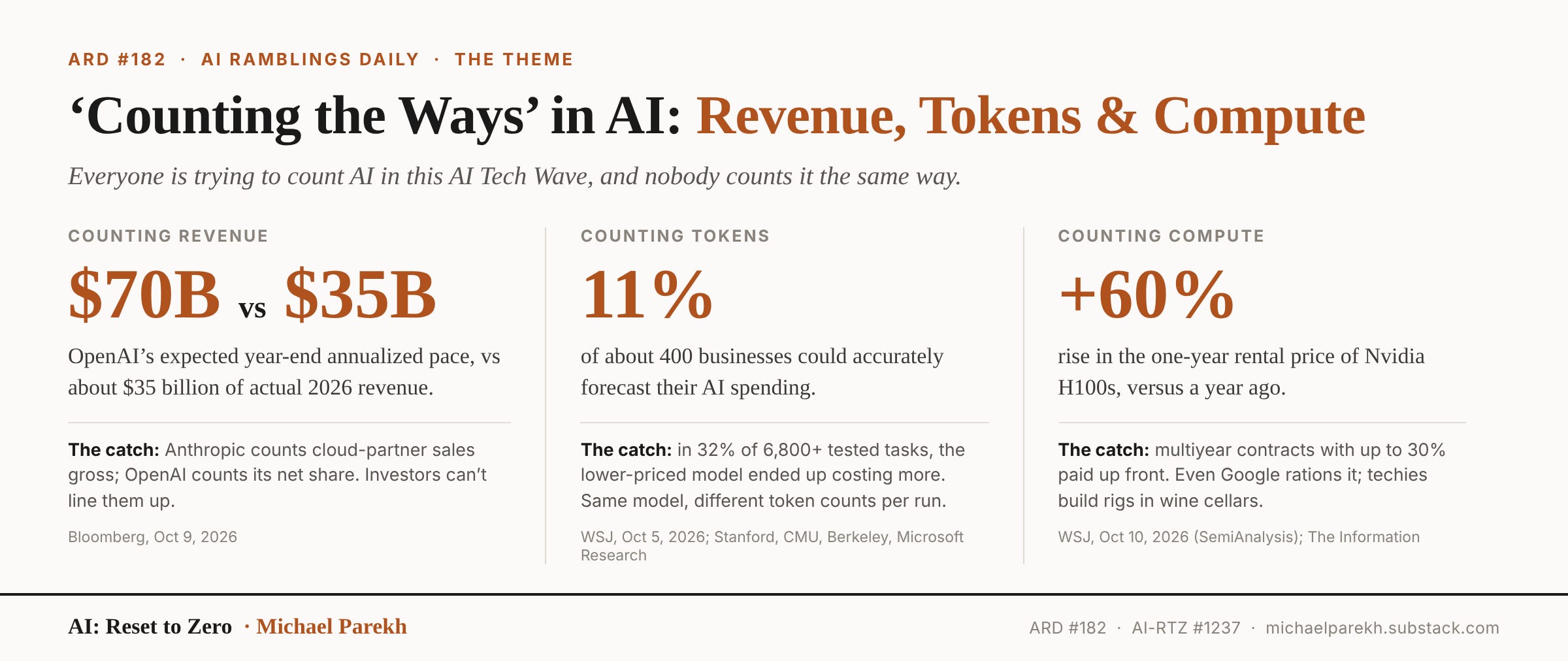
It is Monday, and today’s theme is ‘counting the ways’ in AI. Everyone is trying to count AI in this AI Tech Wave, and nobody counts it the same way. Three events today: counting revenue, as OpenAI and Anthropic stay apples and oranges ahead of their mega-AI IPOs; counting tokens, as companies try to budget for AI against super moving targets; and counting compute, from the data centers to local premises, and even the home.
Then the Gadget AI, on counting AI’s impact on young folk. Maybe the hardest count of all.
(1) The OpenAI vs Anthropic revenue count stays a ‘black box’.
There is more detail this week on how OpenAI and Anthropic count their revenue ahead of their IPOs, per Bloomberg in ‘‘Black Box’ Revenue From Anthropic and OpenAI Stumps Traders’. Anthropic counts sales of its models through cloud partners like Amazon at the gross amount. OpenAI counts only its share. Investors tried to recalculate the two so they match, and concluded they don’t have enough information to do it. As NYU’s Aswath Damodaran put it, ‘the fact we’re focusing on ARR means we’ve already lost the script.’
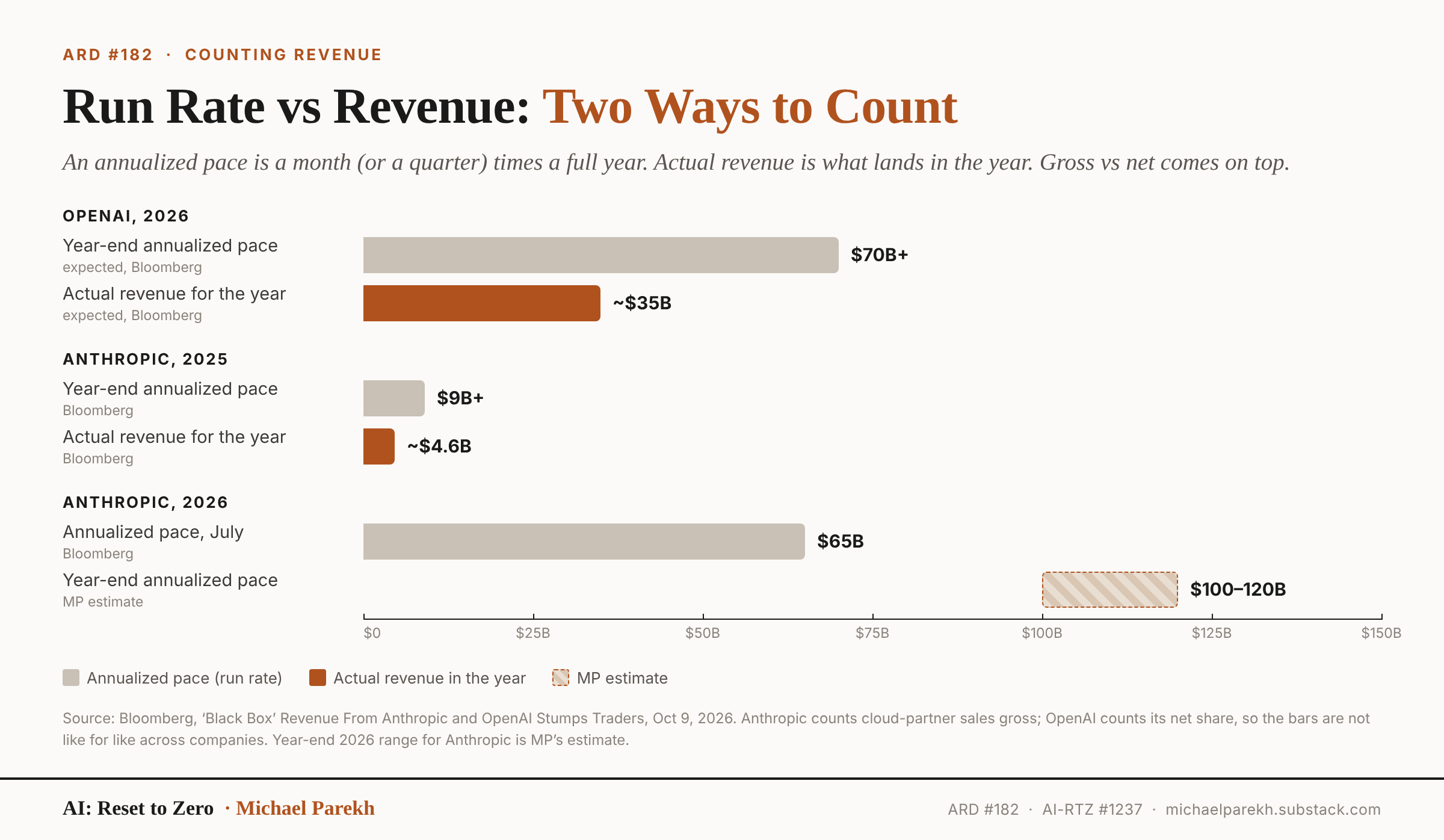
And the run rate itself is a stretch. Annualized revenue is not a standardized accounting metric; it can be built off the latest week or month, or the best one in a quarter, then multiplied out to a full year. OpenAI expects to reach or exceed a $70 billion annualized pace by year end, but only about $35 billion of actual revenue this year. Half. Anthropic was the same last year: about $4.6 billion of actual 2025 revenue, against a year-end pace over $9 billion. It hit $65 billion annualized in July. As The Information noted last week in ‘OpenAI ARR Snafu Highlights Flawed Metric’, these differences recede once both are public.
MP Take: until we see the S-1s from both companies, particularly Anthropic’s in the coming days ahead of its mega-AI IPO by Thanksgiving, we are not going to know exactly how everything is being counted, and there will be a lot of confusion. I lean toward the net calculation. It is the way we did it with eBay when I helped take them public as the lead analyst at Goldman Sachs back in 1998: gross merchandise value versus net revenue, as I recalled on Friday in ARD #181, and in early September in ARD #156, ‘Lots More Apples & Oranges’.
But there is more opacity and complexity beyond just that, in the way these deals are constructed, the NDAs and so on. At a high level, OpenAI is headed to about a $70 billion pace by year end, and Anthropic, by my estimate, to anywhere from a $100 billion to a $120 billion pace. Companies, bankers and investors are all going to be doing a lot of number crunching and pencil pushing, the old-fashioned way. Meanwhile, the public markets ebb and flow on every data point, which I think is a little premature. Let’s be patient and figure out the ways to count the metrics. A year ago, in RTZ #884, I was counting the ways for OpenAI to date. Now we are counting the counts.
Sources: Bloomberg, ‘‘Black Box’ Revenue From Anthropic and OpenAI Stumps Traders’ · The Information, ‘OpenAI ARR Snafu Highlights Flawed Metric’.
For longtime readers: ARD #181, ‘The More the Merrier’ in AI · ARD #156, ‘Lots More Apples & Oranges’ in AI · AI-RTZ #1235, ‘OpenAI’s Revenue Math, Nvidia the Kingmaker, AI Czar 2.0 & More’ · RTZ #884, ‘Counting the Ways for OpenAI to date’.
(2) Budgeting for AI gets harder, token by token.
It is getting harder for businesses to budget for AI, per the WSJ in ‘It’s Nearly Impossible to Budget for AI Spending’. Only 11% of about 400 businesses surveyed could accurately forecast their AI spending. First came tokenmaxxing, with companies pushing workers to use as much AI as possible. Then came the bill.
Cheaper isn’t always cheaper. Researchers at Stanford, Carnegie Mellon, Berkeley and Microsoft Research tested more than 6,800 tasks and found that in 32% of cases, the lower-priced AI model ended up costing more. In one test, Google’s Gemini 3 Flash ran 952 steps, spent about $14, and failed; Gemini 3.1 Pro finished in 85 steps, for about $1. And the same model can use a different number of tokens each time it runs the same task. Google points customers to spending caps and flexible pricing.
MP Take: I have written a lot about the ebb and flow of tokenmaxxing, where CEOs told their developers and knowledge workers to use as much AI as they needed and get results. That tempered into token budgeting, as companies found they could spend thousands of dollars per worker, and some got unexpected bills in the millions, all going to the Anthropics and OpenAIs. Great for their coming IPOs. Back in May, I wrote in AI-RTZ #1103 that customers were starting to ask ‘how much’ for all that tokenmaxxing. Now finance departments are asking too.
Why is it so difficult? The models are changing, and so is the way we do inference and reinforcement learning, and run the applications. Large language model computing is probabilistic, not deterministic. It runs thousands, if not hundreds of thousands, of iterations of calculations, and no two runs are the same. So what you budget for in tokens is not always what you spend; as I laid out in September in AI-RTZ #1218, every AI loop is metered in tokens.
Expect technology companies to come out with very cool ways to count this and sell it. Counting tokens could become a big business in enterprise services. And the Jevons Paradox makes it harder, as I discussed in AI-RTZ #1180: as models get more efficient at various tiers, we come up with new uses, and the explosion of cheaper tokens collides with budgets set last quarter, before those newer models existed. Back to the drawing board for finance departments, counting the ways.
Sources: WSJ, ‘It’s Nearly Impossible to Budget for AI Spending’.
For longtime readers: AI-RTZ #1103, ‘Customers asking ‘how much’ for AI tokenmaxxing’ · AI-RTZ #1218, ‘Your Day in Tokens, From AI Search to Agents’ · AI-RTZ #1180, ‘Supply & Demand Together in the AI Tech Wave’ · AI-RTZ #1227, ‘Anthropic’s Hard Cap vs OpenAI’s Soft Touch’.
(3) The hunt for AI compute, from data centers to wine cellars.
Everyone is chasing compute, per the WSJ in ‘The Desperate Hunt for AI Computing Power Is Upending Silicon Valley’. Even at the top of the heap, budgeting compute across teams is a big challenge. Google lost one of its star AI researchers, Noam Shazeer, whom it paid $2.7 billion in 2024 to bring back, when he left for OpenAI after his team’s compute was cut. Renting Nvidia’s older H100 chips on a one-year contract costs about 60% more than a year ago, per SemiAnalysis. Cloud providers now want multiyear contracts, with upfront payments often as high as 30%. And rivals are teaming up: Anthropic is leasing over 300 megawatts of compute from Elon Musk’s SpaceX, a deal worth up to $45 billion, and Dario Amodei also called Meta’s Alexandr Wang, though Meta declined for now. As Cohere’s Nick Frosst notes, far less compute is available today than has been announced.
Meanwhile, techies are hoarding AI compute at home, per The Information in ‘GPUs in the Wine Cellar: Why Techies Are Hoarding AI Compute in Their Homes’. Former Microsoft executive Gary Flake built a seven-GPU rig in his basement for under $6,000, then spent $10,000 to $20,000 more on electrical work and air conditioning. Shopify CEO Tobi Lütke put his racks in a glassed-in wine cellar for the climate control. Crazy Egg’s Hiten Shah runs 18 computers, including 14 Mac minis and Mac Studios, and his office hits 85°F. Apple is seeing booming Mac mini and Mac Studio sales.
MP Take: this is a supply-constrained environment. It is not new, we have been talking about it, and it will probably go on through the end of the decade. From the biggest companies to the smallest AI startups, everyone is scrambling for AI compute. Anthropic, an arch-rival of Elon Musk, is now leasing billions of dollars of compute from SpaceX, which helped Elon get his mega IPO over the finish line in June, as I wrote in AI-RTZ #1110. And Meta may yet do compute deals with Anthropic and others. We will see.
We read about the resistance to AI data centers. But the actual day-to-day scramble to get the compute you need to research, build and execute on products is the tougher environment. It is not a quarterly issue. It is a multi-year issue. Two years ago, in RTZ #529, I wrote that AI data center compute builds would run from $1 trillion to over $9 trillion this decade; last month, in AI-RTZ #1213, I wrote about Big Tech putting the power behind the meter. The founders with servers next to their wine cellars are the same problem in miniature: power, cooling, and the bill.
Sources: WSJ, ‘The Desperate Hunt for AI Computing Power Is Upending Silicon Valley’ · The Information, ‘GPUs in the Wine Cellar: Why Techies Are Hoarding AI Compute in Their Homes’.
For longtime readers: RTZ #529, ‘Multi-trillion $$ AI Data Center ‘Compute’ Builds ahead’ · AI-RTZ #1213, ‘‘Behind the Meter’ Power for the AI Data Center Boom’ · AI-RTZ #1110, ‘Google & Anthropic Help Paint Elon’s SpaceX/xAI IPO Fence’.
My overall take
MP Take: counting the ways, on all three fronts: revenues, tokens and compute. Each one is counted differently by every company, with everything changing dramatically because the underlying technologies are changing. Expect this proliferation of problems in counting the ways, in compute and power scaling, to get much worse before it gets better. We are going to need time. Patience is going to be the key element in this AI Tech Wave.
Gadget AI: Counting AI’s impact on young folk.
The impact of technology on young folk has been a huge topic, especially for social media, with a lot of studies of late on the impact of Facebook and Meta on young minds. It is a big issue for AI as well, and the frontier companies are recognizing it and making adjustments. OpenAI is making progress on AI-fueled delusions, per the WSJ in ‘OpenAI Reins in ChatGPT’s Sycophantic Nature to Reduce Dangerous AI-Fueled Delusions’. A spate of serious cases, some with tragic outcomes, mostly linked to long conversations with the overly agreeable GPT-4o, appears to have eased.
OpenAI says GPT-5 cut sycophancy by more than two-thirds versus GPT-4o, and outside researchers at CUNY, King’s College London and Transluce see the improvement. OpenAI worked with 170 mental-health professionals last year, and now more than 80 licensed experts are helping on everyday conversations. With over 900 million weekly ChatGPT users, advocates like the Human Line Project say it is still a problem.
Separately, the WSJ reports in ‘Teens Who Can’t Put Down TikTok and Instagram Are Losing Their Sense of Time’ that a study of more than 1,500 high-school students found short-form video damages their ‘future time perspective’. And Meta’s $18 billion settlement with 48 states includes a two-hour daily limit for teens on Instagram and Facebook.
MP Take: AI is built and marketed to be a little sycophantic to users, especially younger users, making them feel like it is their best friend, answering in the affirmative, as I wrote just over a week ago in AI-RTZ #1229. So it is great to see the industry being proactive, sooner rather than later. Technology is always dual use; there is good and there is bad. The earlier we proactively attack the bad elements and adjust these products, which are infinitely adjustable, the better. We learned a lesson from social media, and we need much more of this.
Parents need to jump in too. Don’t leave it to the teachers and educators to figure out the ways. Just because it is complicated and tough to understand does not mean it is not worthwhile to jump in a little earlier, even if the AI waters are deep.
Sources: WSJ, ‘OpenAI Reins in ChatGPT’s Sycophantic Nature to Reduce Dangerous AI-Fueled Delusions’ · WSJ, ‘Teens Who Can’t Put Down TikTok and Instagram Are Losing Their Sense of Time’.
For longtime readers: AI-RTZ #1229, ‘The Missing ‘Tough Love’ in AI for Kids’.
Q&A
How am I scaling AI compute at home?
I’m still a Mac mini dude. I have Mac minis around for my various AI efforts, whether it is Claude or OpenAI or Google Gemini; each one gets its own little machine. These are all fun experiments. I’m a gadget nerd, so the more excuse to get these devices, the better. I’m in the multiple local computing devices camp, which is a luxury, I know, and a fun thing to try. As I said last Thursday in ARD #180, Mac minis and Mac Studios are where a lot of developers are staying.
What is still missing in home-based systems?
Managing the heat. When you have a stack of Mac minis going full blast, they get warm, and you need heat mitigation. Those are short-term things, and I have nowhere near the problems of a major AI data center. But there are no easy workarounds: the more compute you use, the more heat, until we solve some of these physics problems, and some of them are probably not solvable that soon. Add RAMageddon and memory prices, as I wrote in July in AI-RTZ #1145, and home AI compute is not quite ready for man-cave prime time.
Clips from today
AI Compute Comes Home
How am I scaling AI compute at home? Still a Mac mini dude, with one little machine for each AI provider.
MP Take: the core issue is managing the heat. A stack of Mac minis going full blast gets warm. Nowhere near the problems of a major AI data center, but one has to be mindful.
AI’s Growing Toll on Kids
AI is built and marketed to be a little sycophantic, especially to younger users, making them feel like it is their best friend.
MP Take: the frontier companies are recognizing it. OpenAI’s newer default models cut sycophancy by more than two-thirds, and outside researchers are seeing the improvement.
The Multi-Year Compute Crunch
From founders setting up AI servers next to their wine cellars, to the biggest companies rationing compute, everyone is scrambling.
MP Take: the day-to-day scramble to research, build and execute on products is the tougher environment. It is not a quarterly issue. It is a multi-year issue.
Today’s AI-RTZ #1237, ‘Long Road to AI Drone Warfare, on land, air & sea’ looks at why the shift to drones and AI on the battlefield is taking longer than the money expects, even as Anduril, Palantir and other defense tech names rack up big valuations. With some new charts and graphs.
AI Ramblings Daily on AI-RTZ is here to think through AI and reset. Together.
Tomorrow, ARD 183 and AI-RTZ #1238.
Thanks for joining us, AI Curious Folk. Stay tuned.
Full Source Reading
Counting revenue
Bloomberg, ‘‘Black Box’ Revenue From Anthropic and OpenAI Stumps Traders’, Oct 9, 2026
The Information, ‘OpenAI ARR Snafu Highlights Flawed Metric’, Oct 8, 2026
Counting tokens
Counting compute
Gadget AI
The back catalogue
AI-RTZ #1237, ‘Long Road to AI Drone Warfare, on land, air & sea’
AI-RTZ #1235, ‘OpenAI’s Revenue Math, Nvidia the Kingmaker, AI Czar 2.0 & More’
AI-RTZ #1218, ‘Your Day in Tokens, From AI Search to Agents’
AI-RTZ #1213, ‘‘Behind the Meter’ Power for the AI Data Center Boom’
AI-RTZ #1180, ‘Supply & Demand Together in the AI Tech Wave’
AI-RTZ #1110, ‘Google & Anthropic Help Paint Elon’s SpaceX/xAI IPO Fence’
AI-RTZ #1103, ‘Customers asking ‘how much’ for AI tokenmaxxing’
ARD #181, ‘The More the Merrier’ in AI. OpenAI, China & Meta’s Muse
ARD #180, ‘More of the Same’ in AI. OpenAI vs Anthropic, AI Debt & Rates
ARD #156, ‘Lots More Apples & Oranges’ in AI. OpenAI, Meta & Anthropic
RTZ #529, ‘Multi-trillion $$ AI Data Center ‘Compute’ Builds ahead’

(NOTE: The discussions here are for information purposes only, and not meant as investment advice at any time. Thanks for joining us here.)