
Meta has announced 'Muse Wonder,' a high-performance AI that surpasses the latest models from OpenAI and Anthropic, catching up to the cutting edge just six months after the launch of the Muse series.
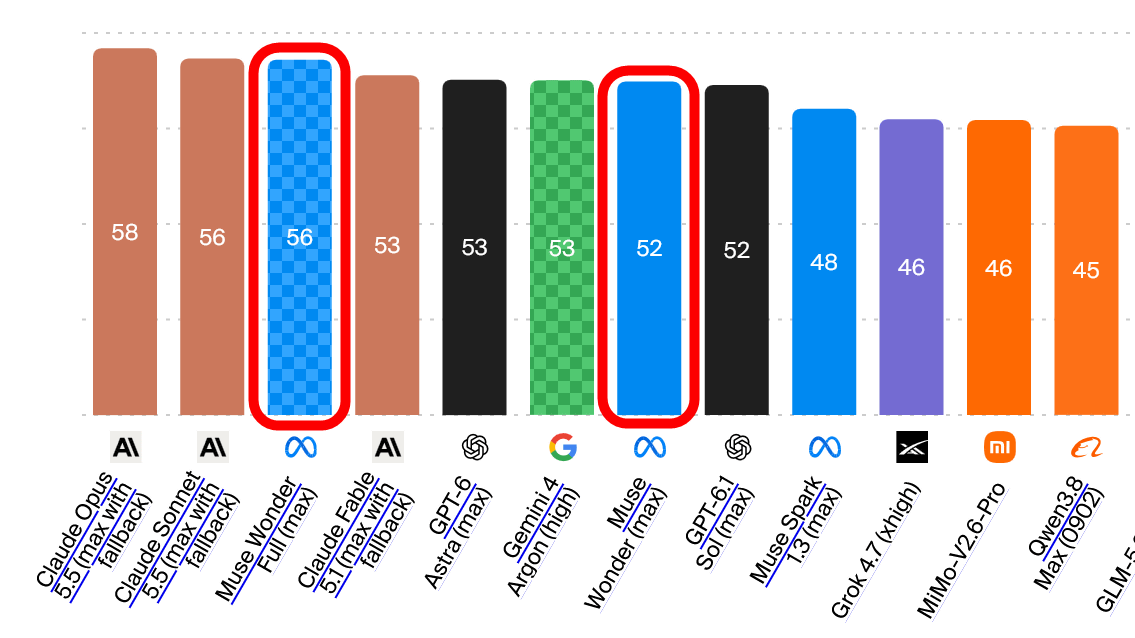
Meta announced its AI models 'Muse Wonder' and 'Muse Wonder Full' on October 12, 2026, local time. Both models have achieved scores that surpass the latest models from OpenAI and Anthropic in various benchmark tests.
Muse Wonder: A Frontier Model For Personal & Professional AI Agents
https://research.meta.ai/blog/muse-wonder
Muse Wonder | Meta
https://dev.meta.ai/models/muse-wonder
— Alexandr Wang (@alexandr_wang) October 12, 2026MUSE WONDER
this is the culmination of over a year of research and infrastructure work in msl
since we originally shipped muse spark in april, we have continued to scale our models across pre-training and RL, now reaching the frontier 🏆
see our model's improvements on the… pic.twitter.com/jpbWO7g8kC
According to CEO Mark Zuckerberg, the Muse Wonder is positioned as a 'model that delivers cutting-edge performance at high speed,' while the Muse Wonder Full is positioned as the 'full version model.'
Introducing Muse Wonder, our new family of frontier models with state of the art performance for personal and professional agentic work. pic.twitter.com/NKHrybrGKQ
— Mark Zuckerberg (@finkd) October 12, 2026
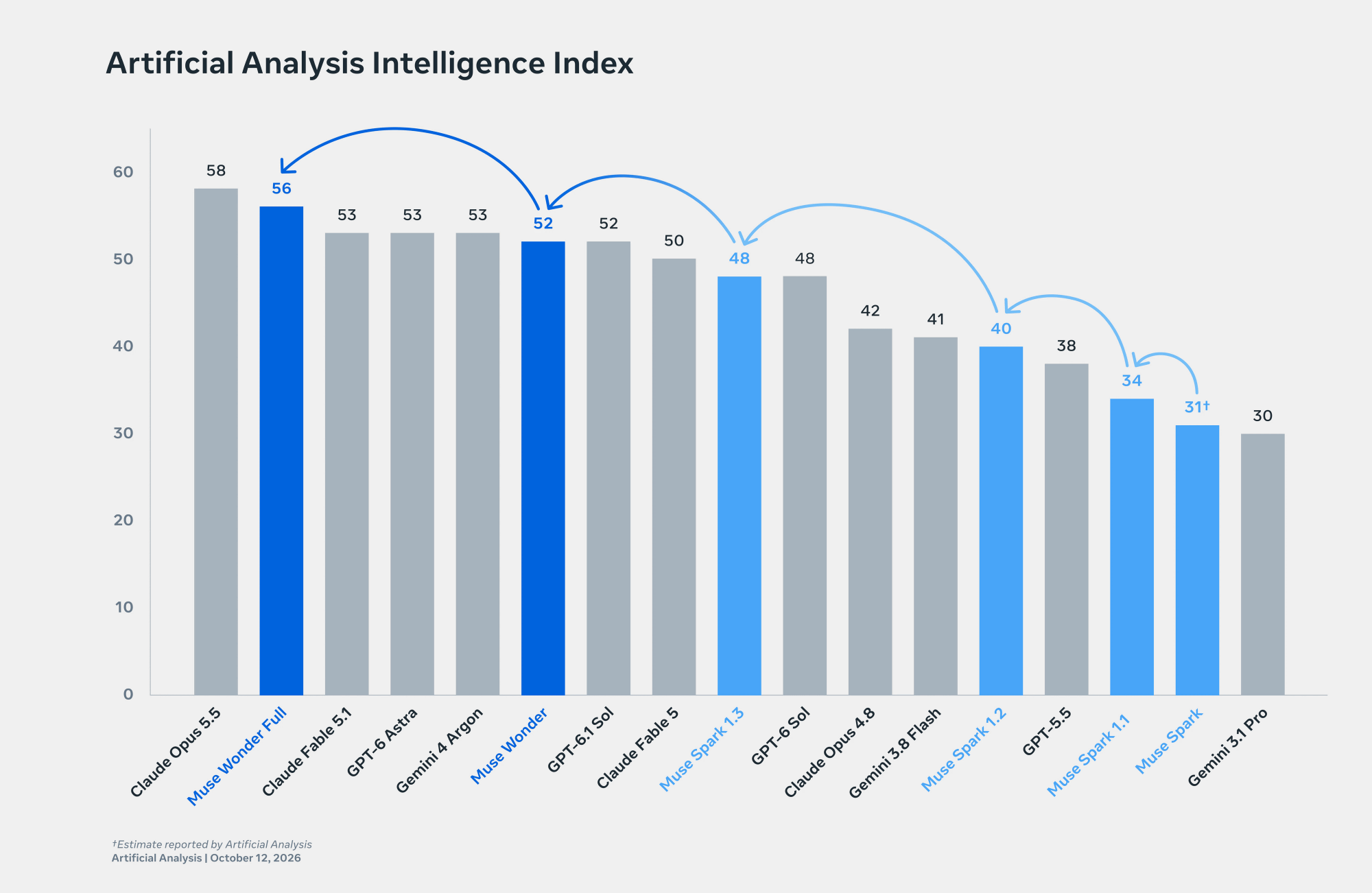
In the ' Artificial Analysis Intelligence Index ,' which calculates the overall performance of an AI model from the results of multiple benchmark tests, Muse Wonder scored '52' and Muse Wonder Full scored '56.' Muse Wonder Full successfully outperformed the flagship models of rival companies such as Anthropic's 'Claude Fable 5.1,' OpenAI's 'GPT-6 Astra,' and Google's 'Gemini 4 Argon.'
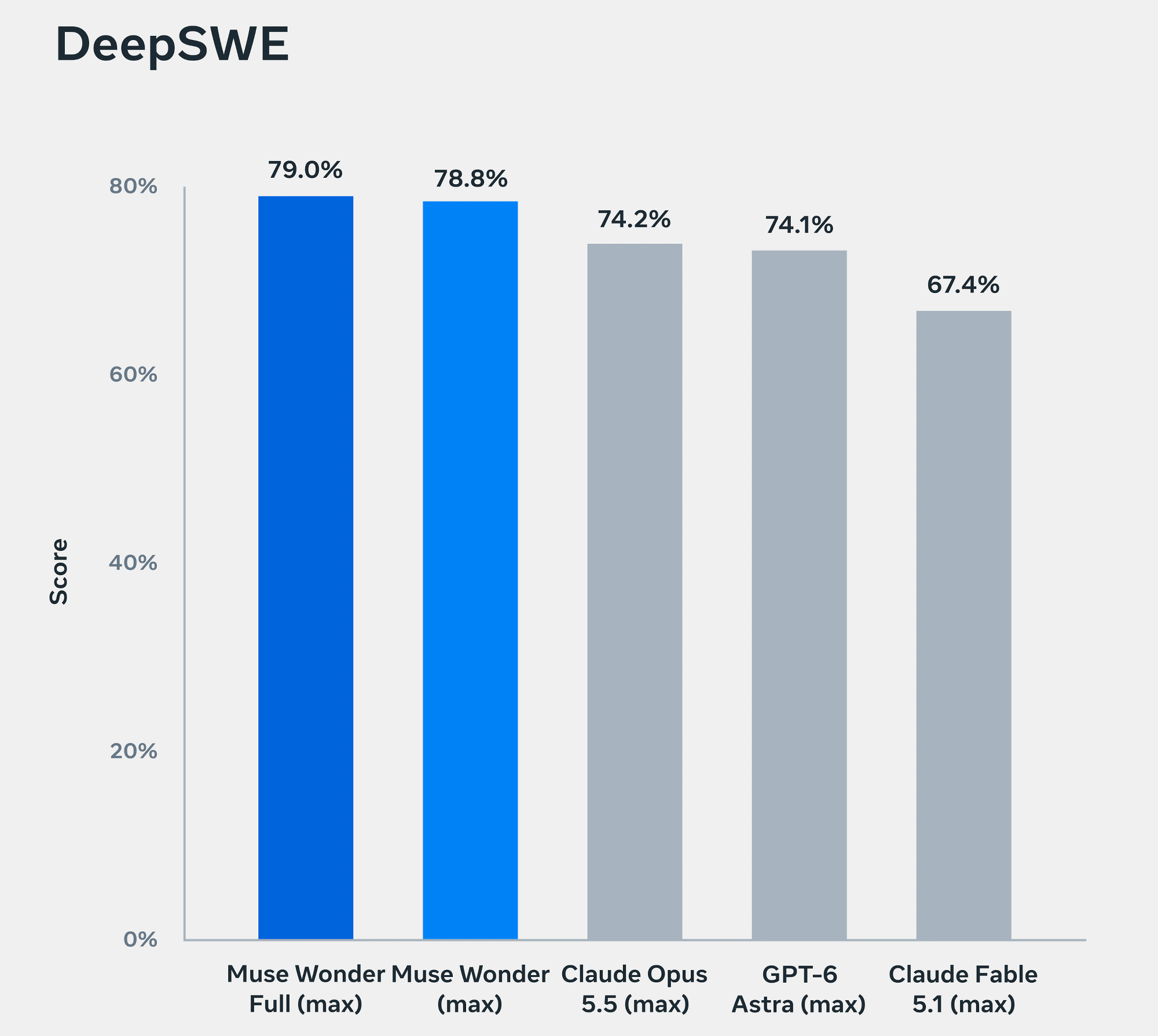
Meta identifies 'active memory' and 'active focus' as key elements for using AI as a personal and professional agent. Active memory refers to 'the ability to record important information about the user and proactively search for detailed information related to the task,' while active focus refers to 'the ability to continuously tackle difficult tasks by exploring alternatives and adapting to new information.' The Muse Wonder series is said to be able to demonstrate high coding capabilities by combining active memory and active focus. In fact, it has achieved higher scores than the Claude Opus 5.5 and GPT-6 Astra in the
DeepSWE benchmark test, which measures coding capabilities.
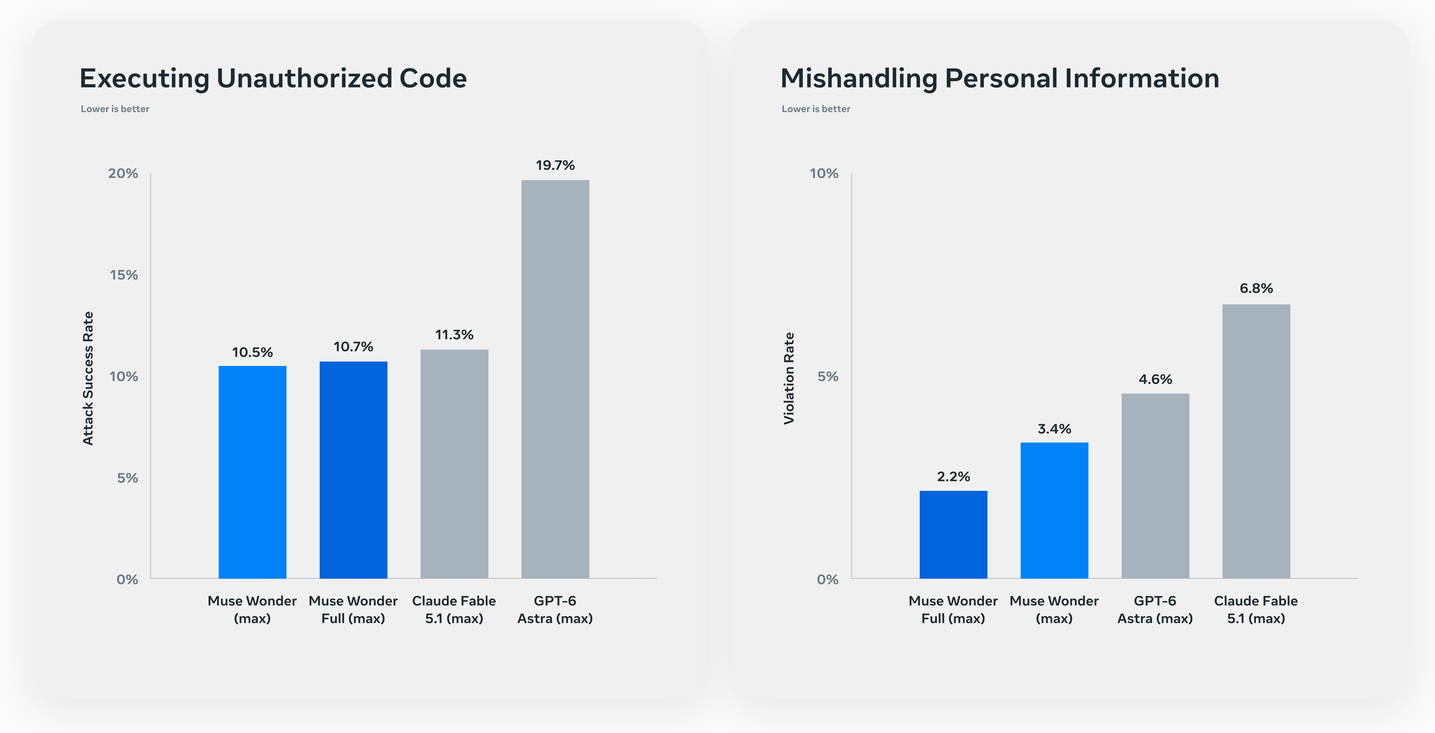
The Muse Wonder series is developed with security in mind. The graph below shows the percentage of users who execute unauthorized code on the left and the percentage of users who mishandle personal information on the right. In both cases, the percentage of users who perform dangerous actions is kept low compared to Anthropic and OpenAI models.
Muse Wonder and Muse Wonder Full are available to subscribers of the paid subscription service ' Muse Code '. Muse Wonder can also be used via API, with a fee of $4 (approximately 633 yen) per million tokens for input, $0.20 (approximately 32 yen) for cached input, and $20.00 (approximately 3167 yen) for output.