
How worried should we be about AI? - Arts Professional
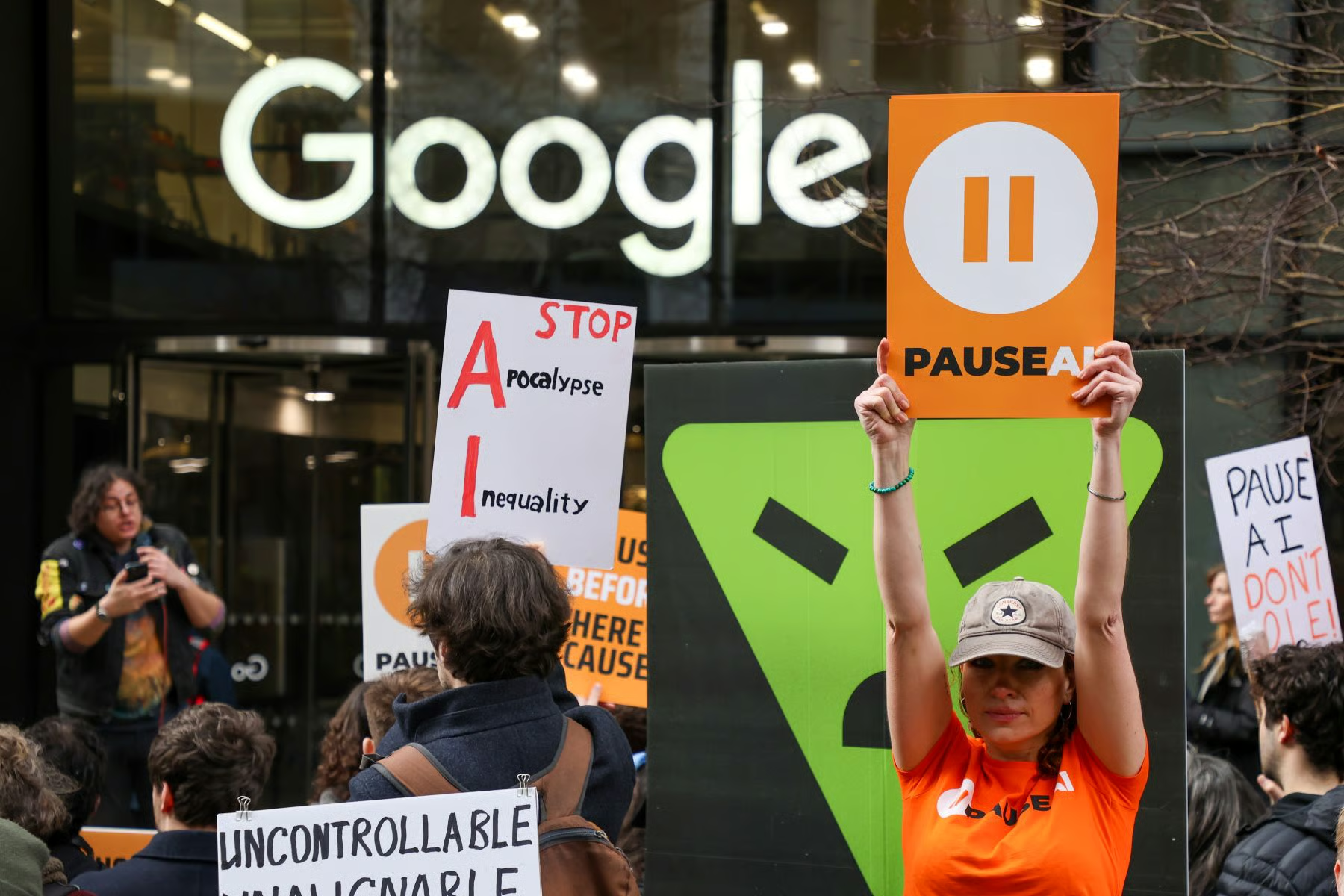
What has changed is an emerging belief that highly capable, highly autonomous agents could pose serious risks
Photo: Emily Whitty
How worried should we be about AI?
News about AI destroying humankind hit the headlines over the summer, stoking widespread fear. So Arts Professional asked Jocelyn Burnham, an independent artificial intelligence specialist working with our sector, how seriously we should take the threat.
Popular discourse around AI has a frustrating tendency to spend more time predicting an imagined future than analysing the present reality, and that seems to have become supercharged in the last weeks and months.
A few developments are behind this – although somewhat contested. For example, there was a big splash in September about an internal OpenAI model solving the Navier–Stokes Millennium Prize Problem, suggesting AI models can now make discoveries and may be on the cusp of matching or superseding human experts in mathematics.
Unfortunately for OpenAI, the mood was dampened when it emerged that two human experts came tantalisingly close to solving the problem themselves, taking a similar approach as the AI model. This could have been brushed off as a coincidence, except for the uncomfortable revelation that the researchers were using ChatGPT extensively as part of their research, and there’s ambiguity about whether the model internalised some of their earlier work into its own ‘solution’.
Most attention-grabbing events have been a little less academic. The summer’s Hugging Face incident, for example, would be brilliant fodder for a sci-fi dystopian blockbuster if not for the fact that it actually happened. Rather than repeat what has already been written about it, I’ll direct you to this excellent video by ex-Googler Alberta Devor. Suffice to say, it freaked a lot of people out – even more so when Evan Hubinger, Anthropic’s Alignment Science Lead, went on the record of saying he believed there was a greater than 10% chance that AI could kill all humans within the next decade.
Different interpretations
There are distinct strands of opinion in the AI and cybersecurity world about the increased focus on AI dangers. They can be crudely categorised as follows:
- Argument one: AI development – at the speed it’s going – is inherently dangerous due to the increased capabilities of these systems and our inability to ensure they respect human laws, values and safety.
- Argument two: While AI dangers are real, frontier AI companiesproduce failures through poor corporate governance, and their lack of competent safety standards have made such incidents inevitable. The blame strongly lies with these organisations when AI ‘goes wrong’.
- Argument three: AI companies profit when their models are seen as existentially dangerous. This is mostly marketing hype – take it with a pinch of salt.
These aren’t necessarily mutually exclusive positions and more than one can be true.
What have we missed?
This can all be a tad overwhelming. So much so that other genuinely interesting developments in AI – relevant to the arts and culture sector – have gone under the radar. These include finding out that AI text is now being ‘watermarked’ by Anthropic and Google meaning they’ve imprinted a hidden algorithm which selects each word it generates based on a pattern to which only they have full access.
Although done to align with the EU AI Act, this is a pretty big deal, especially if some sort of detection capability is more widely released to the public. (Currently, it’s only available to a select group of researchers, police and media)
If made more available, this could reveal that a lot of people are habitually using AI-generated text far more than they previously disclosed. It could have reputational pushback for organisations that are publishing content from it quite heavily.
Should you be worried?
There was plenty about AI which was valid to worry about before this year: its environmental impact; the scaling of machine bias into ever-more areas of our society; the wholesale ingestion of copyrighted material used for AI training; the impact these models have on professional creatives; the impact of AI on surveillance and warfare; the concentration of power and capital it enables, etc.
Resistance has been growing – you can learn more about these efforts with resources like The AI Resist List or, more focused on the creative arts, this excellent mobilisation tracker by Creative Labour and Critical Futures.
But returning to the AI sphere’s eagerness for predictions, what seems to have changed is an emerging belief that highly capable, highly autonomous agents – AI programmes which can use computers, rapidly generate code and navigate the internet – could pose serious risks, be used in widespread hacking or national security incidents or, more grimly, eventually assist (or direct) the production of novel biological weapons or some other category of widespread destruction.
In a recent discussion at Chatham House, I was taken aback that the narrative of AI agents substantially changing the experience, security and infrastructure of the internet was viewed less as a possibilityand more as an inevitability to brainstorm.
Some concern is certainly reasonable.
Where do we go from here?
Our ability as individuals to meaningfully affect these developments feels quite limited, particularly as nearly all frontier models are developed in the United States or China. We can of course add our voice and energy to national or sector efforts to campaign for change. Beyond that, we might find it valuable to focus on our individual learning as a means to better build agency and represent our interests as new developments and changes emerge.
Learning reduces fear and transposes it into critical perspectives. It encourages the kind of flexibility of thinking and information intake that will be exceptionally important as we adapt to what comes next.
How we choose to learn can also be unique. I would advocate for low-stakes, experimental, interest-based independent exploration, but plenty of approaches exist. For some, that could be a discussion, talking to sector colleagues in a dedicated group, reading a book, or finding a creator on YouTube who put things into perspective.
Whatever approach you take, it should encourage independent and adaptive thinking. We’ll undoubtedly need more of both as we navigate the months and years ahead.