UNESCO launches AI courses for university teachers
Four new Russian-language UNESCO courses help higher education teachers develop practical and responsible generative AI skills.
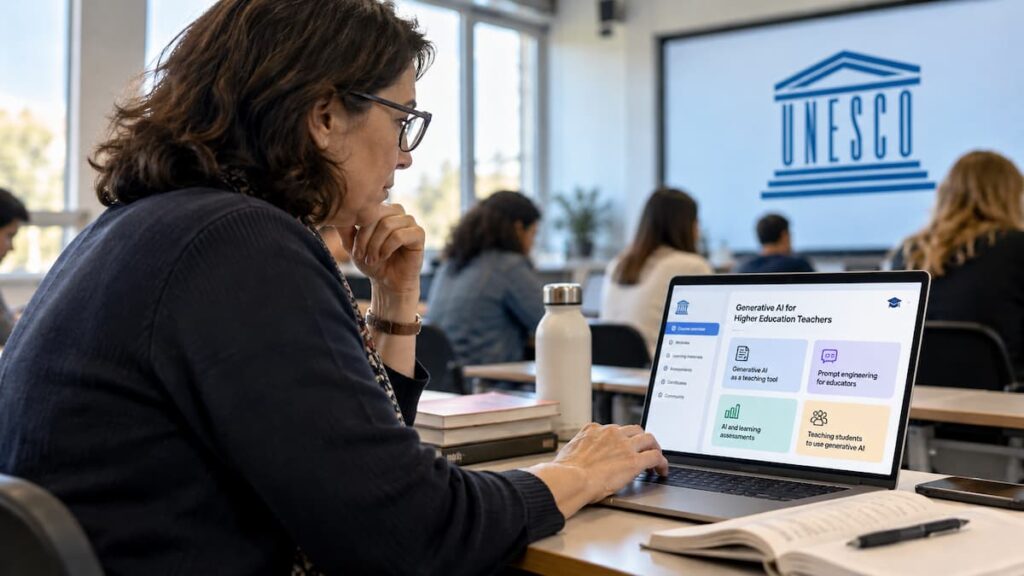
The UNESCO Institute for Information Technologies in Education (IITE), together with the International Centre for Higher Education Innovation under the auspices of UNESCO (UNESCO-ICHEI), has launched four free, Russian-language online courses to help higher education teachers integrate generative AI into teaching and learning. Announced on 12 October 2026, the initiative aims to strengthen educators’ practical AI skills while encouraging effective and ethical use of the technology.
The courses cover four areas: using generative AI to prepare lectures, tests and assignments; prompt engineering for higher education teachers; AI-assisted learning assessments; and helping students use generative AI responsibly. The assessment course also explores developing grading rubrics, generating personalised feedback and analysing student performance data. The courses are designed to provide practical teaching strategies alongside foundational knowledge of generative AI.
The training is available through the International Institute of Online Education (IIOE) platform. Each course is self-paced and can be completed independently or as part of a broader professional development programme. Participants can access the courses free of charge after registering on the platform and selecting Russian-language micro-certification courses. Those who successfully complete the required assessments receive certificates in Russian and English from UNESCO IITE and UNESCO-ICHEI.
The initiative adds to UNESCO IITE’s work on strengthening teachers’ AI competencies. In September 2026, the institute also released an analytical report on teacher AI competency frameworks, examining existing approaches and offering recommendations for national frameworks. The new courses provide educators with practical training opportunities, although the announcement does not specify enrolment targets, participating institutions or expected completion numbers.
Why does it matter?
As generative AI becomes increasingly relevant to higher education, teachers need the knowledge and practical skills to use it effectively without compromising educational quality or responsible technology use. The courses address this need by combining teaching applications with assessment methods and guidance on student engagement. Their free, self-paced format may also make professional development more accessible to Russian-speaking educators, while supporting wider efforts to develop AI competencies in education.