
OpenAI resolves eight-hour GPT-6.1 Sol disruption across Work and Codex
Service Incident
OpenAI says GPT‑6.1 Sol degraded across ChatGPT Work, Codex Web, the Codex API, CLI and VS Code from 08:10 to 16:36 UTC on October 13. The service recovered, but OpenAI has not published a cause or error‑rate breakdown.
The incident ran from 08:10 to 16:36 UTC
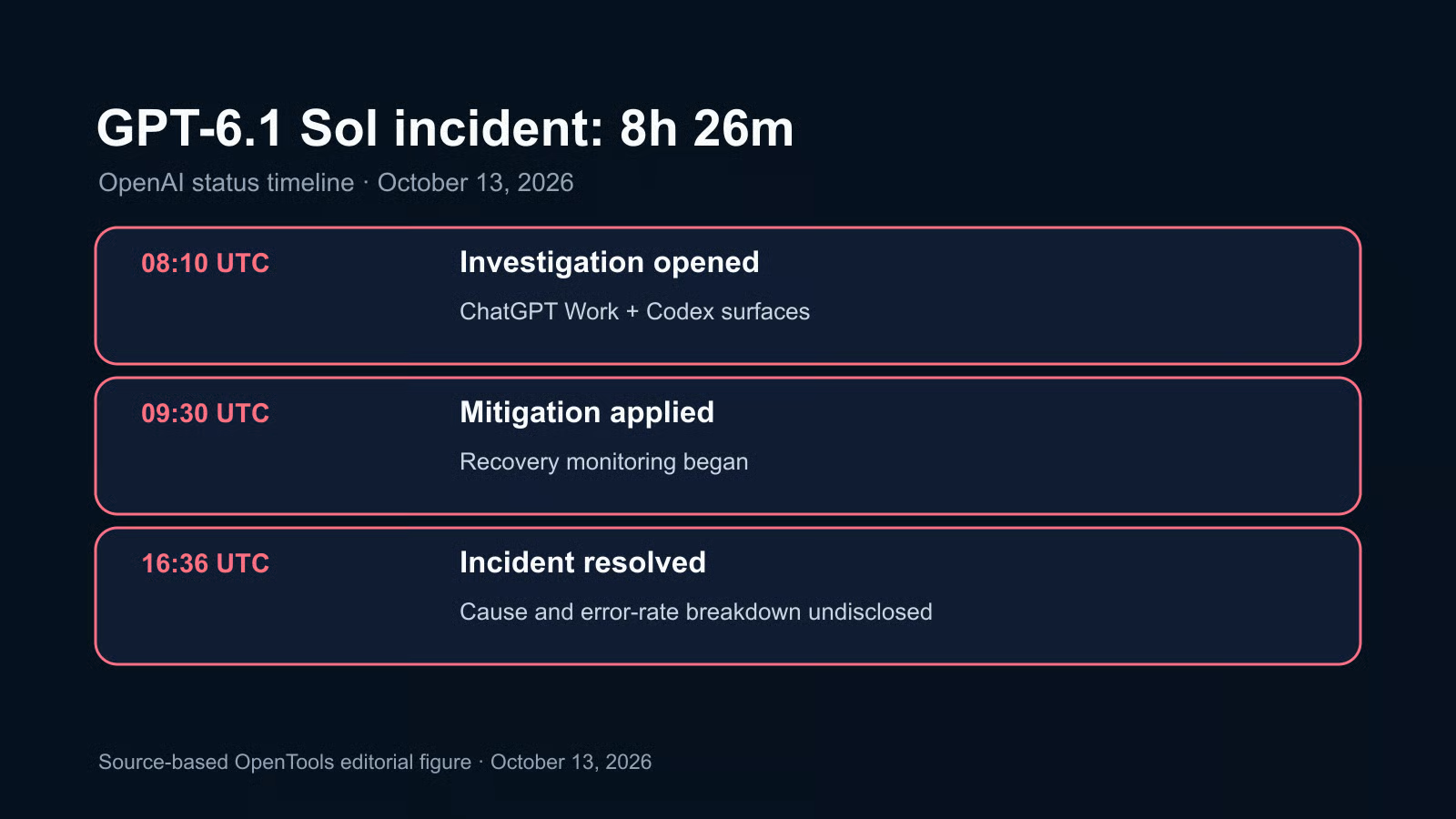
OpenAI opened an investigation at 08:10 UTC on October 13, 2026 and identified degraded performance on GPT‑6.1 Sol in Codex and ChatGPT Work eight minutes later. Its incident record says a mitigation was applied at 09:30 UTC and the company monitored recovery until resolving the incident at 16:36 UTC.
That makes the published incident window 8 hours and 26 minutes from the first investigation update to resolution. OpenAI did not provide an earlier impact start, so the status‑page clock should not be treated as proof that every affected request began failing at 08:10.
The status page classified the event as degraded performance rather than a complete outage. Individual users may therefore have seen slow responses, intermittent errors or no obvious failure at all.
ChatGPT Work and four Codex surfaces were affected
OpenAI listed ChatGPT Work plus Codex Web, Codex API, Codex CLI and the VS Code extension as affected components. The incident was tied specifically to GPT‑6.1 Sol, not to every OpenAI model or product.
The component list matters because a successful request on one surface would not establish that the others were healthy during the incident. A team using the CLI locally, a cloud task in Codex Web and API‑driven automation had three separate paths to reconcile.
OpenAI's page also warns that availability metrics are aggregated across tiers, models and error types. A resolved global incident can coexist with a lingering account, workspace, network or client problem.
OpenAI disclosed recovery, but not the technical cause
The public updates move through investigating, mitigation, monitoring and resolved. They do not name a root cause, affected request percentage, regional pattern, error codes, data‑integrity issue or rollback. OpenAI also did not say whether queued or interrupted tasks resumed automatically.
Those omissions limit what can be concluded. The incident confirms availability degradation across the named surfaces; it does not establish lost work, duplicated actions, model‑quality regression or a security breach.
If OpenAI publishes a post‑incident explanation, the important additions will be the failure mechanism, exact impact window, recovery behavior for in‑flight tasks and any action users must take.
A resolved status should trigger verification, not automatic replay
OpenAI's general troubleshooting guide recommends checking the status page, refreshing or restarting the app and retrying transient failures. That is reasonable for a failed chat response. Stateful agent work needs one extra step: inspect the original task and its outputs before sending the same instruction again.
Check whether a file changed, a command completed, a pull request was created or an external action succeeded despite a timed‑out interface. Re‑run only the missing portion. For API clients, reconcile the application record and any idempotency key before issuing another mutation.
The objective is to distinguish a failed display from a failed operation. A green status page confirms OpenAI closed the shared incident; it does not certify the completion state of an individual task.
Teams should preserve the incident window in their own logs
Mark 08:10–16:36 UTC as the provider‑reported window and compare it with local timestamps, model selection and client surface. Keep unknown start times as unknown rather than extending the incident to fit every error.
For unresolved failures, OpenAI's troubleshooting guidance asks users to retain timestamps and relevant identifiers when contacting Support. A useful report includes the model, surface, task or conversation ID, exact UTC time and the last confirmed action. Avoid placing private repository data or credentials in a public report.
The incident is resolved, but the record is still operationally useful: it defines which requests deserve reconciliation and which later failures need a different explanation. Follow OpenAI's OpenTools organization page for related platform coverage.
Figure: OpenAI's published incident timeline and affected surfaces on October 13, 2026. Source: OpenAI Status. Figure by OpenTools Team; no third‑party expressive material used.
Sources
- 1.OpenAI Status (status.openai.com)
- 2.help.openai.com (help.openai.com)