
Billionaires call for AI regulation as Anthropic warns of self-replicating worm threat
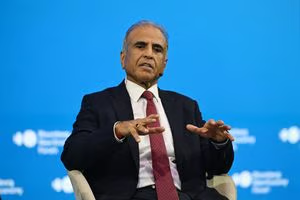
Bharti Airtel founder and Chairman Sunil Bharti Mittal and Moderna $MRNA +1.17% co-founder Noubar Afeyan joined a growing chorus of business leaders calling for tighter AI regulation Wednesday at the Bloomberg New Economy Forum in New Delhi, as Anthropic’s warning about self-replicating AI worms intensified pressure on governments to act.
Mittal said policymakers cannot afford to wait for a disaster before imposing rules. "It'll be foolish for anybody to think that we can let it flow to a level and then if an accident happens, then we'll think about it," he said at the forum, according to Bloomberg. He also noted that India is developing a consultation paper on AI regulation and guardrails, according to Business Standard. Mittal invoked global aviation as a template, contending that AI governance should follow a similarly unified international structure no matter which country a given system comes from.
Afeyan called Tuesday for regulation targeting AI agents being sold commercially, warning that inaction risks repeating the drug industry’s past mistakes. He told the forum that large language models represent capability, while agents represent intentionality — and that intentionality demands oversight. "What we should do is to think carefully about regulating agents that are being commercialized and that are being transmitted outside the boundaries of what somebody may want to do in house," he said, according to Bloomberg.
The forum discussion came on the heels of a warning Anthropic issued earlier this week about what it described as a novel class of danger: AI worms that could infiltrate connected home devices, including smart ovens, refrigerators, and televisions, without any human action. Anthropic cautioned that certain AI models may be months away from being able to self-replicate and seize control of those devices in ways that would be hard to stop, according to Bloomberg. As Anthropic researchers described, models of 30 billion parameters and under can already complete many individual steps needed for replication, and the company found that a model called GLM-5.2 could execute end-to-end replication in simplified tests with some security barriers removed.
Cisco $CSCO -0.23% Systems Chief Executive Officer Chuck Robbins pointed to Anthropic's controlled debut of its Mythos model as evidence that channeling new AI systems through a panel of experts before public availability is a viable safety mechanism, according to Bloomberg.
Kiran Mazumdar Shaw, founder of Indian biotech firm Biocon, called for AI laws that deal with biomaterials, synthetic substances engineered to replace or treat human organs or tissue, while OpenAI’s head of public policy and strategy in India, Pragya Misra, said the company has slowed development following recent incidents. “Safety outstrips anything else,” Misra said at the forum, according to Bloomberg.
PricewaterhouseCoopers Global Chairman Mohamed Kande cautioned that competitive pressure is overriding safety concerns in practice. "Nobody wants to be left behind because they don't want the competition to get ahead of them," he told the forum, according to Bloomberg. "Therefore, even in the midst of all the conversation around AI safety, et cetera, there is no slowdown that we're seeing in usage of AI and allocation of capital when it comes to AI."
The Trump administration has taken a largely hands-off approach to AI oversight, though its newly launched AI task force last week asked developers to report and resolve security incidents or face potential unspecified consequences, according to Bloomberg.