
AI: Microsoft’s Copilot evolving to ‘a Costco of AI’. AI-RTZ #1240
…Charles Lamanna’s ‘model monogamy’ reset, from making Google ‘dance’ to AI agents, and ‘pick a side’.

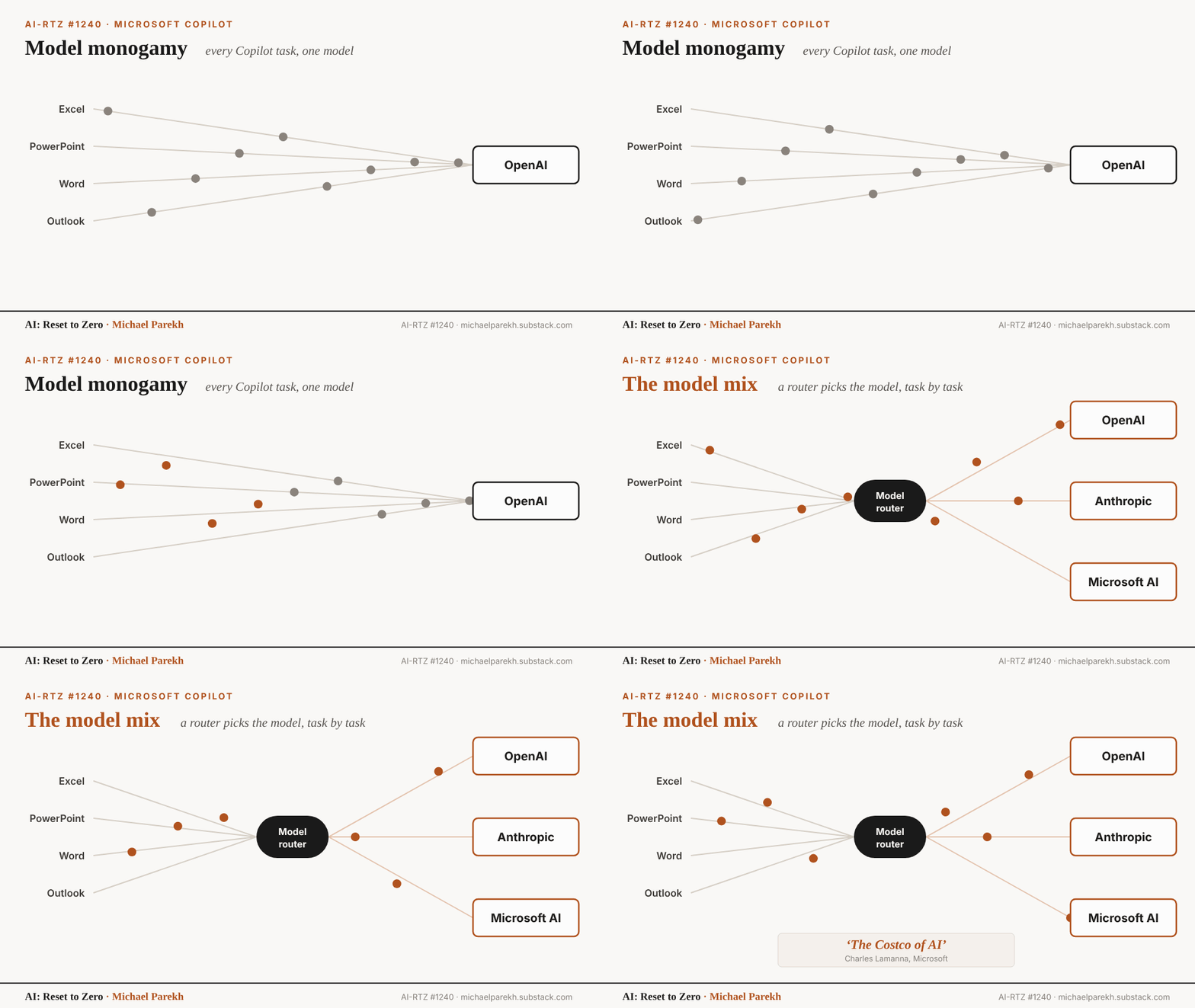
Microsoft’s Copilot has been on a long road in this AI Tech Wave since Microsoft’s iconic OpenAI investment and partnership in 2019.
From AI search, to AI reasoning, to AI PCs, and now to AI agents. Along the way, it went from one model partner, OpenAI, to a mix of models. And the executive who pushed that change hardest, Charles Lamanna, is now running Office and Copilot, and is being talked about inside Microsoft as a possible successor to CEO Satya Nadella. Let me unpack.
The Information has the inside story in ‘How Microsoft’s New Office Chief Fixed Copilot and Won Over Nadella’. In the summer of 2025, customers were complaining that Copilot was buggy and not good enough at automating work in Excel or PowerPoint.
Lamanna, 38, then a Microsoft president, went to Nadella with a proposal: pay Anthropic for its AI models to make Copilot better. ‘At the time, that was heresy,’ Lamanna says. Microsoft could use OpenAI’s models at no extra cost, thanks to its partnership, and commercial chief Judson Althoff pushed back on the price. Lamanna won Nadella over with demos showing Anthropic’s models were better at the math in Excel and at making good-looking PowerPoints.
The key point, in Lamanna’s words, was getting Copilot off a single model maker:
“It would be dangerous if we built Copilot for too long assuming model monogamy, because you basically would, like, bake in too much dependence on that model’s behaviors.”
The results so far are notable. Copilot’s corporate users have more than doubled since the start of the year to over 30 million. AT&T now has about 18,000 Copilot seats and relies on it for the ‘lion’s share’ of its personal productivity automation. And Lamanna’s organization has grown to about 25,000 people, more than triple a year ago, now spanning Copilot engineering, Teams and, since this month, Office itself.
From one model to the right model
Lamanna’s next step is the economics. Copilot’s ‘agent mode’, which steers both OpenAI and Anthropic models to reason longer on tasks in Office, is now the default. As OpenAI’s models caught back up to Anthropic’s in recent months, he has had Copilot lean more on OpenAI for agent mode, because Microsoft can run those models for free. His teams built a model router, using a homegrown LLM, that picks the cheapest model that can do the job without sacrificing quality. Most Office users now let it choose in ‘auto’ mode. Even so, Microsoft is on track to pay Anthropic more than $2 billion a year to power Copilot.

Lamanna has a memorable way to describe the goal. Microsoft should be ‘the Costco of AI’, he tells staff:
“We’re not going to be some boutique that only the top coders and the top R&D folks in the world get to access at a huge price. We’re going to drive all these prices down, so everyone can enjoy it.”
He has also driven Copilot Cowork, which resembles Anthropic’s Claude Cowork, and Autopilot, an always-on AI agent inspired by OpenClaw, which I discussed on ARD #176. Earlier this month, Microsoft rolled them into a revamped Copilot super-app, with the agent features priced by use. Lamanna and Autopilot lead Omar Shahine even talk daily about rivals’ agents, like Meta’s Muse, which I wrote about earlier this week in AI-RTZ #1238, and Instinct. Using outside tools is unorthodox at Microsoft. Shahine calls it a necessity.
Copilot’s long road, from ‘make Google dance’ to AI agents
This is the latest chapter in a story I’ve followed from the start. In February 2023, Nadella launched Bing Chat with OpenAI’s GPT-4 and told The Verge’s Nilay Patel, in ‘Microsoft CEO Satya Nadella explains how Bing with AI is better than Google’, ‘I want people to know that we made them dance.’ A year later, as I noted in ‘OpenAI also dancing in AI Search’, Google’s search share had barely moved.
In November 2023, Bing Chat became Copilot, and Nadella declared the ‘Age of Copilots’, as I wrote in ‘Microsoft, CoPilot for the Win’. Then came the bundling, Microsoft’s home turf, in ‘Microsoft readies the AI Bundle Hokey Pokey’. In May 2024 it was Copilot+ PCs, with NPUs and Recall, to make Apple dance, as I wrote in RTZ #363 and RTZ #364. Recall was then delayed over privacy concerns. By September 2024, paid Copilot adoption was slower than hoped, on budgets and bugs, per RTZ #470.
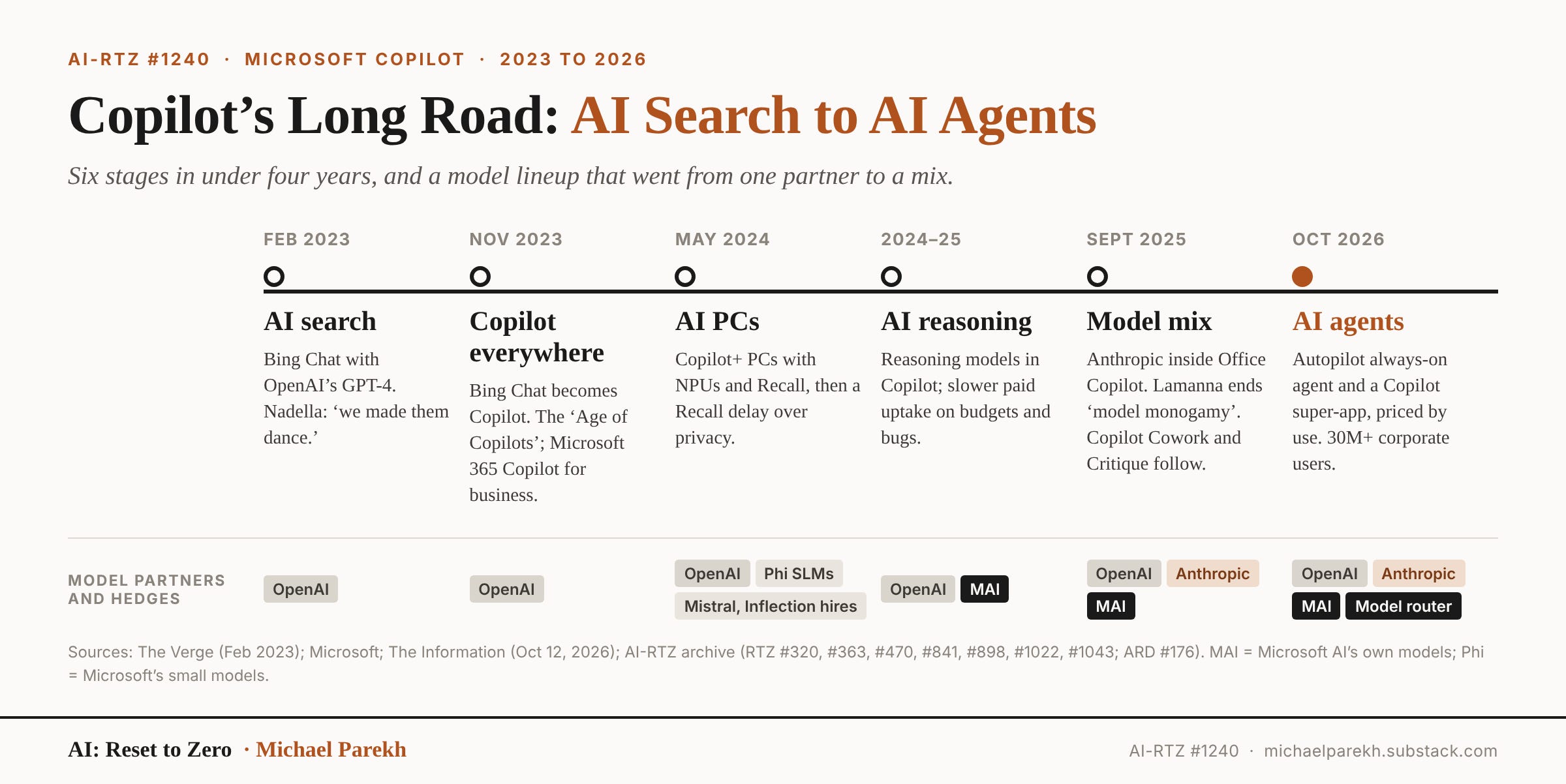
The model mix came next. Microsoft started building its ‘AI Backup Plan’ beyond OpenAI in 2024, with Inflection’s Mustafa Suleyman and Mistral, as I noted in RTZ #320. In September 2025, it brought Anthropic into Office, in RTZ #841. Two months later, it outlined its ‘post-OpenAI’ path with its own models under Suleyman, in RTZ #898. This year, it bundled Anthropic’s Claude Cowork into a $99 Copilot Cowork tier, in RTZ #1022, and had Claude check OpenAI’s work in Copilot Researcher with ‘Critique’, in RTZ #1043.
Hedging the bets, and ‘pick a side’
Microsoft is now partner and rival to both of the leading frontier labs at once. It owns about 27% of OpenAI, has IP rights into the 2030s and a $250 billion Azure commitment, while OpenAI sells ChatGPT Enterprise to the same customers, as I first framed in ‘Going for the Business’ back in 2023. It pays Anthropic billions for Copilot, while Anthropic sells Claude Code and Cowork directly. And in June, Nadella drew a line in the WSJ between the frontier labs and enterprise customers, putting Microsoft on the customers’ side, as I discussed in AI-RTZ #1127, ‘Microsoft picks a side vs Frontier AI models’, and on ARD #111, ‘Us vs Them’.
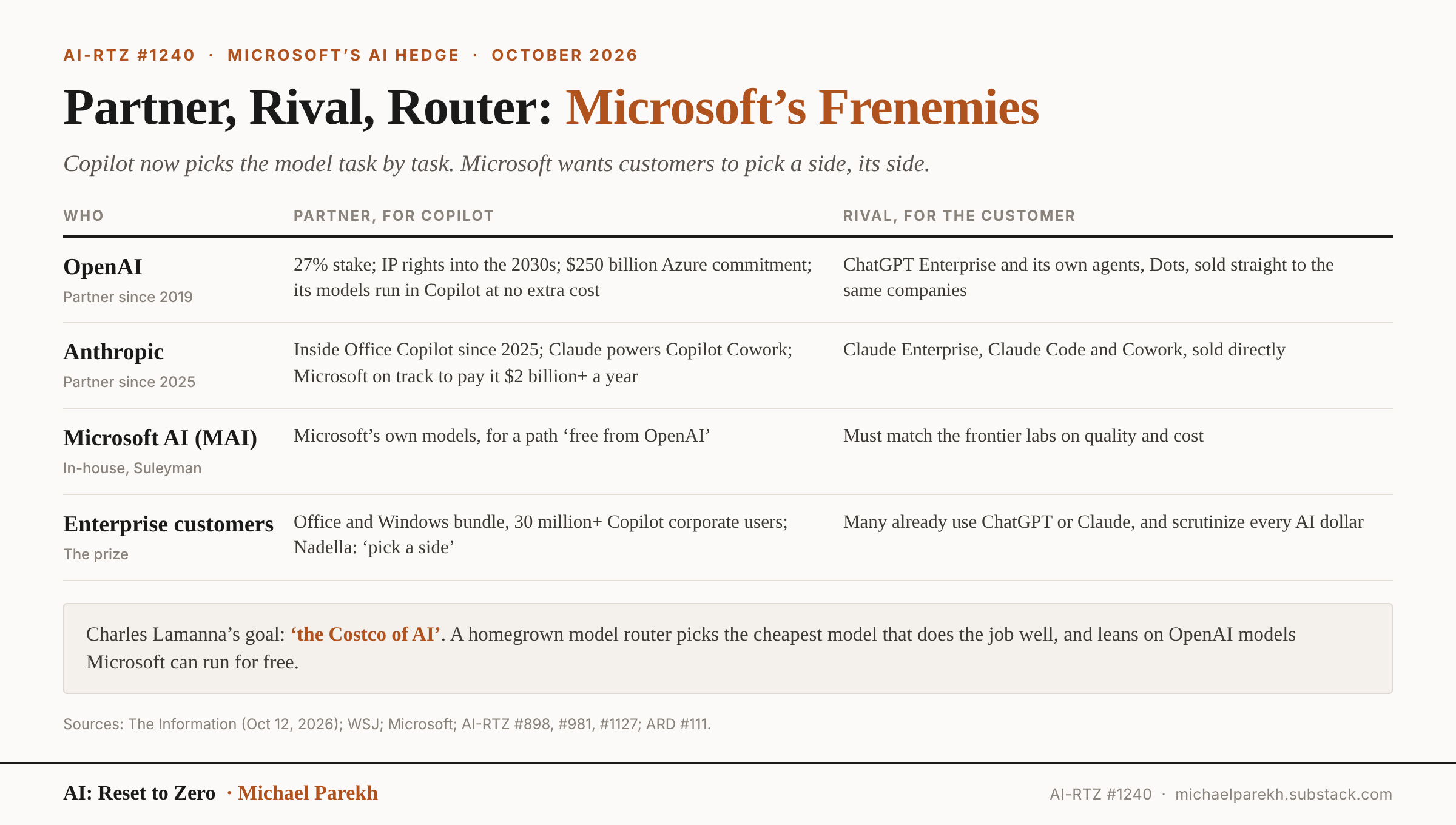
The router is the hedge, built into the product. If Copilot can pick the right model for each task, Microsoft keeps its leverage with every model maker, and its margins. That’s ‘pick a side’ in code. The test is whether customers who already use ChatGPT or Claude come back. National Life Group’s CIO told The Information that Copilot was ‘useless’ in 2023 and has improved markedly, but most of his employees still use ChatGPT. And as I wrote yesterday in AI-RTZ #1239, much of enterprise AI is still arriving top down, as a mandate, with workers ‘voluntold’ to use it.
A possible heir
Then there is the succession angle. Lamanna started at Microsoft as an intern, co-founded MetricsHub, which Microsoft bought, and rose through Scott Guthrie’s cloud unit to run Dynamics 365 and Power Apps, with a ‘no jerks’ policy. In March, Nadella made him an executive vice president over Copilot engineering, reporting directly to him. This month he added Office, after Rajesh Jha’s retirement. The two meet weekly.
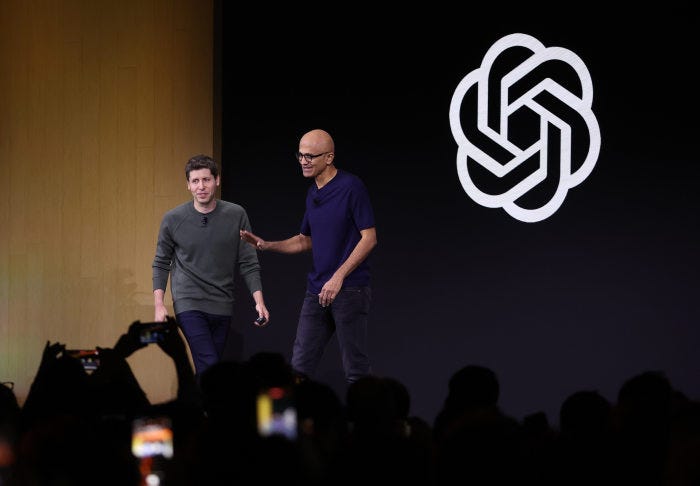
Nadella has also been bringing a handful of executives to Microsoft’s quarterly board meetings, including Lamanna, Jacob Andreou, Xbox CEO Asha Sharma, security chief Hayete Gallot and Arun Ulag. Some senior executives see that as introducing the board to possible successors. Asked if he would want to be a CEO again, Lamanna said, ‘in the abstract, yes.’ Nadella has been CEO since 2014, and nothing suggests he is going anywhere soon. But the bench is being built. And a long way from his singular partnership with OpenAI and Sam Altman.
My take
Microsoft under Nadella continues to be the exception to the tech wave rule, where incumbents get overrun by the new technology, as I discussed in RTZ #905. Copilot stumbled for a couple of years. But Microsoft did what it does best: it adjusted. It moved from model monogamy to a model mix, rebuilt the plumbing, and is now competing on value with a bundle. ‘The Costco of AI’ is the bundle hokey pokey for this AI Tech Wave.
The multi-model approach is the future for enterprise AI, as I noted in RTZ #1043. The router gives Microsoft leverage with OpenAI, Anthropic and its own models alike. But it has two catches. First, the frontier labs are selling their own agents straight to the same customers, and they have the momentum, with their mega-AI IPOs ahead. Second, every task Copilot routes to someone else’s model is a cost, not a margin. Its 15 million paid Copilot seats in January, as I noted in RTZ #981, against over 450 million Office 365 users, shows how much runway is left, and how much convincing.
And it will take time. Enterprises are scrutinizing every AI dollar, and many workers formed their view of Copilot in 2023. Lamanna’s job, and possibly his audition, is to turn 30 million corporate users into paying, daily habits, while keeping the margins. It’s a classic Microsoft play: patient, pragmatic, and bundled. With a potential CEO succession storyline on the side.
Microsoft remains laser focused on where its AI bread is buttered in this AI Tech Wave, and who is in the kitchen. Stay tuned.
Sources and further reading
For longtime readers
AI: Microsoft readies the AI ‘Bundle Hokey Pokey’ (January 2024)
RTZ #363: Microsoft AI ‘Copilot PCs’ now to make Apple Dance
RTZ #726: Microsoft puts its best foot forward for AI Developers
RTZ #905: Closer look at Microsoft CEO Satya Nadella’s AI Strategy
RTZ #1022: Microsoft and Anthropic illustrate a ‘horizontal harness’ at scale
ARD #176: ‘Come Hell or High Water’ in AI. Anthropic, DC & SpaceXAI
AI-RTZ #1238: Meta’s ‘Wonder Full’ Muse Joins the AI Frontier
AI-RTZ #1239: Publishing’s ‘Voluntold’ AI Revolt, a Case Study for Every Industry
(NOTE: The discussions here are for information purposes only, and not meant as investment advice at any time. Thanks for joining us here.)