
ASUS Launches Cloud-Free Generative AI Accelerators with Up to 40 TOPS, Supporting Voice Recognition
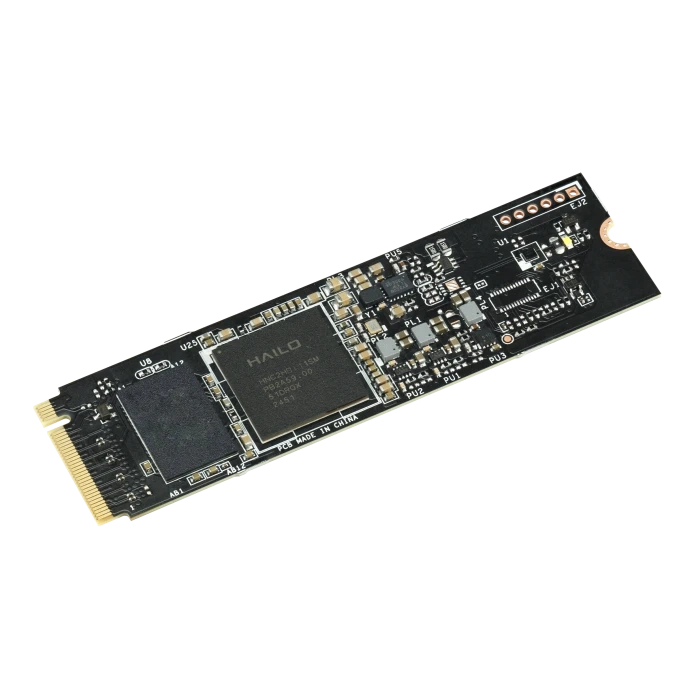
ASUS JAPAN began sales on October 16 of three models in its "ASUS UGen300" series of edge AI accelerators capable of processing generative AI locally, along with the entry-level "ASUS UGen200." The lineup features up to 40 TOPS of inference performance and can handle large language models (LLMs), vision language models (VLMs), and the "Whisper" speech recognition engine entirely without cloud dependency.
The announcement was made the previous day, October 15, with estimated street prices set at ¥29,980 to ¥49,980 (approximately $190 to $310) for the UGen300 series and ¥24,980 (approximately $160) for the UGen200, all tax-inclusive. Two form factors are available—USB-connected and M.2 slot—supporting a wide range of applications from add-on deployment to existing PCs to integration into industrial equipment.
At the core of the UGen300 series is the "Hailo-10H" AI processor developed by Israeli semiconductor company Hailo. It achieves up to 40 TOPS of inference performance in INT4 operations, and when paired with 8GB or 2GB of LPDDR4/4X memory, it enables local execution of generative AI workloads in addition to conventional vision AI processing such as object detection and image classification.
The product lineup consists of three models. The "S-UGEN300-8GLD4-TC," featuring USB 3.2 Gen 2 Type-C connectivity, adds AI inference capability to existing PCs and single-board computers simply by plugging it in. For M.2 2280 slots, the "UGEN300-8GLD4-M2" with 8GB of memory and the "UGEN300-2GLD4X-M2" with 2GB of memory are available, configured for integration into custom-built PCs and industrial computers.
The entry-level "UGen200-640KSR-M2" adopts the Hailo-8L chipset and delivers up to 13 TOPS of performance in INT8 operations. It is specialized for conventional AI processing such as object detection, image classification, and person tracking, targeting sites that don't require generative AI functionality but need low-power inference processing.
Power consumption is extremely low at 2.5W standard for the UGen300 series and 1.5W for the UGen200, making them suitable for fanless enclosures, battery-powered devices, and environments requiring 24/7 continuous operation. Supported operating systems include Windows, Linux, and Android, with support for both x86 and ARM architectures. More than 150 pre-trained models and sample code are provided for developers, shortening the path from proof-of-concept (PoC) to full-scale deployment.
The company positions this product family for smart cameras, industrial sensing, and development sites requiring AI inference in environments where data cannot be transmitted externally. By bypassing the cloud, users gain advantages including elimination of communication latency, assurance of data confidentiality, and reduced communication costs.
Meanwhile, on the generative AI voice front, OpenAI also announced the same day that it has updated the voice conversation feature of its conversational AI "ChatGPT." The new speech model "GPT-Live-1.1" has been applied, improving intonation and vocal expression across multiple languages including Korean. Two new voices were added for Korean users: the male voice "Hanul" and the female voice "Haessal."
ChatGPT's voice feature employs a full-duplex communication method that allows speaking and listening simultaneously. Users can interject additional questions even while ChatGPT is mid-response, and if speech is momentarily interrupted, ChatGPT waits without immediately cutting off the conversation. Filler expressions such as "checking" that were repeatedly used during information retrieval have also been replaced with more natural, context-appropriate phrasing.
This update is being rolled out sequentially to ChatGPT users worldwide, including South Korea, and is available to free-tier users as well. Users can start a voice conversation simply by selecting the voice icon in ChatGPT.
The moves by both companies illustrate contrasting approaches: "edge AI," which processes AI inference on-device without cloud dependency, versus "cloud AI," which enhances cloud-based voice interaction. ASUS's products are aimed at industrial applications and security-conscious environments where generative AI must be handled without sending data externally, while OpenAI's update targets improved natural voice conversation experiences for consumers.
As the application domains of generative AI continue to expand, the broadening of processing location options lowers adoption barriers for developers and enterprises. In particular, the ASUS UGen300 series' ability to run LLMs and VLMs locally at low power consumption serves as a key differentiator from existing edge AI products, with potential to capture demand in areas requiring real-time performance and data protection, such as smart cities, manufacturing quality inspection, and medical imaging diagnostic support.
The pricing structure is as follows:
| Product Name | Connection | AI Processor | Memory | Estimated Street Price (Tax-Inclusive) |
|---|---|---|---|---|
| S-UGEN300-8GLD4-TC | USB Type-C | Hailo-10H | 8GB | ¥49,800 (approx. $310) |
| UGEN300-8GLD4-M2 | M.2 2280 | Hailo-10H | 8GB | ¥45,980 (approx. $290) |
| UGEN300-2GLD4X-M2 | M.2 2280 | Hailo-10H | 2GB | ¥29,980 (approx. $190) |
| UGen200-640KSR-M2 | M.2 2280 | Hailo-8L | Not equipped | ¥24,980 (approx. $160) |
Note: Prices are estimated street prices announced by ASUS JAPAN.