
Why Robotics Still Hasn't Hit Its ChatGPT Moment
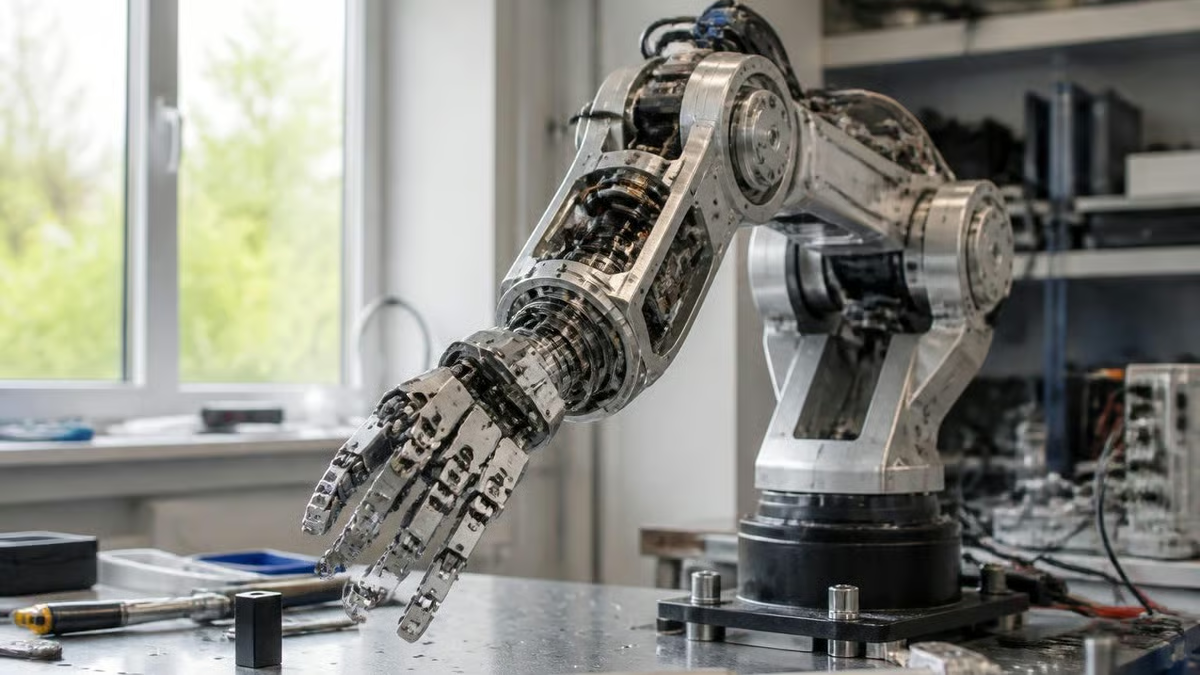
The robotics industry isn't anywhere near its breakthrough moment, despite the hype around AI-powered humanoids and foundation models. Amulya Vishwanath, who spent seven years leading product marketing for Nvidia's robotics platforms before jumping to venture capital, argues the sector is still in its "Lego era" - rebuilding basic building blocks like actuators, robotic hands, software, and safety standards from scratch. It's a sobering counterpoint to the growing chorus of investors and founders betting that a general foundation model will spark a ChatGPT-style revolution in robotics any day now.
Nvidia has become synonymous with the AI boom, powering everything from ChatGPT to autonomous vehicles with its GPU chips. But one of its former robotics insiders is pumping the brakes on expectations that robots will follow the same explosive trajectory as large language models.
Amulya Vishwanath, who led product marketing for Nvidia's robotics platforms for seven years before transitioning to venture capital, told TechCrunch that robotics is currently in its "Lego era." The industry is still assembling - or in many cases, completely rebuilding - the fundamental components needed for widespread deployment: better actuators, more dexterous robotic hands, robust software frameworks, and comprehensive safety standards.
It's a reality check for an industry that's seen massive funding rounds and sky-high valuations on the promise that robotics is just one foundation model away from a ChatGPT moment. Companies like Figure AI, 1X, and Tesla have raised hundreds of millions betting on AI-powered humanoids. But Vishwanath's perspective suggests the hardware gap remains stubbornly wide, even as software capabilities race ahead.
Advertisement
The disconnect matters because it shapes investment timelines and deployment expectations. While OpenAI went from zero to mainstream adoption in months with ChatGPT, robotics companies face years of hardware iteration, manufacturing scale-up, and real-world testing. Nvidia's recent push into robotics simulation and AI agents shows the company understands this gap - you can't skip the physics.
Vishwanath's seven-year tenure at Nvidia gave her a front-row seat to the company's robotics evolution. She watched as Nvidia invested heavily in AI safety infrastructure and poured resources into simulation platforms. The company's Omniverse platform has become a critical tool for training robots in virtual environments before they touch the real world, but even that sophisticated software can't solve for inadequate hardware.
The "Lego era" analogy is particularly apt. Just as Lego bricks need to fit together precisely to build complex structures, robotics requires standardized, reliable components that can be combined in predictable ways. Right now, the industry lacks that standardization. Different companies use different actuators, different control systems, different safety protocols. There's no equivalent to the Transformer architecture that unified AI development.
Advertisement
This fragmentation shows up in venture capital patterns too. While AI software startups can reach unicorn status on relatively modest capital, robotics companies burn through hundreds of millions just to get to market. The hardware iteration cycles are longer, the supply chains more complex, the regulatory hurdles higher. Nvidia's own $1 billion commitment to super intelligence research includes quantum computing and energy security alongside AI - recognition that breakthrough technologies need more than software.
Vishwanath's move from Nvidia to venture capital positions her to fund the next generation of robotics infrastructure. But her "Lego era" framing suggests she's looking for companies building those fundamental blocks, not just slapping foundation models onto existing hardware and calling it revolutionary.
The tension between software progress and hardware reality is playing out across the industry. Jensen Huang's recent calls for AI safety collaboration with China acknowledge that robotics deployment will be a global challenge requiring coordinated standards. And Nvidia's new cuPotential library for AI-powered chip design shows the company is still investing in the tools needed to build better robotics components.
Advertisement
The counterargument is that foundation models will accelerate hardware development by enabling better simulation, faster design iteration, and more adaptive control systems. Maybe the Lego era will be shorter than previous hardware cycles. But Vishwanath's insider perspective suggests investors should temper their timelines and fund accordingly.
For founders, the message is clear: building a robotics company in 2026 means solving hard engineering problems that can't be wished away with better AI models. The companies that win will be the ones that crack actuator efficiency, power density, and manufacturing cost - not just prompt engineering.
Vishwanath's "Lego era" framework offers a more grounded view of robotics progress than the ChatGPT-moment hype suggests. While foundation models will certainly accelerate development, the industry still needs years of hardware innovation, standardization, and real-world testing before robots become as ubiquitous as AI chatbots. For investors and founders alike, that means longer timelines, bigger capital requirements, and a focus on fundamental engineering rather than software shortcuts. The robotics revolution is coming, but it's building itself one Lego brick at a time.