
Testing Genspark AI Workspace 6.0: Is the automated office model really effective?
A detailed review of Genspark AI Workspace 6.0 across 18 tasks: Impressive multitasking automation but requires users to tightly control credit and data costs.
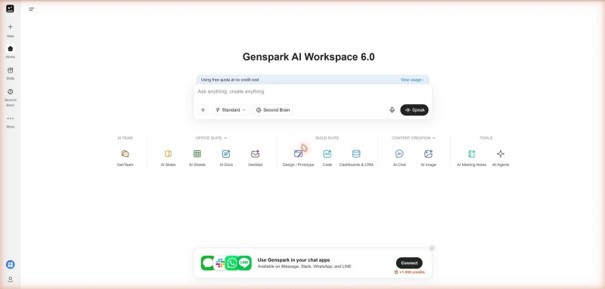
Genspark AI Workspace 6.0 represents a significant technological shift in artificial intelligence (AI): moving from a purely question-and-answer model to a comprehensive workflow automation system. Instead of switching between separate software programs to create slides, write reports, or process spreadsheets, users can now manage the entire office through a single control interface.
Operational architecture: The coordination between Super Agents, Defectors, and Skill Pools.
The core of Genspark's technology lies in its Super Agent, which acts as the overall coordinator. Upon receiving commands from a single input field, the system breaks down the objective, creates a route, and coordinates the task across a network of 28 specialized AI agents. These agents are divided into three main capability groups: the office group (processing documents, spreadsheets, slides), the construction group (design, coding, creating dashboards), and the content creation group (creating images, videos , audio, and podcasts).
In addition to specialized agents, the integrated Skill repository helps package standardized workflows. Each Skill includes a sequence of processing steps, presentation standards, and output formats. As of October 2026, the community Skill repository recorded 222 entries, with Anthropic contributing 67 Skills, Genspark 51, and OpenAI providing 8 Skills, with the remainder developed independently by the community. Users can save a refined workflow as a new Skill in approximately 90 seconds.

To maintain contextual continuity, Genspark implements a Second Brain feature and a 50GB storage Hub. This structure allows AI models to continuously retrieve personal data, project rules, and reference documents from the work history without requiring users to re-enter background information.
Real-world performance and resource consumption data across 18 tasks.
Through real-world testing with the Genspark Plus package (priced at $24.99/month with a limit of 10,000 credits), the total consumption for 18 features reached approximately 1,804 credits. The data shows a significant disparity in resource allocation between purely office tasks and complex multimedia tasks.
| Task group | Features | Output | Recycle consumption |
|---|---|---|---|
| Planning, automation | Super Agent + Skill | Schedule posts for one month, create 3 Excel spreadsheets, and write 17 articles. | 0 credit |
| Dashboards & CRM | Convert Excel data | Create a management application with 4 metrics and 3 charts. | 0 credit (automatic processing of 4–7 credits/time) |
| Content creation | AI Slides | Create an 8-slide channel intro (13 minutes). | 0 credit |
| Content creation | AI Image, moodboard | Create a color palette with 6 shades, maintaining consistency in the character's face. | 0 credit |
| Audio & Multimedia | AI Music | Produce a 90-second soundtrack. | 44 credit |
| Audio & Multimedia | AI Audio | Create a 5-second greeting and an 8-second sound effect. | 23 credits |
| Audio & Multimedia | AI Video | Create a 5-second video clip. | 693 credits |
| Audio & Multimedia | AI Pods | Export a 5-minute and 46-second podcast with two voices. | 816 credit |
| Research & Comparison | Deep Research | Comprehensive report in 8 parts (25 minutes) | 0 credit |
| Research & Comparison | Fact Check | Verify the information in 5 statements. | 0 credit |
| Translation & Chat | Translation, AI Chat | The Mixture-of-Agents model selects the optimal translation. | 15 credits per transaction |
| Document management | Second Brain, Hub | Automatically extract user profiles in 3 minutes. | 0 credit |
| Office & Minutes | Meeting | Meeting minutes in 4 parts from a 9-minute audio recording. | 0 credit (ask for 33 more credits) |
| Video processing | Clip Genius | Automatically cut a long video into two short clips. | 0 credit (download video with 24 credit) |
The system's strength lies in its ability to handle massive spreadsheet tasks. Tests showed that processing a data file containing 1,140 articles into a six-page spreadsheet with 1,222 formulas was accurate, and the system was able to automatically detect and correct calculation errors. However, media tasks such as 5-second videos consumed 693 credits, significantly higher than the initial estimate of 420 credits.
Technical risks and control challenges
Despite its superior performance, Genspark's automated assistant model still exhibits some noteworthy technical limitations. Firstly, there's a language discrepancy issue where some Skills or profile aggregation tasks return results in English or Chinese, even though the initial command requested Vietnamese.
Secondly, there's the issue of accuracy in data verification. While FactCheck tools can detect errors in service pricing based on timeframes, they can still make inaccurate, absolute negative judgments (such as claiming a website has no articles when it actually has dozens). Therefore, absolute negative statements still require direct human verification.
Finally, there are issues of security and hidden costs. During setup processes, the system may default to enabling external email sharing features or activating high-frequency automated schedules, leading to silent credit deductions even when the user is not browsing. Overall, Genspark demonstrates the immense potential of the AI office model, but controlling data output and managing operating costs remains a responsibility that cannot be entirely delegated to machines.