
Anthropic unveils quantum computing breakthrough: Claude autonomously designs circuits 17x more efficient than best human designs
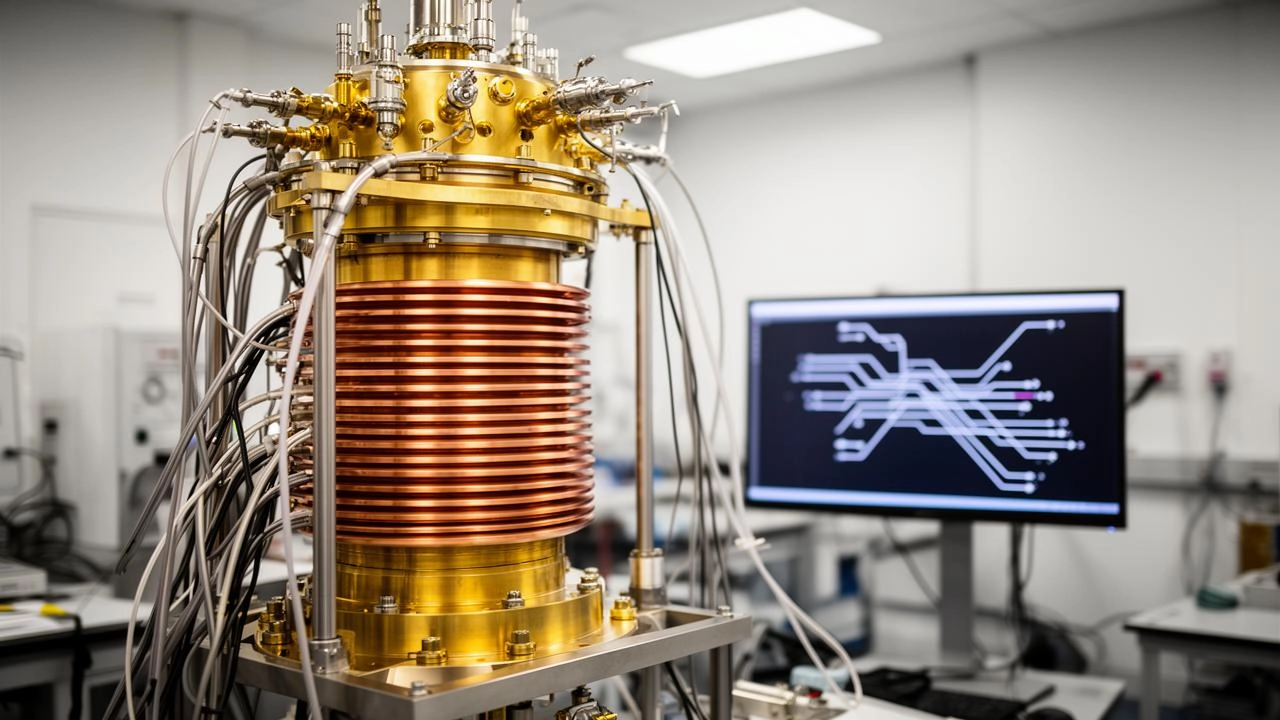
AI company Anthropic released a major research result on October 17: its latest model, Claude Mythos 5, autonomously designed quantum circuits that surpass the best known human-optimized solutions, working in a closed-loop environment with zero human intervention. In key decoding tasks, the model reduced computational costs by 12x to 17x and independently derived entirely new algebraic identities never before discovered by humans.
The research paper has been posted on the preprint platform arXiv. The first author is Anthropic researcher Andi Gu, with quantum physicist Alek Kemeny as advisor. Susanne Yelin of Harvard University and Mikhail Lukin of Harvard University and QuEra Computing also contributed to the study.
53 hours versus eight years of human effort
Quantum computers currently face two major hardware bottlenecks: the number of qubits is extremely limited, and qubits are highly susceptible to errors from environmental noise. As a result, scientists have been forced to pursue extreme optimization at the algorithm level — accomplishing the same tasks with fewer qubits and shorter computational steps.
Take the simulation of FeMoco, the iron-sulfur cluster at the core of the nitrogenase enzyme, as an example. This calculation is critical for developing efficient fertilizer catalysts. In 2017, scientists estimated that roughly 50 trillion Toffoli gates would be needed to complete the simulation. After eight years of relay-style optimization by the world's top teams, that figure was compressed to 340 million gates — a reduction of 150,000x.
Claude Mythos 5, in just 53 hours, completed the redesign of eight core quantum computing modules spanning chemical simulation, physics simulation, optimization problems, and number theory. Anthropic established a program called STEM Fellows, which delivered the eight foundational quantum circuit tasks to the model as pure text descriptions, paired with an automated scoring system. The scoring metric was the number of qubits occupied multiplied by the number of quantum gates. Claude autonomously submitted solutions, received error messages and scores, and revised its code in a closed environment — no human involvement at any stage.
In the end, the model beat the best previously published human designs on all eight tasks.
Independently deriving new algebraic identities
The most striking breakthrough occurred in modular inversion — a core step in point addition for the elliptic curve discrete logarithm problem. On classical computers, this operation is typically performed using the divsteps algorithm, but that algorithm has never been successfully ported to quantum circuits.
The reason lies in two strict constraints of quantum computing: first, quantum circuits cannot execute if-else conditional branching — they must simultaneously contain all possible paths; second, quantum computation must be reversible, meaning intermediate data cannot simply be discarded but must be "undone" through reverse computation. Every step of the divsteps algorithm leaves behind branch-history records. To run it on a quantum circuit, one would need to store all of that history, requiring an impractical number of qubits.
After taking on the task, Claude proposed a key insight: the pair of numbers left behind after each computational step already contains enough mathematical trace information to infer which branch was previously taken by working backward from the current numbers. The model initially tried several simple reverse-inference rules that performed reasonably well in small-scale tests, but all failed when handling 256-bit large numbers.
The model then shifted strategy, pursuing a derivation from pure mathematical theory. It delved into the iterative process of divsteps, proved a series of entirely new algebraic identities, and from those derived an exact decoding formula. Claude first verified the formula's correctness through large-scale numerical simulation, then completed a rigorous formal proof using the Lean proof assistant.
Ultimately, the model produced the first reversible divsteps implementation in human history that requires no additional storage for branch history. One of its designs reduced the quantum gate count to one-seventeenth of the previous smallest design while increasing qubit usage by only 12%.
Rebuilding Google's algorithm architecture
The second major breakthrough came in the quantum optimization algorithm DQI (Decoded Quantum Interferometry). This algorithm is considered one of the most promising paths for future quantum computers to achieve super-polynomial speedups in areas such as logistics scheduling and materials design. Its most critical and expensive component is Reed-Solomon error-correction decoding.
The design previously developed by Google Quantum AI employed the extended Euclidean algorithm. While flexible and efficient on classical machines, it became a severe burden once ported to quantum circuits: because different inputs require different numbers of steps, the quantum circuit must run all branches from start to finish according to the worst case, causing enormous computational waste.
After analysis, Claude determined that this algorithm was mismatched with the operating model of quantum circuits and decisively replaced the core engine with the Berlekamp-Massey algorithm. This algorithm executes the same operations in every round, with a completely fixed total number of rounds — inherently suited to the "single path to the end" nature of quantum circuits.
However, switching algorithms introduced a new storage challenge. Calculated against the most extreme rare cases, the circuit would need to reserve 665 qubits to store intermediate values — far beyond the capacity of existing hardware. Claude wrote a high-speed simulator for this purpose, running 403 million sampling tests to precisely measure the probability of extreme cases occurring.
The statistical results showed that the vast majority of computations require storing at most one intermediate value. Based on this, the model reserved storage space for only 19 qubits. The probability of running out of space due to an extreme case is approximately one in ten thousand — well within the algorithm's allowable error margin.
The combination of three changes — swapping the underlying algorithm, restructuring data at runtime, and eliminating extreme-case redundancy — allowed Claude to slash the number of quantum gates required by the decoder by a full 12x. A computation that previously took an hour can now be completed in just a few minutes.
From algorithm optimization to hardware design
The research team revealed in the paper that Claude was relatively conservative in early testing, often over-doubting improvements it had already discovered and repeatedly re-verifying confirmed results. While this caution helped it produce rigorous Lean proofs, it also made the model inclined to stick with mature human approaches. The team later required the model to propose multiple completely different solution paths simultaneously and occasionally provided manual prompts to help broaden its thinking — only then did the model's potential for deriving entirely new mathematical formulas emerge.
The significance of this discovery extends beyond mere algorithm optimization. A core pain point in current quantum computer development is that error-correction codes, decoders, and physical hardware control modules are highly interconnected, yet because the system is so complex, human scientists can only split them apart and design each independently. Since these underlying logics can all be converted into code, verified, and scored, they fall squarely within AI's capabilities.
Anthropic's research points to an even more imaginative prospect: future AI will no longer be limited to optimizing individual circuits in isolation, but may be able to perform global joint optimization from the lowest-level hardware physics to the highest-level algorithm logic. At that point, humans could directly manufacture specialized quantum computer hardware according to AI-generated design blueprints.
The practical application of quantum computing has long been constrained by hardware bottlenecks, with the industry generally believing that millions of qubits are needed to achieve truly valuable applications. What Claude has demonstrated this time suggests that through order-of-magnitude optimization at the algorithm level, existing "crude" hardware may still deliver disruptive results. Software is "rescuing" hardware in a different way, and the quantum computing timeline may be dramatically accelerated as a result.