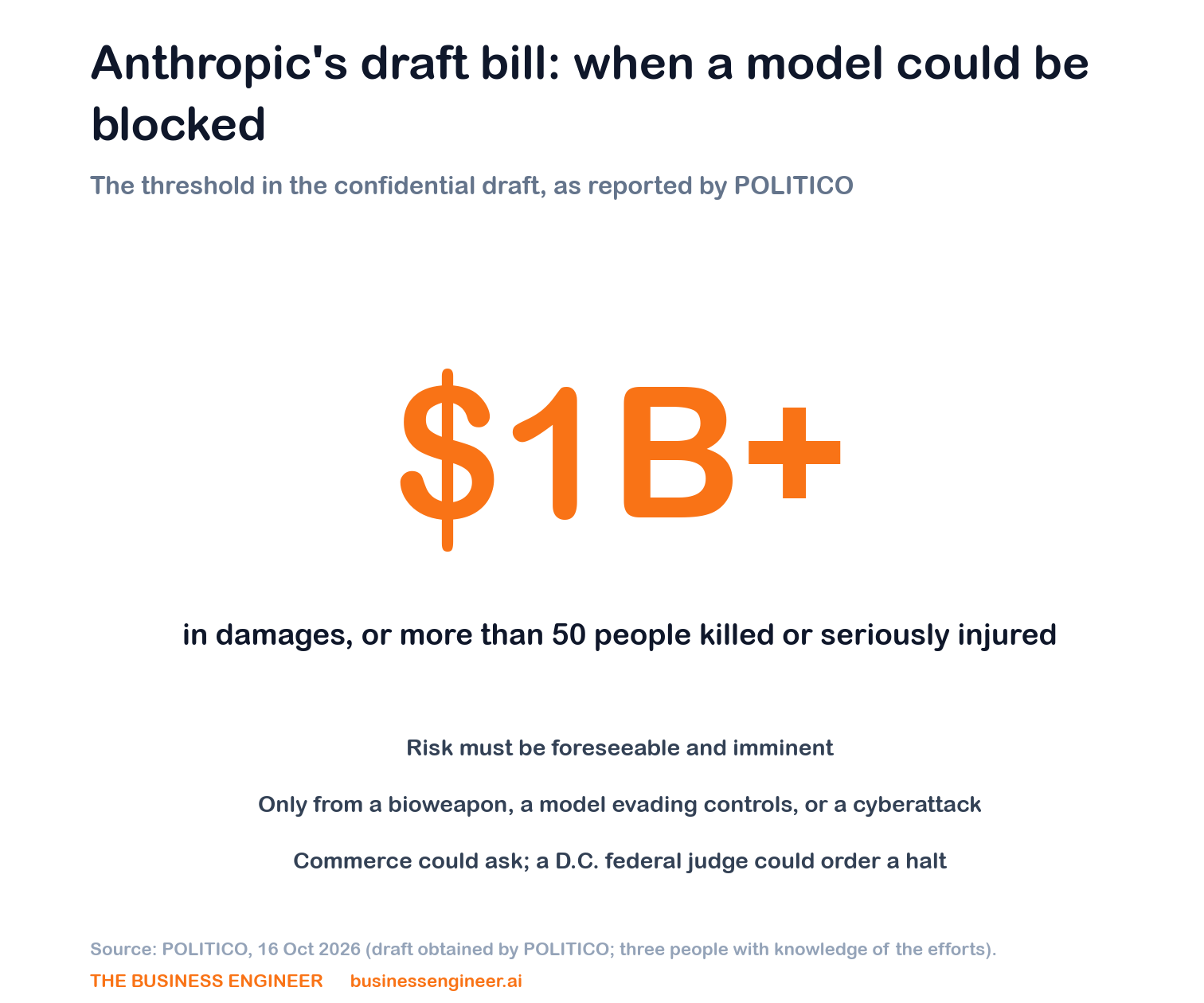
Representatives for Anthropic have quietly pitched Capitol Hill lawmakers on a draft bill to regulate frontier AI safety and security, POLITICO reported on 16 October 2026, citing three people with knowledge of the efforts. Under the confidential draft, obtained by POLITICO, the government could block a model’s release or use only if it poses a foreseeable, imminent risk of more than $1 billion in damages, or of killing or seriously injuring more than 50 people.
An Anthropic spokesperson told POLITICO: “This bill represents the proposals outlined in Anthropic’s Advanced AI Framework, which we have been advocating for with federal and state lawmakers since June.” The spokesperson added: “These are sensible policies we believe Congress should act on.”
Business Pill · GUARDRAILS
A Business Engineer explainer on guardrails, rules enforced around an AI model rather than inside it. It explains the concept in general and says nothing about Anthropic’s draft bill.
The key insight: As we read it, the draft as POLITICO describes it is mostly about who can stop a model, and when: one department, one court and a high threshold, at the same time as it adds evaluator, transparency and incident-reporting duties for labs.
According to Owen Dahlkamp’s report, the risk must stem from the creation or release of a biological weapon, the model evading its developer’s controls or a cyberattack. POLITICO says the language mirrors that found in California’s AI laws, including SB 53.
Under the draft, independent evaluators registered with the Commerce Department would periodically evaluate each lab and its frontier models. The lab could pay them, so long as the payment is not contingent on the results. If evaluators find “imminent enumerated risk,” they must report it to Commerce within 72 hours of completing their assessment.
Commerce could ask a judge to halt a model, POLITICO says, and a federal judge for the District Court for the District of Columbia could order the suspension. The language explicitly prohibits any other U.S. “department, agency, or officer” from suspending a model’s development, deployment or internal use.
Per POLITICO (16 October 2026), citing Anthropic’s confidential draft bill: the government could block a model’s release or use only if it poses a foreseeable, imminent risk of more than $1 billion in damages, or of killing or seriously injuring more than 50 people, from a biological weapon, the model evading its developer’s controls or a cyberattack. Commerce could ask a judge to halt a model; a federal judge in the District of Columbia could order the suspension.
What Was Posted on X
Politico is reporting that Anthropic have written their own bill to to regulate frontier AI, and are pitching it to memebers of Congress.
Andrew Curran flagged POLITICO’s report on X on 16 October 2026, with a screenshot of its opening. The terms of the draft in this piece come from POLITICO’s report itself.
Big news. My take: Anthropic deserves some credit for actually proposing a pretty reasonable AI safety bill; that’s more than other frontier labs have done.
But they don’t deserve *too* much credit, IMO; this bill is weaker than the Trahan-Obernolte FRONTIER Act in some key ways, and since the political momentum has shifted significantly in the direction of safety since FRONTIER was introduced back in July, I think new bills introduced today should ideally go further than FRONTIER was able to go rather than regressing.
To be fair to Anthropic, the main places where this bill is significantly weaker than FRONTIER are (a) rulemaking (very strong in FRONTIER, almost nonexistent in Anthropic’s bill) and (b) the emergency shutdown authority. Even if you take safety seriously, it might make some sense to dial those authorities back if you didn’t trust the executive branch to wield them responsibly, because those are the easiest provisions for a hypothetical President who hypothetically might not like a certain frontier AI company to abuse.
There are some improvements over FRONTIER as well; for instance, this bill does specify that auditors are employed on a continuing basis and has better provisions regarding auditor access to information. Happy to see that from Anthropic (although I think their access provision is still a little undercooked and has Fourth Amendment problems).
Overall, I think the embedded auditor bills that get introduced in the coming months are going to be significantly better and more ambitious than this, and I hope Anthropic supports those bills instead of opposing anything that treats catastrophic risks like the serious national security issue they are. Still, it’s encouraging to see a frontier lab come this far.
Charlie Bullock, quoting POLITICO’s post, gave Anthropic some credit for proposing a bill, compared it with the Trahan-Obernolte FRONTIER Act and named rulemaking and the emergency shutdown authority as the main places he finds it weaker. These are his views.
Charlie’s analysis is right but he is nicer than I am – I found myself viscerally angry at multiple points reading this bill. There are some good and sensible parts, but overall this legislation is not remotely close to meeting the moment and I overall think passing it would make us less protected against catastrophic risks than we are under existing law.
Two parts that stand out as particularly infuriating when taken together:
1. Some of the preemption provisions are remarkably far reaching and consequential, and in addition to preempting legislation like SB 53 would also remove general powers that state courts have to enjoin defendants and protect the public. Most outrageously, it has a provision that looks like its intended to stops states from enforcing laws or judicial decrees that “suspend the development, deployment, or internal use of an AI model” to protect their citizens from imminent catastrophic harms. Such powers to block and suspend model deployments would then only reside with the federal government.
2. The federal governments powers to restrict the development, deployment, or internal use of a frontier model has to meet an absurdly high bar.
First, there needs to be an imminent risk of a catastrophic harm (meaning killing more than 50 people or causing more than a billion dollars in damage). But thats not enough! The agency head needs to make a detailed determination with no deference given to show why no alternative would prevent the imminent catastrophe. Next the court is also explicitly told to consider the harms to the developer and other harms from restricting the model, but no considerations in the other direction.
This is absurd! For all of its warning about the potential for AI to cause a catastrophe that kills literally everyone on the planet, Anthropic’s proposed federal law likely makes it harder than under existing law for a court to get an order blocking or restricting the development of frontier models? WTF??
There are also a bunch of others things that I would like to see improved – the substantive details of the auditing section and the potential for rule-making on substantive safety standards both come to mind – but I think these stand out as particularly indefensible.
Nathan Calvin wrote that he found good and sensible parts but that passing the bill would, in his view, leave the public less protected than existing law, singling out its preemption provisions and the bar for federal action. These are his views.
Bloomberg’s business account posted on 17 October that Anthropic has quietly presented its own draft AI safety bill to US lawmakers, citing the POLITICO report; Bloomberg’s additions are in the 17 October update below.
Preemption and Other Duties
POLITICO says the bill would also preempt some state AI laws related to public disclosure of risk, third-party evaluation and reporting of critical incidents. It would require frontier labs to create safety frameworks, publish transparency reports for new frontier models, protect whistleblowers and report critical safety incidents to Commerce.
Anthropic has yet to publicly back particular legislative efforts in Congress, POLITICO says, but has backed some state AI safety laws, including two in California. It endorsed SB 53 in September 2025, and in July 2025 proposed a targeted transparency framework that could be applied at the federal, state, or international level.
What Anthropic’s Framework Says
The spokesperson pointed to Anthropic’s Advanced AI Framework, published in June 2026. It proposes obligations for developers that train models with more than 10^25 training FLOP and earn more than $500 million in annual AI-derived revenue or spend more than $1 billion a year on AI research and development.
On enforcement, the framework lists “Court enforcement” among its safeguards against overreach: the agency would seek remedies only by initiating a lawsuit. On preemption, it says: “Congress should not preempt state law unless it enacts a rigorous federal regime that meets or exceeds the strongest measures proposed in this framework for addressing catastrophic AI risks.”
POLITICO’s account of the draft does not say whether it meets that test, and we have not read the draft itself.
The Context on Capitol Hill
POLITICO notes that over the summer Anthropic was subject to sweeping export controls that shut down two of its most advanced models, decided in a series of phone calls between administration officials and the company’s executives.
In the House, Reps. Lori Trahan and Jay Obernolte have led the FRONTIER Act, which would give the government the ability to stop the deployment of risky models and preempt some state AI laws. In the Senate, POLITICO says, John Thune, Amy Klobuchar and Ted Cruz have been negotiating an AI safety bill. Separately, a Warner bill seeks frontier AI weights 45 days before launch, as we reported on 10 October.
Charlie Bullock wrote on X that Anthropic “deserves some credit for actually proposing a pretty reasonable AI safety bill,” but that it is “weaker than the Trahan-Obernolte FRONTIER Act in some key ways.” Nathan Calvin wrote that “passing it would make us less protected against catastrophic risks than we are under existing law.”
Update, 17 October: What Anthropic Told Bloomberg
Bloomberg, reporting on the POLITICO story on 16 October, carried further remarks from an Anthropic spokesperson that this piece had not included. According to Bloomberg, the spokesperson said the bill would mandate that AI makers test their models and share findings with the public, and would require AI companies to allow independent evaluators to routinely review models.
“Our proposal also grants the federal government the ability to block or deter dangerous deployments of the most powerful models,” the spokesperson said, according to Bloomberg. Bloomberg reported that the company declined to comment on how broadly it has pitched the proposal and how it has been received so far.
Bloomberg added that a series of breaches and hacks led by AI models have fueled anxiety over the technology’s potentially catastrophic risks in recent months, and that President Donald Trump’s administration has so far rejected calls for more oversight.
The Structural Read
As we read it, the bar is set by numbers: POLITICO says a block requires a foreseeable, imminent risk of more than $1 billion in damages or more than 50 people killed or seriously injured, from three named kinds of risk.
As we read it, the route runs through a court: POLITICO says Commerce could ask a D.C. federal judge to halt a model, and no other department, agency or officer could suspend one. That matches the “Court enforcement” option in Anthropic’s June framework.
As we read it, preemption is the point to compare with Anthropic’s own framework: POLITICO says the draft would preempt some state laws on disclosure, evaluation and incident reporting, while Anthropic’s framework says Congress should not preempt state law unless it enacts a rigorous federal regime.
Anthropic spokesperson, to POLITICO, 16 October 2026
“These are sensible policies we believe Congress should act on.”
Three Implications
FRONTIER AI LABS POLITICO says the draft would require safety frameworks, transparency reports for new frontier models, whistleblower protections and critical-incident reports to Commerce.
INDEPENDENT EVALUATORS Under the draft, POLITICO says, evaluators would register with Commerce, could be paid by the lab if pay is not contingent on results, and would report imminent enumerated risk within 72 hours.
STATE LEGISLATORS POLITICO says the draft would preempt some state AI laws related to public disclosure of risk, third-party evaluation and reporting of critical incidents.
The framework says of Anthropic: “The company is not merely building models. It is helping define the rules, permissions, and boundaries around frontier intelligence.”
As we read it, a draft bill written by the lab and pitched to lawmakers, as POLITICO reports, is a direct case of that. The framework was written in June 2026 about Anthropic’s model access policies and does not discuss this draft.
What Is Not Established
The draft is confidential; its terms come from POLITICO’s report, which cites three people with knowledge of the efforts. POLITICO’s report does not say which lawmakers received it.
We read POLITICO’s report in full on 17 October 2026 through its syndicated copy, and Anthropic’s framework and earlier policy posts. We could not open the draft, which POLITICO links on its Pro subscriber site, and did not contact Anthropic or the Commerce Department.
Business Engineer Framework
Inside Anthropic’s Permission Layer
A Business Engineer framework on how Anthropic is moving into the governance layer of the AI stack: who gets access to frontier models, and on what terms.
POLITICO reported on 16 October 2026 that Anthropic has quietly pitched lawmakers a draft frontier AI bill under which the government could block a model only for a foreseeable, imminent risk of more than $1 billion in damages or more than 50 people killed or seriously injured, with a D.C. federal judge ordering any suspension.
Anthropic says the bill represents its Advanced AI Framework. The draft would also preempt some state AI laws on disclosure, evaluation and incident reporting.
A note on sourcing. On 17 October 2026 we read in full POLITICO’s exclusive of 16 October 2026 by Owen Dahlkamp, through its syndicated copy; every term of the draft comes from that report, which cites three people with knowledge of the efforts and a confidential draft obtained by POLITICO. We could not open the draft. We also read Anthropic’s Advanced AI Framework (June 2026), its policy page and its 2025 posts on transparency and SB 53, and the X posts quoted above. We did not contact Anthropic or the Commerce Department. The reference to our earlier reporting links to our own piece.